
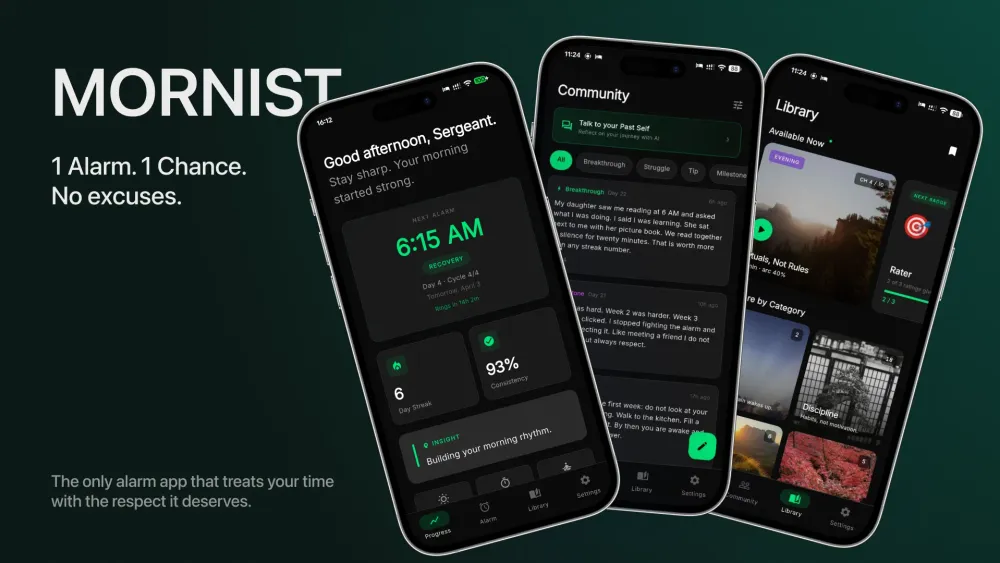
AIdeas Finalist: Mornist
Six months ago I could not wake before 9 AM. Today I wake at 5:40 without an alarm. Not because I found a louder ringtone, but because I stopped treating waking up as a sound problem and started treating it as a training problem. Mornist is the AI coach that does that training: 2-1-1 periodization, Bedrock speeches, designed to make itself obsolete. 22 beta users, 29 tracked days, 69% on-time.

App Category: Daily Life Enhancement
My Vision
Mornist is an AI-powered behavioral coach disguised as an alarm clock. It trains willpower to wake up early using a protocol borrowed from athletic periodization. Not by forcing you awake, but by systematically building your capacity to get up on your own.
The core mechanism is the 2-1-1 Protocol: two days of pushing your wake time earlier, one day of consolidation, one day of recovery. The same stress-adaptation-recovery cycle that elite coaches use to build physical endurance, applied to the neuroscience of waking. The user never sets their own alarm. The AI calculates it. Remove the negotiation, and the gap between intention and action closes.
What makes this more than an alarm is identity. During onboarding, you choose a title: Sergeant, Doctor, Captain, Scholar. Every morning, Bedrock generates a speech addressed to that identity, referencing what you said you would do the night before. Amazon Polly speaks it aloud. Hearing "Good morning, Doctor. You said you would finish the chapter. The books are waiting." in a warm human voice is fundamentally different from reading a notification. It is the difference between an instruction and a relationship.
The goal is to make Mornist obsolete. After sustained mastery, the alarm goes silent. If you wake on your own within your window, the app celebrates. Eventually, you graduate. An alarm app you depend on forever has not solved anything. One that teaches you to wake without it has changed your life.
Why This Matters
Insufficient sleep costs the US economy up to $411 billion and 1.2 million working days every year, projected to reach $456 billion by 2030 ( RAND Corporation ). Across five OECD countries, the total exceeds $680 billion annually. In 2023, The Lancet Public Health called for sleep to be treated as a global public health priority alongside diet and exercise ( The Lancet, 2023 ). This is not a lifestyle trend. It is a public health crisis with measurable economic damage at national scale.
Waking up early is a keystone habit, a single behavioral change that cascades into dozens of others. Research by Charles Duhigg, BJ Fogg, and others shows that people who establish a consistent early wake routine spontaneously start exercising, eating better, reading more, and keeping promises to themselves. They are more patient with their families, more focused at work, less reactive on their phones.
This is not a productivity tool. It is a behavioral intervention at the one decision point that shapes every other decision in the day. The social impact is not in the app. It is in the person who uses it. A parent who wakes calmly before their children. A student who has two quiet hours before class. A shift worker who reclaims their morning instead of losing it to inertia.
Mornist addresses this at scale because the coaching is AI-generated and personalized. There is no human coach to hire, no program to attend. A factory worker in rural Georgia and a medical student in Berlin receive the same quality of behavioral coaching, adapted to their individual rhythm, their identity, their evening intention. That is democratized behavioral change. Social impact through individual transformation.
How I Built This
Architecture
The system follows the user's natural evening-to-morning cycle:
Evening (9 PM): User sets an intention ("Why are you waking up tomorrow?"). Amazon Bedrock generates a personalized speech. Amazon Polly converts it to audio. Both are stitched into a single alarm file (ring + speech + ring) and cached on the device. Zero network calls at alarm time.
Night (automated): AWS Lambda runs the neuro-periodization algorithm via Amazon EventBridge. It evaluates the user's cycle day, success rate, and behavioral mode, calculates tomorrow's exact alarm time, and stores it in Amazon RDS (PostgreSQL).
Morning (calculated time): The alarm rings with the pre-cached stitched audio. No snooze button. The user taps "I'M AWAKE" and gets a 15-minute content window with their personalized speech, playable via audio, with a countdown timer. Miss the window? Gone forever. Scarcity makes the content feel earned, not disposable.
Technical Stack
Component | Technology | Why |
|---|---|---|
Mobile | Flutter (iOS 26+ / Android) | Single codebase, native alarm integration via AlarmKit (iOS) and AlarmManager (Android) |
Backend | FastAPI (Python) + PostgreSQL | Async API with SQLAlchemy, handles behavioral algorithm + content generation |
AI Content | Amazon Bedrock (Claude 3.5 Haiku) | Morning speeches, Past Self chat, evening briefs, content moderation |
Voice | Amazon Polly (Neural) | Identity-addressed spoken greetings. The most impactful moment in the product |
Compute | AWS Lambda + EventBridge | Nightly per-user alarm calculation + stitched audio generation |
Database | Amazon RDS | User state, algorithm phases, daily logs, badge progress, community stories |
What Makes Mornist Different
I studied every major alarm app: Alarmy, Sleep Cycle, Gentle Wakeup, Rise. Every single one treats waking up as a sound problem or a puzzle problem. Alarmy makes you scan a barcode. Sleep Cycle optimizes your sleep cycle timing. Gentle Wakeup uses light simulation.
None of them treat waking up as a willpower training problem. None use periodization. None generate personalized AI speeches addressed to your chosen identity. None have a Past Self chat. None build a community around shared morning struggle. And critically, none are designed to make themselves obsolete.
The differentiation is not a feature comparison. It is a philosophical difference in what the product believes about the user. Existing apps assume you need to be forced awake. Mornist believes you are capable and need to be trained, the way an athlete is trained. With stress, recovery, and progressive adaptation.
Key Features Built Since Round One
Badge-Based Progression: 9 earnable badges (First Light, Week Warrior, Month Milestone, etc.) that unlock features: Past Self chat, community access, stoic morning articles, sleep insights. Features gate on behavior, not time. You earn access through consistency.
Past Self Chat (Bedrock): A conversational AI that role-plays as the Day-1 version of you. It knows your streak, your misses, your chapters read. It speaks as someone who had only hope and zero proof, looking at who you have become. Not a coach. Not an advisor. You, talking to the version of yourself who made the first decision.
Community Stories (with AI moderation): Users share anonymous morning reflections: breakthroughs, struggles, tips, milestones. Every post is screened by Bedrock before publishing. A trending algorithm ranks stories by recent-like momentum, not all-time popularity, rewarding current engagement.
Stoic Morning Track: 8 articles connecting Stoic philosophy to the experience of waking up early. Marcus Aurelius arguing with himself about getting out of bed. Seneca on time. Epictetus on the dichotomy of control. Gated behind the Week Warrior badge (7 consecutive days).
Morning Routine Builder: Users define their post-alarm routine (stretch, meditate, journal, cold shower). After alarm dismiss, personalized notifications fire at cumulative time intervals for each step. Stored on the backend. Survives reinstalls.
Business Model
Mornist uses a freemium model. The core alarm + 2-1-1 protocol is free forever. Premium unlocks AI-generated speeches (Bedrock), Past Self chat, community stories, advanced analytics, and custom alarm sounds. AWS costs per user are low. Bedrock Haiku + Polly per day runs approximately $0.003/user/day, making a $4.99/month subscription profitable at even small scale.
Demo
The app is live:
- App Store (iOS): https://apps.apple.com/us/app/mornist/id6761543094
- Website: https://mornist.app
- Android: closed testing, public release coming soon
- Backend deployed on EC2 with full AWS integration
What I Learned
Real Users, Real Data
After round one, the most important thing I did was ship. Mornist is live on the App Store with real users and real behavioral data.
Platform Statistics:
- 22 registered users across the beta period
- 19 users with active alarm history
- 34 published articles across 5 categories
- 18 community stories with 131 total likes
- 9 earnable badges driving feature progression
My Personal Usage (29 days tracked, March 19 – April 17):
- 20 successful on-time wake-ups out of 29 days (69% success rate)
- 9 missed days, logged honestly, zero shame
- 6 badges earned: First Light, Cycle One, Early Bird, Week Warrior, Reader, Voice
- 55 AI-generated morning speeches via Bedrock
- 55 Polly text-to-speech conversions
- 52 stitched alarm audio files (ring + speech + ring)
- 227 dashboard views, 50 content engagements, 8 Past Self conversations
- Wake time moved from 7:30 AM to 6:15 AM
Firebase Analytics:


App Store Reviews:

The data tells the real story: the behavioral pipeline works. Users fire alarms, dismiss them, engage with content, earn badges, read chapters, post community stories, and talk to their past self. Every step is tracked, every interaction is measurable.
Development Insights
Spec-driven development with Kiro was essential. The neuro-periodization algorithm has dozens of edge cases (20-day miss streaks, perfect months, mode transitions). Defining every state transition as a specification before coding saved weeks of confusion.
Prompt engineering is the hardest part of AI integration. I spent more time on the Past Self prompt than any other feature. The difference between "I understand your struggle" (chatbot) and "I can't believe you actually made it to day 30. When I set that first alarm, I wasn't sure I'd survive day 2." (past self) is the difference between a generic tool and something that changes behavior.
Zero-shame design is harder than gamification. Every word the AI generates is audited: does this create guilt? Replacing "You missed your alarm!" with "Your dashboard is ready when you need it" required constant vigilance. It is a fundamentally different design philosophy.
Building something designed to make itself obsolete requires courage. Trust Mode, where the alarm goes silent and you bet on the user, felt risky. But it is the entire point. If someone needs my app forever, I have not helped them. If they wake up one morning on their own and smile, that is success.
Mornist is not an alarm app. It is a personal AI coach that trains one habit and transforms an entire life. One morning at a time.
Built with Amazon Bedrock, Amazon Polly, AWS Lambda, Amazon EventBridge, Amazon RDS, and Kiro IDE.
Region: EMEA | Category: Daily Life Enhancement
Enjoyed reading this content? Let the author know!
Your likes, comments, shares, and saves help creators reach more builders.

Loading recommendations
Loading article