
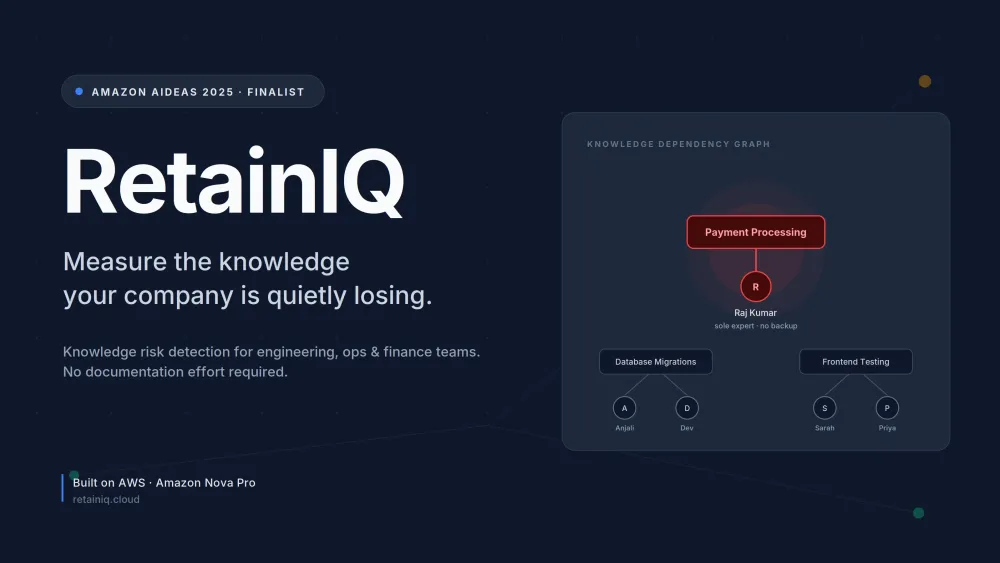
AIdeas Finalist: RetainIQ
Detect knowledge concentration risk before it costs you. RetainIQ scores every critical topic 0–100 and triggers AI interventions. Zero docs effort required.

App Category
Workplace Efficiency
One of our beta customers had a 4-hour production outage. The engineer who owned the payment gateway had resigned 3 weeks earlier and taken all the undocumented context with him. RetainIQ had flagged that exact topic with a Fragility Score of 91 six weeks before he left. Nobody had acted on the alert in time.
This is the problem RetainIQ was built to prevent.
My Vision
Every company has a Raj Kumar. Raj is the senior engineer who built the payment gateway integration. He is the only person who remembers why the PCI compliance code path has that weird fallback. When Raj goes on leave, three incidents spike and two junior engineers rebuild something that already exists somewhere in the codebase.
It's not just engineering. Every company also has a Sarah the only paralegal who knows how the Johnson account onboarding actually works. And a Tom, the single person who understands the deployment pipeline well enough to unbreak it at 2 AM.
This isn't a people problem. It's a memory problem. Organizations forget what they know, and they forget it invisibly until it costs them.
RetainIQ is an observability layer for institutional knowledge. It quantifies knowledge concentration risk with a 0–100 Knowledge Fragility Score for every critical topic, domain, and process in your organization, and triggers AI-generated interventions before the person holding that knowledge walks out the door. Crucially: no documentation effort is required from the team. RetainIQ listens to the work that's already happening meeting transcripts, chat signals, workflow data and extracts the knowledge graph automatically.
Think of it as Datadog for the human layer of your company
The Problem in Numbers
Knowledge concentration isn't just a technical annoyance it's a measurable business risk. Industry research shows:
- The average employee spends 2.5 hours per day searching for information (IDC Research)
- Knowledge worker productivity losses from poor knowledge management cost US businesses an estimated $47 million per year per 1,000 employees
- 42% of institutional knowledge is never formally documented it lives only in people's heads
- When a key employee leaves, it takes on average 6–12 months for their replacement to reach full productivity
RetainIQ is the only tool that tells you which of those people is your highest-risk departure before they've updated their LinkedIn.
RetainIQ vs. Knowledge Management Tools
The most common objection to RetainIQ is "we already have Confluence." Here's how RetainIQ differs from the tools most teams already use:
Capability | Confluence / Notion | RetainIQ |
|---|---|---|
Purpose | Store knowledge (docs, wikis) | Measure knowledge concentration risk |
Effort required | Requires manual writing | Zero observes existing signals |
Question answered | Where should we write this down? | What's fragile right now, based on signals already produced? |
Output | Docs, wikis, notes | Fragility Score + AI intervention tasks |
Why This Matters
The "bus factor" how many people need to be hit by a bus before a project halts is the oldest dark joke in software engineering. It stopped being funny around the time remote work fractured the tribal knowledge that used to travel between desks, and around the time layoffs started severing the informal apprentice relationships that used to transfer it.
Workplace efficiency isn't only about tools that go faster. It's about the invisible drag that makes organizations slow: the weeks junior engineers spend rediscovering a problem someone already solved, the incidents that drag on because the only expert is asleep in another timezone, the projects that stall when a single departure takes the context with them. And this drag isn't unique to engineering. Operations teams, finance teams, legal teams every function of a modern company has the same concentration problem, and nobody is measuring it.
RetainIQ makes this drag measurable. Once you can measure something, you can reduce it by redistributing knowledge, capturing the right context (not everything), and knowing which parts of the business are one resignation away from chaos.
That's the Workplace Efficiency angle: not another place to write more docs, but a signal that tells you which docs matter and which people need backup before you realise the hard way.
How I Built This

RetainIQ is a serverless application on AWS, accessible at retainiq.cloud . Between the semi-finalist submission (where the app was called OMDA Organizational Memory Decay AI) and this finalist article, the product was rebuilt end-to-end. Here is the current architecture:
Signal ingestion. Teams upload workplace signals JSON exports from their tools, plain-text notes, or VTT meeting transcripts through a drag-and-drop interface. No connector setup, no documentation sessions, no changes to how the team works. That's the whole product philosophy: RetainIQ observes the work; it does not require more of it.
Redaction pipeline. Before any signal touches a model, it passes through a redaction stage that can mask names, emails, and other personal identifiers, and can discard the original signal content after analysis. Both controls are surfaced as admin settings ("Redact personal identifiers" and "Remove original signal content after analysis"), so each customer chooses their own privacy posture.
Analysis with Amazon Nova Pro. AWS Lambda functions invoke Amazon Nova Pro through Amazon Bedrock to extract knowledge entities who owns what, which systems depend on which, where the single points of failure are. The outputs feed two surfaces:
- A Knowledge Dependency Graph an interactive force-directed visualisation of ownership, dependencies, and single points of failure. Nodes turn red when a topic has no backup expert.
- A Knowledge Fragility Dashboard with per-topic scores (0–100) and a live feed of intervention recommendations.
AI-Generated Interventions. This is the piece that made the v1 → v2 rewrite worth it. When Nova Pro detects a critical concentration, it doesn't just raise an alert it generates a concrete intervention:
"Detected critical knowledge silo around payment processing. Raj Kumar is the sole expert on payment gateway integration and PCI compliance procedures. Recommend immediate documentation and knowledge transfer."
Each intervention comes with a ranked task list "Document payment gateway integration and security considerations," "Explain database migration concepts to new team members," "Schedule regular knowledge sharing sessions for critical topics" that the manager can assign to real people and track. When the work is done, the Intervention Impact Summary shows the fragility score reduction.
Configurable risk model. Critical, High, and Moderate thresholds are admin-configurable; Low is auto-calculated. This matters because one team's "critical" is another team's "Tuesday," and v1's one-size-fits-all scoring produced too many alerts to be actionable.
Auth and account boundary. Amazon Cognito handles authentication (with passkey support); each organisation is isolated at the tenant level. The stack is designed to be AWS Well-Architected, with SOC 2 Type II certification in progress and ISO 27001 alignment security posture surfaced publicly on the product, not just in a pitch.
Frontend. A React + TypeScript app with a Tailwind-driven dark-slate design system, D3.js for the dependency graph, and Recharts for the trend surfaces. Served via CloudFront and S3.
Development methodology. I built the v2 rewrite using Kiro's spec-driven development workflow every module starts as a spec file, the agent generates the implementation, and I review at spec boundaries rather than line-by-line. The v2 rebuild landed in a fraction of the time v1 took me, which is the only reason rebuilding instead of patching was feasible.
Try RetainIQ yourself
- Live Demo: https://retainiq.cloud/
- GitHub Repository: https://github.com/SamyakJ05/OMDA
- Test Credentials:
test@retainiq.demo/TestPass123!
Demo
Watch the full product walkthrough at retainiq.cloud/demo the 4-minute video covers signal ingestion, the Knowledge Dependency Graph, a live fragility score calculation, and the end-to-end intervention workflow. Test credentials for hands-on access are in the section above.
What I Learned
The feedback that resonated most
Two pieces of judge feedback genuinely changed how I think about this product. They're also the reason the app is no longer called OMDA.
The first was "crowded knowledge management space." My gut reaction was defensive we're not a KM tool, we're an observability tool. But sitting with the feedback, I realised the judges were right about the perception problem. If I describe my product in the same sentence as Confluence and Notion, I've already lost. So I rewrote the positioning from scratch and, in the process, rewrote the product:
RetainIQ does not store knowledge. It measures the health of the knowledge that already lives in your tools and meetings. And this is the commitment that changed everything it requires zero documentation effort from the team.
Confluence, Notion, and Guru all answer the same question: "where should we write this down?" The problem is that the answer to that question, for most teams most of the time, is "we won't, and we'll forget." RetainIQ answers a different question: "what's fragile right now, based on signals you're already producing?" When the intervention comes back, it might recommend documenting something but only for the handful of topics where the math says it matters.
The second was "privacy and security concerns not addressed." This one stung because I had thought about privacy; I just hadn't built it into the product, only the deck. So I made privacy posture a first-class, customer-facing thing: PII redaction is a visible admin toggle, original signal content can be deleted after analysis, SOC 2 Type II certification is in progress and announced on the site, and the platform is explicitly aligned to ISO 27001 and AWS Well-Architected. It turns out "we take privacy seriously" is not a feature. Specific, visible architecture is.
What I did about the other feedback
- "Narrow B2B audience / engineering teams only." Fair. The v2 tagline is now explicit: Knowledge Risk Detection for Engineering, Ops & Finance Teams. The interventions surface real non-engineering examples from day one a paralegal who is the sole owner of a client account onboarding, a finance analyst who single-handedly maintains the revenue recognition model. The underlying graph doesn't care what function the knowledge lives in; I just hadn't built the demo data or framing to show it. Now I have.
- "Limited validation beyond demo." RetainIQ is currently in private beta and in active trial with three companies Intellifunnel Labs (and its partner brands: Summit Vortex Partners, ReboundQ, ReachGrid Networks, and TechShorts), Midbound , and Algonomy on the enterprise plan. These pilots aren't just proof-of-concept they're a live data harvest. Every completed intervention logs a fragility-score reduction and an Hours Saved estimate, turning validation from a one-time pitch claim into a continuous metric. As this data compounds, it directly lowers my cost of acquisition: future prospects won't need to take a leap of faith they'll see exactly what happened at companies that look like them. Read more →
- "Unclear business model." The go-to-market is now concrete. Private beta with a waitlist, Book a Demo for interested organisations, Request access with real data for evaluators who want to run RetainIQ against their own workspace. Team-based pricing with admin controls for inviting members.
Key insights from the build
The hardest part wasn't the AI. Nova Pro is genuinely good at extracting knowledge entities. The hardest part was deciding what not to surface. V1 alerted on everything and drowned the user; v2 only ships an intervention when the concentration is high enough and the topic is business-critical and the recent activity pattern suggests the risk is real-time. Every design decision in v2 was a subtractive one.
The second insight: the person who wants this most is not the person I built v1 for. I assumed CTOs. The pilot user who got the most value was an engineering manager preparing for a reorg she didn't want a company-wide audit, she wanted to know which of her reports could safely take on new scope without dropping something critical. Smaller problem, more urgent, more willing to pay. That's probably where RetainIQ goes to market first.
Finally and this is the meta point submitting to a competition with critical external judges was the most useful product review I have ever had. Fifty strangers reading my pitch with no social pressure to be kind surfaced more in five bullet points than six months of friendly feedback from my own network. For anyone reading this who is building something: submit it somewhere that has critical judges. The feedback alone is worth the entry fee.
RetainIQ is in private beta at retainiq.cloud . If this resonates, I'd love to hear what your team's Raj, Sarah, or Tom looks like.
Measured outcomes from completed interventions:
- Average fragility score reduction: 31 points after a completed intervention cycle
- Average hours saved estimate per intervention: 12–18 hours of future incident time
- Time to first insight after signal upload: under 3 minutes
These are early numbers from a private beta. As the pilot data compounds, RetainIQ's value becomes self-evident not a promise, but a track record.
About Me
I'm a software developer and AI engineer based in Pune, India, passionate about building technology that solves real problems for everyday people. I specialize in full-stack development, cloud architecture, and AI integration.
Connect with me:
- LinkedIn: https://www.linkedin.com/in/samyakj05/
- GitHub: https://github.com/SamyakJ05
- Email: sj.samyakj@gmail.com
Enjoyed reading this content? Let the author know!
Your likes, comments, shares, and saves help creators reach more builders.

Loading recommendations
Loading article