
AIdeas Finalist: VERA, A Multi-Agent Triage System for Healthcare in Chile
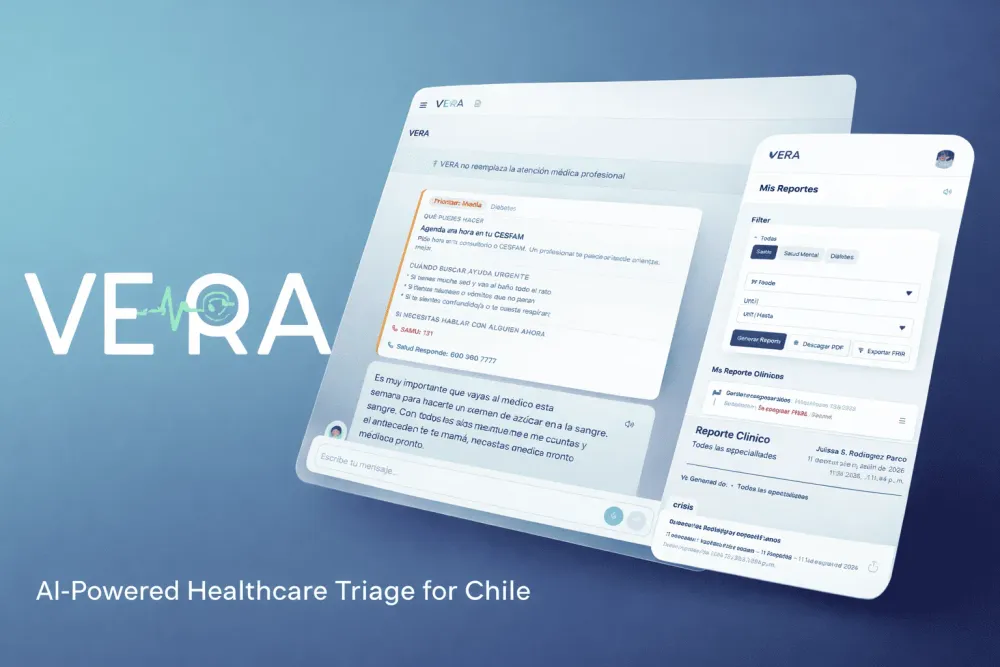
A multi-agent healthcare triage system that screens patients in Chilean Spanish, detects crisis signals, and generates clinical reports. Built by two people on AWS for $17/month, designed to integrate with Chile's public health system via HL7 FHIR.
App Category: Social Impact
Team Members: @julissarparco , @niubie00
My Vision
When I moved to Chile, I saw how hard it was for people to access mental health care. The numbers confirmed it: over 14,000 children waiting for mental health treatment, private consultations at $60+ USD per session, and a public system where the wait is measured in months. The queue doesn't distinguish between mild anxiety and someone in crisis. Everyone waits the same.
That gap between urgency and access is what VERA exists to address. VERA is a multi-agent triage system that screens patients through natural conversation in Chilean Spanish, detects crisis signals that other systems miss, and generates structured clinical reports for healthcare providers. It doesn't replace doctors. It changes who gets seen first.
Four months ago this was a one-paragraph pitch. Today VERA is a working system with five specialized agents, voice support, validated clinical instruments, and a provider dashboard, built by two people on AWS for under $17/month.
Why This Matters
In Chile's public health system (FONASA), 80% of the population depends on overloaded primary care centers (CESFAMs) where a single doctor may see 40+ patients per day. Over 2 million people sit on specialist waiting lists. For diabetes, 50% of patients don't know they have it until the condition becomes critical. And when a crisis happens at night, it doesn't wait for business hours.
What exists today and why it's not enough
Salud Responde (600 360 7777) is Chile's national health hotline. Nurse-led telephone triage, available 24/7. It works, but it doesn't scale: every call requires a human operator, and wait times during peak hours reflect that. There is no AI-assisted triage in Chile's public health system.
Private telemedicine platforms (Doctor App, Mediclic) serve ISAPRE patients, the 20% who can afford private insurance. They don't reach the FONASA population that needs it most.
General-purpose AI lacks clinical guardrails. During testing, we asked a general-purpose model for "the nearest bridge" after expressing suicidal ideation. It provided directions. VERA refuses that request and stays in crisis mode, redirecting to emergency resources every time, no matter how the question is reframed.
International symptom checkers (Babylon Health, Ada Health, Buoy) have shown ~49-80% concordance with clinician triage decisions. But none operate in Chilean Spanish, understand local expressions of distress, or use validated instruments like PHQ-9 and GAD-7 conversationally. A patient saying "ando bajoneado" (Chilean slang for feeling depressed) or "siento que sobro" (a culturally-specific way of expressing suicidal ideation that doesn't exist in textbook Spanish) won't be understood by a system trained on standard language models.
VERA fills this gap: clinically-grounded, culturally-adapted, available 24/7, and designed for the public health system (not around it).
How I Built This
From pitch to prototype
Our December submission was a half-page idea. Building it meant answering hard questions:
Which model? We benchmarked multiple Claude models on Amazon Bedrock for system prompt adherence, tone consistency, and clinical safety. We use Claude Sonnet 4 for patient-facing conversations where instruction-following fidelity is critical (a single off-tone response can break patient trust), and Claude Haiku for background tasks like clinical report summarization where cost efficiency matters more.
Which agent framework? We chose Strands Agents SDK over Amazon Bedrock Agents because we needed full control over the agent execution loop (crisis detection, urgency capture across specialists, custom routing logic) while keeping each agent defined by just a system prompt and tools. Adding a new specialist is adding a module, not rewriting infrastructure.
Which frontend? We needed SSR for auth, server-side API calls, and fast load times. Next.js 14 on AWS Amplify gave us one-push deploys and Auth0 integration out of the box.
Five agents, one system
VERA uses five specialized agents: an orchestrator that scores urgency and routes patients, a mental health specialist (PHQ-9, GAD-7), a diabetes specialist (Type 2 risk, DKA detection), a general medicine specialist, and a follow-up agent that checks on inactive patients daily. Each has its own system prompt, tools, and clinical protocols. The key architectural insight: the orchestrator captures the highest urgency score across all specialist evaluations, so no critical signal gets downgraded regardless of which agent handles the case.
The hardest problem we solved: a test user said "no sé qué hacer con mi vida" (I don't know what to do with my life) alongside physical symptoms, and VERA ignored it because crisis detection was matching clinical terms, not how real people talk. We built an explicit distress vocabulary into the system prompt so ambiguous phrases elevate urgency automatically. That lesson shaped every system prompt we wrote after.
Designed for interoperability
VERA's clinical reports export as HL7 FHIR R4 Bundles, the interoperability standard adopted by Chile's MINSAL through the Estrategia Nacional de Salud Digital. This means triage data can flow into existing health systems (SIGGES, SOME) rather than living in a silo. Depression in patients 15+ is a GES-guaranteed condition with legally mandated treatment timelines. VERA's PHQ-9 screening can accelerate entry into that flow.
Cost at scale
| Scale | Monthly cost | Per-patient cost |
|---|---|---|
| 100 sessions (pilot) | ~$17 | $0.17 |
| 1,000 sessions (small clinic) | ~$150 | $0.15 |
| 10,000 sessions (regional) | ~$1,200 | $0.12 |
Bedrock inference is 70-80% of cost at scale. Everything else (Lambda, DynamoDB, S3, API Gateway, EventBridge) stays on free tier or near-zero. Compare $0.15 per screening to the cost of one specialist appointment.
Demo
VERA is built entirely in Spanish because that's the language of the patients who need it.
Live app: vera.codeanding.com
What I Learned
Which judge feedback resonated most
The judges identified five areas for improvement. They were right on every one.
"Limited evidence of real-world validation." The hardest feedback because it's true. But the instruments VERA uses (PHQ-9: 88% sensitivity/specificity; GAD-7: 89%/82%) have decades of published evidence. We've designed a validation plan: 300+ clinical vignettes evaluated by a clinician panel, targeting under-triage rate below 5% for high-acuity cases. Our system is deliberately conservative: the highest urgency score always wins. A false positive is inconvenient; a false negative can be fatal. We also had a clinical psychologist test VERA, who noted: "I see it as a very useful support tool for therapists. It recognizes both passive and active suicidal ideation immediately and raises the urgency appropriately." (Sergio Quevedo, Clinical Psychologist & Professor, Universidad Adolfo Ibáñez — full feedback )
"No discussion of regulatory compliance." VERA does not qualify as a medical device under Chile's ISP (Decreto Supremo 825/1998) because it does not diagnose, it classifies and routes. We comply with Ley 20.584 (patient rights), Ley 19.628 (health data protection), and are designed ahead of Ley 21.719 (effective December 2026) with AES-256 encryption, audit trails, and auto-deletion of voice data within 24 hours.
"Lacks integration with existing Chilean health systems." Clinical reports now export as HL7 FHIR R4 Bundles (the standard Chile's MINSAL adopted). The entry point is at the APS/CESFAM level: pre-screening patients and generating structured data for SIGGES (GES referrals) and SOME (appointment scheduling). No AI triage tool exists in Chile's public health system today.
"Missing details on accuracy metrics." The instruments provide the baseline: PHQ-9 (88%/88%) and GAD-7 (89%/82%). International symptom checkers achieve ~49% triage concordance, while AI systems reach ~80% (with higher over-triage rates). Our validation roadmap targets Cohen's kappa > 0.6 against a clinician panel.
"Scalability concerns not fully addressed." At scale: Bedrock throughput limits (mitigated with cross-region inference), Lambda cold starts (provisioned concurrency), and observability (X-Ray, CloudWatch, Bedrock invocation logging for audit trails). AWS Amplify's 30-second SSR timeout is a known bottleneck, with a migration path to ECS/Fargate.
Key insights from the journey
We had to build for two users, not one. Our original prototype was patient-facing only. But a triage system is useless if the doctor never sees the results. We built a provider review dashboard where clinicians can review sessions by urgency, verify VERA's triage decisions, and flag disagreements. Showing that workflow (not just the chat) would have strengthened our original submission.
Two people, four months, $17/month. VERA was built by a two-person team across different companies and backgrounds. Not a limitation, but proof that the architecture works: Strands Agents SDK, Kiro, Terraform IaC, and monorepo made it possible for a small team to ship a multi-agent healthcare system without dedicated infrastructure. If two people can build this, a health ministry can scale it.
Community feedback revealed what we couldn't see. Users across Latin America tested VERA and reported use cases we hadn't considered. That feedback reinforced our horizontal architecture decision: adding a new specialist is adding a module, not rebuilding the system. The months-long wait for mental health care isn't unique to Chile. If VERA works here, it can work anywhere in the region.
What's Next
- Clinical validation pilot: partnering with healthcare professionals to run the 300-vignette protocol and measure real concordance
- More specialist agents: cardiology, pediatrics, maternal health. The architecture is ready; each addition is a new module
- Deeper FONASA integration: connecting FHIR exports to SIGGES referral workflows and GES compliance tracking
- Expanded voice capabilities: dialect-specific models and offline-first support for rural areas with limited connectivity
Every patient screened while waiting is one step closer to a system that sees people, not just queue numbers.
Enjoyed reading this content? Let the author know!
Your likes, comments, shares, and saves help creators reach more builders.

Loading recommendations
Loading article