
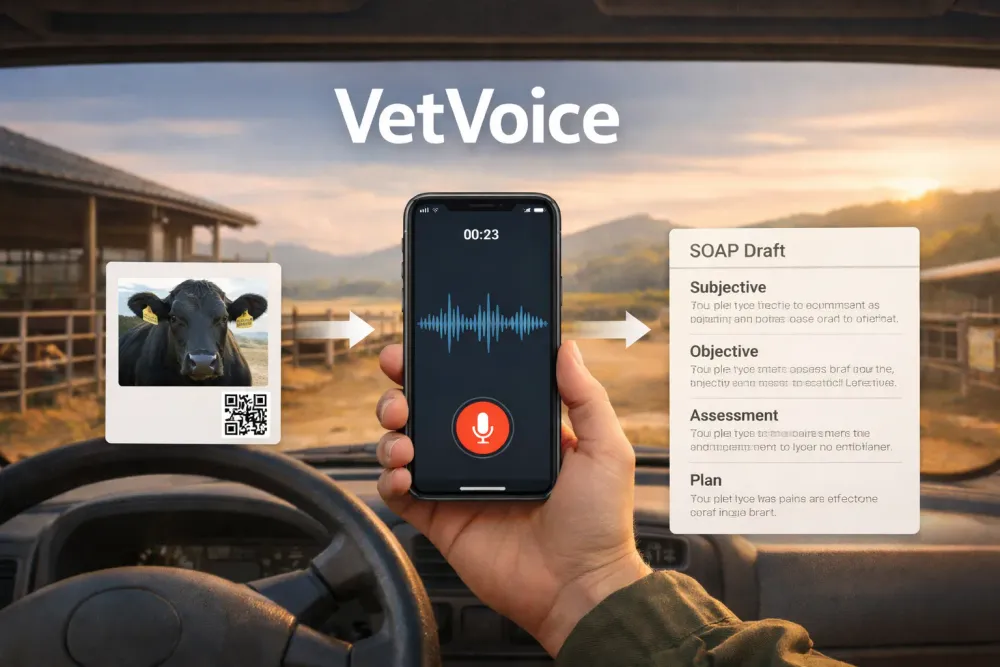
AIdeas finalist: VetVoice — Turning Field Voice Memos into Clinical Record Drafts
General-purpose transcription often falls short on veterinary field audio. VetVoice adds domain-specific guardrails to turn rough voice memos into reviewable clinical record drafts.

App Category: Workplace Efficiency
My Vision

After finishing farm visits, large-animal veterinarians rarely have the luxury of sitting down in a quiet office to write up their records. Notes need to be captured wherever they are — on the farm, in the truck, between calls. VetVoice is an assistive tool that transforms those rough voice memos from the field into reviewable, editable draft clinical records. The output follows the SOAP (Subjective, Objective, Assessment, Plan) format, a structure widely used in veterinary and medical documentation.
The idea came from a simple observation: the work of a large-animal veterinarian does not end with treatment. There are farm visits, long drives, conversations with farmers, and then record-keeping — often done later in the day, relying on short voice memos or memory alone. The conditions for writing records are rarely ideal.
VetVoice is not a transcription tool. Rather than converting speech directly into text, it reshapes field audio into a structured draft that a veterinarian can quickly review and correct. It does not automate diagnosis or treatment decisions. The final review and editing always remain with the veterinarian. VetVoice's role is strictly limited to assisting with record creation.
Why This Matters
This problem matters because it goes beyond saving time. Large-animal veterinary work is not desk work that stays inside a clinic. It involves farm visits, on-site treatment, discussions with farmers, early-morning calls, and occasional overnight emergencies. Working hours tend to be long and unpredictable. On top of all that, veterinarians are expected to document their observations and procedures after each visit — but they cannot always do so in a calm, unhurried setting.
Under these conditions, record-keeping is not just paperwork. It becomes a recurring operational burden that compounds with every visit. After handling a case on a farm, a veterinarian might leave only a quick voice memo in the truck and reorganize the details later. In large-animal practice, field audio is full of domain-specific terminology, abbreviations, and shorthand. General-purpose speech recognition or meeting transcription apps often cannot reliably turn that kind of audio into record-quality output.
In other words, documentation is not a separate administrative task. It is the final task in an already long chain of work.
According to a survey by Japan's Ministry of Agriculture, Forestry and Fisheries, the average time per farm visit is 4.3 hours, of which 1.7 hours is travel alone. A significant portion of a veterinarian's day is spent on activities other than treatment itself, and record-keeping lands at the very end of that long chain. When you consider that a single veterinarian may handle multiple farm visits in a day, the cumulative documentation load becomes substantial.
Record creation is not a minor task in large-animal practice. It matters to both veterinarians and farmers. But in reality, it can easily be pushed to the end of the day and treated as paperwork. VetVoice directly addresses the burden of creating that first draft. Instead of starting from a blank page, veterinarians begin with a reviewable draft, so they can spend less time on records and more time on work that has greater impact: clinical decisions, follow-up, and conversations with farmers that support the long-term health and management of the herd. I believe that reducing this kind of quiet, repetitive friction supports the people who work in the field — and by extension, helps sustain the continuity of regional livestock care.
How I Built This

At first glance, a general-purpose speech recognition or meeting transcription app might seem sufficient. But the challenge I faced was not converting speech to text — it was reliably turning field audio into a draft that is actually usable as a clinical record.
To achieve this, VetVoice's pipeline is broken into distinct stages: speech recognition → dictionary correction → normalization → structured extraction → SOAP draft generation. Field audio contains background noise, abbreviations, incomplete sentences, and inconsistent phrasing. If you try to handle all of this in a single end-to-end generation step, it becomes difficult to identify where quality breaks down and even harder to improve. By separating the stages, I can trace where problems occur and tune each step independently.
The key design principle was not to rely on larger, more expensive models, but to add domain-specific guardrails earlier in the pipeline. Concretely, this means using dictionary files, normalization rules, and master data matching to expand abbreviations and smooth out phrasing variations before the structured extraction and SOAP generation steps. I also separated the LLM roles: extraction and generation are handled separately, which makes it easier to balance quality and cost. In this PoC, Claude Haiku 4.5 proved to be the best fit for extraction, while Amazon Nova Lite worked well for SOAP generation.
The competitive landscape for VetVoice is not limited to other veterinary AI products. In practice, the real alternatives are handwritten notes, manual data entry after the fact, general-purpose speech recognition, meeting transcription apps, and manual drafting workflows. These are easy to adopt, and for many use cases they work well enough. But when the input is large-animal field audio — full of domain abbreviations, shorthand, background noise, and incomplete phrasing — these tools often fall short of producing output that can serve as a clinical record without heavy manual rework. VetVoice confronts that gap directly, not by replacing these tools entirely, but by offering a specialized layer that handles what general-purpose solutions cannot.
For evaluation, I used 40 anonymized real field recordings collected with the cooperation of a practicing large-animal veterinarian. These are not mock conversations or scripted scenarios — they closely reflect actual farm conditions. The result: the SOAP CLEAN rate (an internal metric for assessing whether a draft meets usable quality) improved from 0.0375 to 0.8000. This improvement did not come simply from switching to a larger model. It came from the design of the dictionary, normalization, and structuring layers. That mattered because it showed the system was getting better on real field audio, not just in demos.
This architecture was not built as a one-off demo. It is designed as a foundation that can be incrementally improved through dictionary updates, re-evaluation cycles, and failure pattern reviews.
Demo
In this demo, I first show the finished SOAP draft, then trace back to the original field audio. You can see what kind of audio goes in, where expressions are cleaned up, how the content is structured, and how it becomes a reviewable clinical record draft.

Example output screen: generated SOAP and clinical record drafts for veterinarian review.
There are two points worth noticing here. First, field audio containing domain-specific abbreviations and phrasing is not just transcribed — it is reorganized into a format that is easier to review as a clinical record. Second, VetVoice does not automate final judgment. It is designed as an assistive tool, with the veterinarian always expected to review and correct the output.
This is not just a screen recording. It is backed by a pipeline refined through iterative improvement against 40 anonymized field recordings.
What I Learned
Three pieces of judge feedback stood out to me: the target audience appearing narrow, the evidence of expert adoption and field deployment still looking thin, and the path beyond the PoC still being unclear. I found these points fair. My previous article was strong on technical details and evaluation results, but weak on showing how VetVoice would actually enter real-world workflows. The judges were right to ask not just "Does it work?" but "How would it actually be adopted?" A technically sound workflow still has limited value if it does not fit the routines people already have.
In response, I reconsidered how to present VetVoice. It is not a replacement for veterinarians, nor is it an all-purpose AI. It is an assistive tool that reshapes field language into usable record drafts, so that experts can spend their time on more critical decisions and responses. Framing it this way also clarifies the scope: VetVoice does not need to solve every problem in veterinary practice. It needs to solve one specific, recurring problem well enough that practitioners choose to use it.
At the same time, I reaffirmed that building truly useful AI for a specialized domain is not just about using the most powerful model. What made the biggest difference in this project was the combination of dictionaries, normalization, role separation, and evaluation against real field audio. Without testing on actual recordings, it would have been impossible to see what was really working.
I also realized that pushing VetVoice as a standalone app is not enough to achieve real-world adoption. The judges pointed out the lack of integration discussion with existing veterinary practice management systems, and that feedback was fair. Our collaboration has expanded to include multiple practicing veterinarians, and we have begun an ongoing cycle of collecting recordings, registering data, updating dictionaries, and re-evaluating the results.
As a concrete first integration path, I am looking at milook, a remote health management service for cattle already used by veterinarians and farmers in the field. Connecting VetVoice's draft output to a platform like MIlook would let this workflow fit into routines veterinarians already have, rather than asking them to adopt a new tool. That said, MILook is one concrete path, not the only one. VetVoice's pipeline is built as a modular record-assistance layer that can be embedded into other large-animal apps or clinical record systems. Fitting into existing workflows is the realistic path beyond the PoC.
The most valuable lesson I took away is the importance of not trying to solve everything at once. Large-animal practice involves many challenges — travel, long hours, documentation, terminology, operations. I chose to focus on one specific friction point: turning post-visit voice memos into record drafts. It may look small, but it happens often enough to wear people down over time. In AI projects, deciding what not to build is just as important as deciding what to build.
References & Further Reading
Farm-visit workload and travel time
Ministry of Agriculture, Forestry and Fisheries (MAFF), 往診に関する調査結果 — View data
Ministry of Agriculture, Forestry and Fisheries (MAFF), 往診に関する調査結果 — View data
Related legal context for clinical records
e-Gov Law Search, 獣医師法 第21条 — View law
e-Gov Law Search, 獣医師法 第21条 — View law
Existing workflow integration path
MILook, a remote health management service for cattle used in the field by veterinarians and farmers in Japan — View service
Enjoyed reading this content? Let the author know!
Your likes, comments, shares, and saves help creators reach more builders.

Loading recommendations
Loading article