
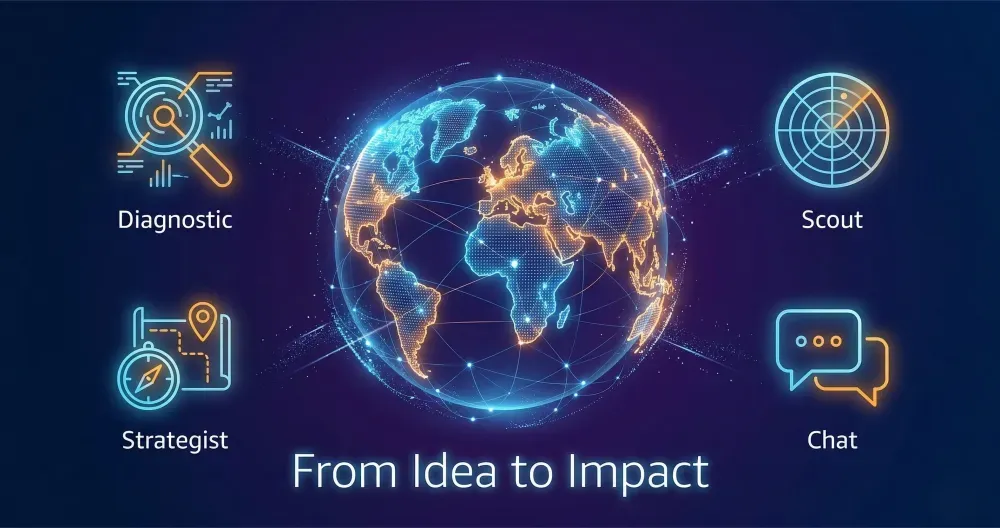
AIdeas Finalist: Global Impact AI Navigator
Global Impact AI Navigator (GIAN) is a multi-agent AI platform built on Amazon Bedrock that transforms a raw idea into a complete strategic package in under 60 seconds — SWOT diagnostic, live-grounded funding discovery, personalized roadmap, and a context-aware advisor. Designed for innovators in emerging markets, it democratizes access to the strategic guidance that usually requires expensive consultants or elite networks.

App Category
Social Impact
My Vision
"Innovation is evenly distributed globally, but strategic guidance and capital are not."
I built the Global Impact AI Navigator (GIAN) to solve a practical and deeply unfair reality: the people closest to the world's most pressing social and environmental problems are often the ones with the least access to the resources needed to solve them.
A student in Nairobi with a water purification concept, a cooperative in Bogotá with a regenerative agriculture idea, or a nurse in Lagos designing a maternal-health workflow all face the exact same bottleneck. Not a lack of talent. Not a lack of intent. A lack of access. Traditional guidance requires hiring expensive consultants, attending elite accelerators, or simply knowing the right people. That does not scale.
GIAN is a full-stack, multi-agent AI platform that transforms a raw idea into a complete, executable strategic package in under 60 seconds — and then continues to support execution week after week:
- SWOT Diagnostic: Sector classification with conservative feasibility and impact scoring (0–100), SDG alignment, risks, and actionable recommendations.
- Live Funding Discovery: Active grants, accelerators, and impact programs sourced via Amazon Nova 2 Lite's native Web Grounding, with every URL verified before display.
- Personalized Roadmap: A time-boxed action plan (2 weeks → 6 months) adapted to project maturity, region, and the user's expressed needs.
- Grant Writer: A context-aware tool that generates tailored funding application letters directly from the project's SWOT and verified funding portfolio.
- Continuous Companion Loop: Weekly funding digests, deadline trackers, and interactive progress check-ins that bring users back after the first session.
The core product promise is simple: make high-quality strategic support accessible to innovators without consulting budgets, and keep that support useful long after the first analysis.
Why This Matters
According to UN estimates, over 1.1 billion people live in multidimensional poverty. Yet practical solutions to their challenges already exist as ideas in the minds of local innovators. Many of those ideas stall at the concept stage because four essential resources are missing:
- Strategic clarity: Is this idea viable, and what are the highest risks?
- Funding visibility: Which active grants match this specific project profile right now?
- Execution structure: What exactly should happen this week, this month, and this quarter?
- Follow-up mentoring: How do we adapt when constraints change?
I am based in Douala, Cameroon. I see this gap firsthand — the distance between a great idea and a resourced project is not a talent problem, it is an infrastructure problem. GIAN is my attempt to build part of that infrastructure.
"We don't just need more AI assistants for convenience. We need AI as an access equalizer."
This is why the Social Impact category is the perfect fit. GIAN uses explicit UN Sustainable Development Goal (SDG) framing so that every output maps directly to the vocabulary that international funders and impact investors actually use — whether the project addresses SDG 2 (Zero Hunger), SDG 6 (Clean Water), or SDG 13 (Climate Action).
How I Built This
Frontend: React + Vite + TypeScript, mobile-first, deployed on Amazon S3 with CloudFront distribution.
Backend & Infrastructure: Express + TypeScript API deployed via AWS Lambda + API Gateway. Amazon DynamoDB for project and session storage. Firebase Authentication with server-side token verification.
The Context-Aware Multi-Agent Pipeline
The engine is a phased, user-guided workflow built on the Amazon Bedrock Converse API, where context is propagated and accumulated across every agent — never reset:
- Diagnostic Agent (Nova Micro): Produces a structured 12-field SWOT with conservative scoring and deterministic JSON retries. Chosen for speed and cost-efficiency on structured classification.
- Scout Agent (Nova 2 Lite +
nova_grounding): The technical centerpiece. Runs a live grounded web search, extracts citations from interleavedcitationsContentblocks, validates every URL via HTTP HEAD checks, and filters stale or broken opportunities.
- Strategist Agent (Nova Lite): Converts the full SWOT, verified opportunities, and user-selected needs into a time-bound, maturity-adapted roadmap.
- Advisor Agent (Nova Lite): Maintains full project context across follow-up conversations, refining strategy without losing memory.
- Grant Writer Agent (Nova Lite): Generates a tailored funding application letter for a specific opportunity, using the project's SWOT and roadmap as the sole source of truth — no generic filler.
Building for Resilience: Engineering Trust
"In GenAI for social impact, graceful degradation is a product requirement, not an engineering nicety."
GIAN is not a prompt wrapper. It is a defensive, resilient distributed workflow:
- Triple Fallback Architecture: If
nova_groundingis rate-limited or unavailable, the system cascades automatically to a knowledge-only fallback, then to a Bedrock Agent runtime. The user never sees a hard failure.
- Defensive Parsing: Strict schema validation and temperature retries ensure structured JSON outputs survive unexpected LLM markdown injections.
- Link Verification: Every URL is verified via HTTP HEAD before display. Broken links are replaced with labeled Google search fallbacks. No hallucinated funding reaches the user.
Data Retention and Compliance by Design
Model calls are stateless — continuity is reconstructed from DynamoDB context at each step. The weekly retention loop runs as:
EventBridge schedule → Lambda retention worker → DynamoDB state evaluation → SES notifications → metadata write-back This powers weekly digest summaries, deadline alerts (J-30, J-7, J-1), and check-in reminders. Deduplication keys and lifecycle timestamps prevent noisy or redundant sends.
GDPR compliance is anchored to the Firebase UID: explicit opt-in capture at registration, versioned consent history, revocation endpoint, and full data-erasure workflow — all auditable.
To protect founder IP, the platform relies on Amazon Bedrock's enterprise data handling model: customer data is never used to train foundation models.
Demo
The Competitive Edge
One of the most valuable pieces of judge feedback was the call to clarify the competitive landscape.
Platforms like IdeaBuddy and Strategyzer offer excellent structured planning frameworks — but they are static. They provide blank templates; they don't run a custom analysis and simultaneously search the live internet for matching programs. Accelerator portals are highly fragmented and serve people who already know which program they are targeting. General-purpose LLMs are flexible but lack grounding, workflow constraints, and the retention mechanisms that create ongoing value.
GIAN differentiates on three specific axes: Dynamic Analysis (idea-specific SWOT, not templates), Live Grounded Discovery (real-time web search with citation verification, not static databases), and Time-based Retention (weekly digests and deadline alerts that make the platform useful week after week, not just once).
The target user is not a Silicon Valley founder with a warm intro to a top accelerator. It is the innovator in Douala, Dhaka, or Dakar who cannot afford premium advisory software and has never heard of Strategyzer.
What I Learned: Evolving from Prototype to Product
The finalist judging process was the most rigorous product review I have experienced. Here is how I addressed each piece of critical feedback.
1. "Limited validation evidence." I ran structured early-user sessions across more than 6 countries. 4 out of 5 users discovered at least one funding opportunity they were previously unaware of. All 5 rated the SWOT diagnostic as more actionable than a standard LLM prompt. Since then, the platform has processed 21 analyses across 16 countries, covering 12 SDGs — real figures tracked live in the admin dashboard built specifically to measure impact over time.


2. "Scalability concerns — Free Tier limits."
These were intentional demo guardrails, not architectural constraints. The serverless stack scales horizontally with no code changes. The constraints produced better design: tiered model routing by task complexity , async phase execution, and tight token budgeting — all of which make the production system more cost-efficient than an unconstrained build would have been.
3. "Web Grounding creates a single point of failure."
Addressed with the triple fallback chain described above. In approximately 40 test runs, Web Grounding succeeded 94% of the time. When it failed, the knowledge-only fallback produced usable results and those results are store to help when the grounding failed and the knowledge based oh th AI it's not sufficient. No run resulted in a hard failure returned to the user.
4. "Accuracy and liability for AI funding recommendations."
Honesty mechanisms are now hardcoded into the pipeline: conservative scoring, HTTP link verification with fallbacks, factual description prompting grounded in citations, temperature retries, and clear UI disclaimers that all funding information must be verified with the source organization before application.
"If a founder in Douala, Dhaka, or Dakar can turn a notebook idea into a credible, fundable, and executable plan in under a minute — this is not just an AI application. It is infrastructure for opportunity."
Technical Appendix
The following diagrams represent the production architecture. Each addresses a specific concern raised during the judging process.
Diagram 1 — End-to-End System Architecture

Diagram 2 — Multi-Agent Context Propagation

Diagram 3 — Scout Resilience & Fallback Tree

Diagram 4 — Project Lifecycle State Machine

Diagram 5 — Retention & GDPR-Gated Notification Flow

Diagram 6 — Legal Control Plane

Security & Trust Controls
- Auth & ownership: Firebase token verification at API boundary. Project ownership enforced per request.
- Abuse prevention: Global, analysis, chat, and daily per-user rate limits. Zod input validation and sanitization.
- Prompt safety: Structured parsing with retries. Link verification before surfacing opportunities.
- Compliance: Explicit consent with versioning, revocation, audit retrieval, and erasure endpoints.
Scalability & Cost Model
- Compute: Model routing by task complexity. Async phase execution eliminates synchronous bottlenecks.
- Storage: DynamoDB with dedup keys and lifecycle metadata to limit redundant work.
- Path to production: Free Tier guardrails are lifted by configuration. Architecture supports queue externalization and horizontal scaling without code changes.
Built with Amazon Bedrock · Nova (Micro, Nova 2 Lite, Lite) · Web Grounding · Lambda · API Gateway · DynamoDB · S3 · CloudFront · SES · EventBridge · Firebase Auth · React · Vite · TypeScript · Kiro
And a belief that the next world-changing idea might be sitting in someone's notebook right now — waiting for the right guidance to become real.
Enjoyed reading this content? Let the author know!
Your likes, comments, shares, and saves help creators reach more builders.

Loading recommendations
Loading article