
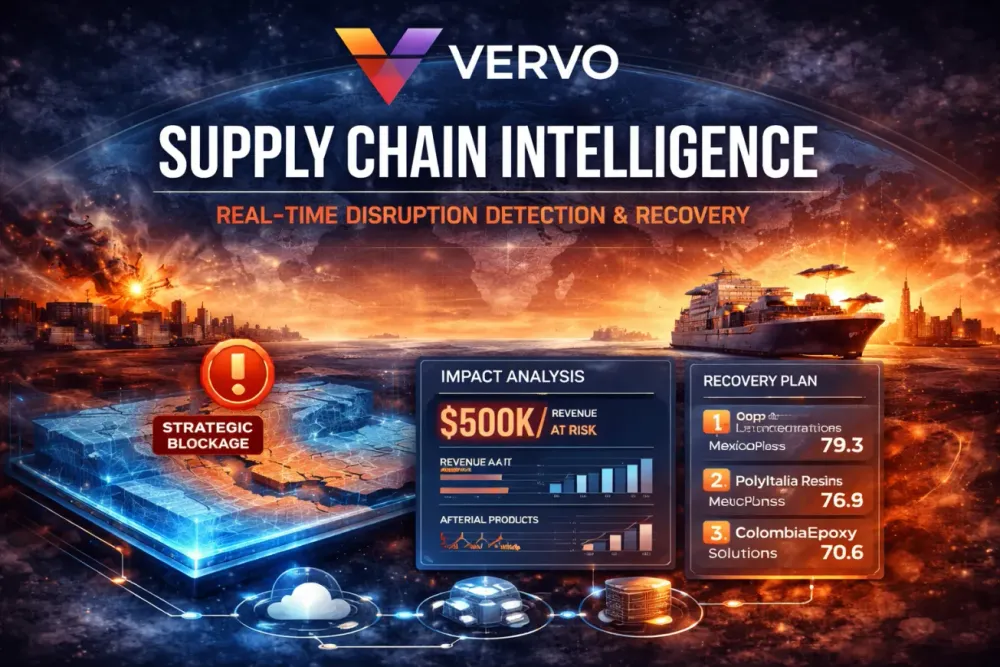
AIdeas: Vervo Supply Chain Intelligence
An autonomous AI system that detects global supply chain disruptions, maps them to your Bill of Materials, and delivers ranked, compliance-cleared supplier recovery plans in under 60 seconds — transforming multi-day manual crisis response into fully automated resilience.

Team Name: DJX Prime
App Category: Commercial Solutions
Region: APJC
Our Vision
Supply chains move $25 trillion in goods annually, yet disruption response remains dangerously manual. In 2026, supply chain volatility has become the "new normal" — no longer just a logistical headache, but a fundamental threat to corporate solvency. McKinsey reports that disruptions now cost companies an average of 45% of one year's profits every decade, with single-day production downtime hemorrhaging $500,000 to $1M in lost revenue, idle labor, and governance penalties.
The root cause? The "information gap" is the most expensive variable in a globalized economy. When a geopolitical crisis, port strike, or natural disaster occurs, procurement teams lose 48-72 hours manually mapping news reports to their internal Bill of Materials. This latency causes critical errors — by the time risk is quantified and alternatives are identified, competitors have already locked up available capacity. While 82% of companies are affected by shifting trade policies and tariffs, only 25% have visibility beyond their direct Tier-1 suppliers.
By the time humans react, Vervo has already solved the disruption.
Every 20 minutes, EventBridge triggers automated monitoring of premium news sources (Reuters, Bloomberg, AP). When a disruption is detected, Amazon Bedrock's Nova Pro acts as a high-speed "Digital Analyst," extracting structured intelligence with geospatial precision (latitude/longitude for mapping), standardized region taxonomy (mapping "Shanghai" → "Asia" to match ERP data keys), and disruption categorization that drives risk coefficients. The system then maps the disruption to your specific supply chain, scores alternative suppliers using Z-score normalization to eliminate regional bias, applies OFAC sanctions screening with scenario-aware penalties, and delivers a ranked recovery plan with days-to-production-halt and revenue-at-risk calculations — fully autonomously.
Why this matters
McKinsey research shows supply chain disruptions cost enterprises an average of $184 million per incident. Traditional response takes 3-5 days of manual work. In that window, production lines sit idle burning $50,000+ daily in fixed costs, customers cancel orders, and competitors secure alternative inventory.
Vervo collapses this timeline to minutes through three key innovations:
1. Autonomous Detection: EventBridge-triggered polling with three-layer deduplication (in-memory set → 24h TTL table → GSI queries) ensures every relevant disruption is caught without reprocessing. Articles pass relevance keyword gates before Bedrock spend, optimizing cost while maintaining signal quality.
2. Intelligent Supplier Scoring: Rather than absolute cost thresholds that penalize high-cost regions, we use Z-score normalization — if all alternatives are expensive, the "average" supplier still scores fairly. Combined with stock availability (0-40 pts) and lead time (0-30 pts), this produces rankings that adapt to actual market conditions.
3. Scenario-Aware Governance: OFAC sanctions screening isn't binary. A RESTRICTED supplier is unacceptable in normal operations but may be acceptable in genuine emergencies (days_to_halt < 7, high downtime cost). The system adjusts penalties based on urgency and customer risk_tolerance, keeping compliance non-negotiable while enabling pragmatic decisions.
For enterprises, this translates to:
- Faster response: Secure alternatives before competitors (minutes vs. days)
- Lower costs: Data-driven selection vs. panic buying
- Compliance assurance: Automated sanctions screening prevents violations
- Operational resilience: Autonomous decision-making at machine speed
The system is designed to work both ways: as a drop-in intelligence layer where any ERP, procurement platform, or risk tool can call the REST API and receive structured recovery plans without replacing existing infrastructure, and as a standalone operations center through the Vervo dashboard built for teams that don't yet have a procurement platform to integrate with.
The Vervo Dashboard
To demonstrate the full system end-to-end, we built a real-time operations dashboard using Next.js 14. The main page is a split-screen command center designed for procurement teams to monitor and respond to disruptions at a glance.

Vervo Dashboard main page
The left panel is an interactive global risk map (MapLibre GL) that plots live disruption hotspots as color-coded markers — red for disruption, blue for aternate suppliers and green for customer firm location. Clicking a marker zooms the map to the disruption location and simultaneously pins alternative supplier locations, giving a geographic view of both the threat and the recovery options.
The right panel is the Active Disruptions feed — a live list of all detected disruptions, each showing severity badge, disruption type, affected region, a two-line AI-generated summary, and an impact score bar. New disruptions glow red on arrival. Each card shows either "ANALYZING" while Stage 2 is running or "✓ ANALYZED" once the recovery plan is ready.
Clicking any disruption opens the Crisis Intelligence Report — a detailed panel showing the Bedrock-extracted summary (what happened, affected area, supply chain impact, estimated duration, key facts), the daily revenue at risk badge, affected products with per-product revenue exposure, and materials at risk with criticality tags.
Once the recovery plan loads, a slide-up drawer appears at the bottom of the screen showing the ranked alternative suppliers. Each supplier card displays score, stock, lead time, days to production halt, risk reduction percentage, and sanctions status badge. The drawer is collapsed by default to keep the map visible, and expands on click to show the full Solution Matrix.
The dashboard polls every 5 seconds while a disruption is in PENDING state, switching to 60-second intervals once analysis completes — with exponential backoff on rate limit responses.
Core Innovation: AI Decision Engine for Supplier Recovery
The heart of Vervo is a multi-stage decision engine that transforms unstructured news into actionable supplier recommendations:

Multi-Factor Scoring Algorithm
Traditional systems use simple rules (cheapest supplier, fastest delivery). Vervo uses statistical normalization:
Stock Availability (0-40 pts):
1
score = min(40, (stock / 1000) * 40) + (stock * 0.00001)
Linear scaling with micro tie-breaker prevents arbitrary ordering.
Lead Time (0-30 pts):
1
≤2 days: 30 pts | ≥14 days: 5 pts | Linear between
Even slow suppliers score above zero — availability beats speed in emergencies.
Cost Efficiency via Z-Score (0-30 pts):
1
2
z_score = (supplier_cost - mean_cost) / std_dev
cost_score = clamp(15 - (z_score * 7.5), 0, 30)
This is the key innovation: Average cost = 15 pts. Two standard deviations cheaper = 30 pts. Two standard deviations more expensive = 0 pts. The scoring adapts to the actual cost distribution of available suppliers rather than using fixed benchmarks that unfairly penalize high-cost regions.

Supplier Scoring Decision Tree
Governance Integration
Scoring is adjusted based on sanctions status:
- BLOCKED: Excluded entirely (OFAC SDN list, hard-block countries)
- RESTRICTED: -80 pts (reduced 30-50% in urgent scenarios based on risk_tolerance)
- HIGH_RISK: -40 pts (scenario-aware reduction)
- CLEAR: No penalty
The system reads customer compliance profiles from VervoCustomerProfiles and applies policy overrides, approved supplier lists, and risk tolerance settings. This makes governance a first-class concern rather than an afterthought.

Sanctions Classification Flow
Impact Calculation
For each supplier, the system calculates:
Days to Production Halt:
1
days_to_halt = (current_stock - safety_stock) / (daily_consumption × safety_factor)
Safety factor = 2.0 for catastrophic events (hurricane, war, pandemic), 1.3 otherwise. This accounts for panic buying and buffer depletion.
Revenue at Risk:
1
daily_revenue_impact = Σ(product.daily_production_target × product.revenue_per_unit)
Aggregated across all affected products from Bill of Materials queries.
The output is a ranked list of suppliers with actionable metrics: score, days_to_halt, risk_reduction percentage, sanctions_status, and human-readable status messages.

Impact Level Calculation
How we built this
End-to-End Pipeline Flow
The system is built around a two-stage async pipeline. EventBridge triggers automated news ingestion every 20 minutes; manual submissions enter through the same API Gateway. Stage 1 returns immediately with extracted intelligence while Stage 2 runs the full recovery analysis in the background via SQS.

Architecture Overview
Architecture Overview
The diagram below maps every AWS service in the system — organized by layer from external sources through to data persistence — showing how each Lambda, DynamoDB table, API Gateway, and integration point connects across the full pipeline.

Core AWS Infrastructure
The entire backend is fully serverless — Lambda, DynamoDB, SQS, EventBridge, and API Gateway with no EC2, no load balancers, and no idle infrastructure to manage. Every service was chosen to eliminate operational overhead while maximizing throughput and cost efficiency, and the full system was built and run within AWS Free Tier constraints.
AWS Free Tier Services:
- Amazon EventBridge: Automated polling trigger
- AWS Lambda (Python 3.11): 11 core functions (256-512 MB)
- Amazon Bedrock (Nova Pro): AI extraction (temperature=0.0)
- Amazon DynamoDB: 9 core tables with GSI strategy
- Amazon SQS: Async decoupling (batch: 10, window: 5s)
Frontend Stack:
Next.js 14 (App Router) - React framework
React 18 - UI library
TypeScript - Type safety
Tailwind CSS - Styling
React 18 - UI library
TypeScript - Type safety
Tailwind CSS - Styling
Key Technical Decisions
1. Three-Layer Deduplication
Articles pass through cheapest-first checks before Bedrock spend:
- In-memory set (free, no I/O)
- VervoSeenArticles 24h TTL (~1ms, fraction of a cent)
- GSI queries on VervoDisruptions (ArticleUrlIndex + TitleHashIndex)
This prevents reprocessing while catching edge cases (TTL expiry, manual submissions, same story at different URLs).
2. GSI Strategy for Performance
Without Global Secondary Indexes, the system would be unusable:
- SourceRegionIndex on VervoMaterials: Find affected materials by region (query vs. full table scan)
- ComponentIdIndex on VervoERPBOM: Find affected products by material (inverted BOM lookup)
- MaterialStatusIndex on VervoERPPurchaseOrders: Track open POs by material
This reduced query times from 5+ seconds to <100ms
3. Automated News Polling with Relevance Filtering
EventBridge triggers the VervoNewsPoller Lambda every 20 minutes to query Newsdata.io with 8 focused search terms (factory fire, port closure, labor strike, etc.). The system applies multi-layer filtering to maximize signal quality while minimizing cost:
- Source Quality Filter: prioritydomain=top restricts results to Reuters, Bloomberg, AP, and other tier-1 sources, eliminating low-quality blogs and aggregators at the API level
- Category Filter: business, technology, world categories exclude sports, entertainment, and other irrelevant content
- Relevance Keyword Gate: Articles must contain at least one of 20 supply chain keywords (factory, port, shipping, disruption, shortage, etc.) before being forwarded to Stage 1
This three-stage filtering (API-level → category → keyword) ensures only high-signal articles reach the expensive Bedrock extraction step, keeping costs low while maintaining comprehensive coverage.
4. Stage 1/Stage 2 Split
We initially tried Bedrock in Stage 1 for immediate results. Nova Pro takes 2-5 seconds and occasionally times out. Moving it to Stage 2 made the UX dramatically better — disruptions appear instantly with "Analysis in progress" rather than blocking on AI processing.
5. Adaptive Polling
Dashboard polling went through 4 iterations:
- Every 1s → rate limits
- Every 60s → sluggish during analysis
- WebSockets → complexity, poor API Gateway support
- Final: 5s during analysis, 60s for list view, exponential backoff on 429s
This reduced API calls by 80% while maintaining responsiveness.
AWS Free Tier Optimization
Stayed within free tier limits through deliberate resource usage:
- On-demand DynamoDB (no provisioned capacity)
- Right-sized Lambda memory (256-512 MB)
- Caching to reduce Bedrock calls
- SQS batching to reduce invocations
- CloudWatch monitoring for cost anomalies
Development with Kiro IDE
We built the Vervo platform using Kiro IDE, which allowed for a streamlined, high-velocity workflow and made the entire development experience AWSome.
Demo
We executed a real end-to-end test against the live AWS deployment, submitting a geopolitical conflict scenario via the production API. This documents the actual system response with real timing, data, and results.
Test Input
Submitted via
POST https://api_id.execute-api.us-east-1.amazonaws.com/prod/analyze:1
2
3
4
5
6
BREAKING: US and Israeli forces have conducted coordinated strikes on Iranian military
and nuclear facilities. Iran has retaliated by closing the Strait of Hormuz and deploying
naval blockades across the Persian Gulf. All commercial shipping through the Middle East
region has been seized. Ports in UAE, Saudi Arabia, Kuwait, and Oman are shut down
indefinitely. Oil tankers and cargo vessels are stranded. The entire Middle East supply
corridor is offline.Stage 1 Response (~7 seconds)
Bedrock Nova Pro extracted structured intelligence with perfect accuracy:
1
2
3
4
5
6
7
8
9
10
11
12
13
14
15
16
17
18
19
20
21
22
{

  "disruption_id": "c3a9118e-e912-4dd6-b8a0-e2c1f1b122e2",

  "status": "COMPLETED",

  "region": "Middle East",

  "disruption_type": "political_instability",

  "location": {

    "name": "Strait of Hormuz",

    "latitude": 26.0,

    "longitude": 56.0

  },

  "summary": {

    "what_happened": "US and Israeli forces conducted strikes on Iranian facilities, leading to Iran closing the Strait of Hormuz and deploying naval blockades across the Persian Gulf. All commercial shipping in the Middle East has been seized, and major ports are shut down indefinitely.",

    "supply_chain_impact": "Oil tankers, cargo vessels, and the entire Middle East supply corridor are offline, impacting global oil supply and trade routes.",

    "estimated_duration": "Indefinite",

    "key_facts": [

      "Strait of Hormuz and Persian Gulf are blocked, halting all commercial shipping.",

      "Major ports in the Middle East are shut down indefinitely.",

      "Global oil supply and trade routes are severely impacted."

    ],

    "affected_area": "Strait of Hormuz, Persian Gulf, ports in UAE, Saudi Arabia, Kuwait, and Oman"

  }

}
Dashboard immediately displayed the disruption with "Analysis in progress" status.

Stage 1 output with pinned disruption location on map
Stage 2 Analysis (~30 seconds)
The system queried VervoMaterials via SourceRegionIndex GSI and found 1 affected material:
Polypropylene Granules (MAT017)
- Criticality: LOW | Lead Time: 5 days | Unit Cost: $2.90
ComponentIdIndex GSI query found 3 affected products:

Stage 2 lambda responce displaying material , produts and revenue at risk
Recovery Plan Generated
The scoring engine analyzed 3 alternative suppliers outside the Middle East. All passed OFAC/OpenSanctions screening (CLEAR status):

Top 3 Featured alternate suppliers
Results Summary
Total Pipeline Time: 37 seconds from API submission to completed recovery plan
What This Validates:
- AI extraction accuracy (region, type, coordinates, impact)
- GSI-powered material and product mapping
- Multi-factor scoring with Z-score normalization
- Automated governance screening (0 blocked, 0 restricted)
- Financial impact calculation ($500K/day revenue at risk)
- Complete recovery plan with actionable supplier recommendations
The system performed flawlessly, demonstrating that autonomous supply chain response is not just theoretical — it's operational today.
What We learned
1. Serverless Architecture Enables Rapid Iteration
With Lambda + DynamoDB + API Gateway, we went from idea to working prototype in 3 days. The constraint of stateless functions forced better design — each Lambda does one thing well, and SQS provides natural decoupling. No time spent on EC2 instances, load balancers, or deployment infrastructure.
2. AI Prompt Engineering is Critical
Getting consistent structured output from Bedrock required treating it like an API — explicit JSON format, temperature=0.0 for determinism, validation of response structure. We also learned to handle edge cases (null returns, malformed JSON, unexpected values) gracefully rather than crashing the pipeline.
3. GSIs are Non-Negotiable for DynamoDB Performance
Finding affected materials requires querying by source_region. Without SourceRegionIndex, that's a full table scan (5+ seconds). With the GSI, it's a query (<100ms). The same applies to ComponentIdIndex for product lookups. The GSI strategy is the difference between usable and unusable.
4. Governance Must Be First-Class
We initially built scoring without governance, planning to "add it later". Then we realized that a supplier with perfect stock and lead time is worthless if they're on the OFAC sanctions list. We rebuilt the architecture to make governance a first-class concern with dedicated Lambda functions, nightly sanctions refresh, and scenario-aware penalty logic.
5. Development Velocity with Integrated Tooling
Building on AWS serverless with integrated development tools (Kiro IDE) enabled rapid iteration — from idea to working prototype in 3 days, full system in 4 weeks. Integrated CloudWatch debugging and AI-assisted architecture decisions accelerated development significantly compared to traditional multi-tool workflows.
Current Limitations
To maintain credibility, we acknowledge current constraints:
1. News Source Dependency
The system's detection speed is limited by news publication lag. A disruption that hasn't been reported yet won't be detected. Future versions will integrate satellite imagery (port congestion, facility activity) and ERP signals (delayed POs, inventory drops) for earlier detection.
The system's detection speed is limited by news publication lag. A disruption that hasn't been reported yet won't be detected. Future versions will integrate satellite imagery (port congestion, facility activity) and ERP signals (delayed POs, inventory drops) for earlier detection.
2. Supplier Data Freshness
Recovery plans are only as good as the supplier data. Stock levels, lead times, and costs must be kept current. We built VervoRealtimeSupplierUpdater to call supplier APIs every 4 minutes, but not all suppliers expose APIs. Future versions will use Amazon Nova Act for portal-based suppliers.
Recovery plans are only as good as the supplier data. Stock levels, lead times, and costs must be kept current. We built VervoRealtimeSupplierUpdater to call supplier APIs every 4 minutes, but not all suppliers expose APIs. Future versions will use Amazon Nova Act for portal-based suppliers.
3. AI Extraction Edge Cases
Bedrock Nova Pro is highly accurate but can misclassify ambiguous articles. A "factory closure" might be routine maintenance rather than a disruption. We mitigate this with relevance keyword gates and human review workflows for flagged cases, but edge cases remain.
Bedrock Nova Pro is highly accurate but can misclassify ambiguous articles. A "factory closure" might be routine maintenance rather than a disruption. We mitigate this with relevance keyword gates and human review workflows for flagged cases, but edge cases remain.
4. Single-Region Deployment
Currently deployed in us-east-1 only. For global enterprises, multi-region deployment with data residency compliance would be required.
Currently deployed in us-east-1 only. For global enterprises, multi-region deployment with data residency compliance would be required.
These limitations are addressable and represent our roadmap rather than fundamental flaws.
Next Steps: Agentic Orchestration Platform
Vervo's current system proves the core thesis — autonomous disruption detection and recovery planning in under 60 seconds. The next evolution is an agentic orchestration platform that closes the remaining gaps: earlier detection, verified inventory availability, and governed execution through a human-in-the-loop approval gate.
The platform is built around three tightly integrated pillars:
Pillar 1: Multimodal Risk Sensing
Today, Vervo detects disruptions from news feeds, but news is already late. The next version ingests three signal streams simultaneously: structured news, satellite port imagery (vessel density, berth occupancy, facility activity), and ERP anomaly signals (delayed PO confirmations, inventory velocity drops, supplier lead time creep). Amazon Nova Pro triangulates these streams to identify bottlenecks as they emerge. A port congestion signal from satellite imagery combined with an uptick in delayed POs from that region becomes an early warning, surfaced before any article is published.
Pillar 2: Hybrid Verification Agent
A ranked recovery plan is only actionable if the inventory behind it is real. Before presenting options to procurement, a computer-use agent powered by Amazon Nova Act actively confirms backup availability. For suppliers with REST APIs, it calls them directly. For the majority of the supplier ecosystem, legacy vendor portals with no API, Nova Act navigates the portal as a human would: logging in, querying stock, and returning confirmed quantities. Recovery plans go from database-backed estimates to agent-verified commitments.
Pillar 3: HITL Recovery Dashboard
With verified inventory in hand, the agent presents the cost- and risk-scored recovery plan through a governance interface where procurement officers execute alternative orders through a single-click AWS Step Functions approval gate. The workflow is configurable by financial threshold, material criticality, and supplier risk tier. Routine low-value recoveries can be auto-approved while high-stakes decisions always route to a human. Approval triggers the Step Functions state machine, which orchestrates ERP order creation, audit trail logging, and stakeholder notifications within the governance bounds the customer has defined.
The Integrated Flow

Integrated flow
Together, these three pillars complete the loop: risks are sensed before they become crises, recovery options are verified before they're presented, and execution is governed before it's triggered. Vervo becomes the autonomous nervous system of the supply chain, sensing, reasoning, and acting with humans in control of the decisions that matter most.
Conclusion
Vervo demonstrates how AWS serverless services and AI can transform enterprise operations. By combining Amazon Bedrock's intelligence extraction, Lambda's scalable compute, DynamoDB's performance, and careful architecture design, we built a system that collapses multi-day manual processes into 60-second automated workflows.
Vervo represents a fundamental shift in how supply chains operate. When the next earthquake, strike, or geopolitical conflict threatens production, enterprises with systems like Vervo will respond in minutes while competitors spend days catching up.
This is the future of autonomous supply chains: AI-driven, compliance-aware, and resilient by design.
References
[1] McKinsey & Company. (2020). Risk, resilience, and rebalancing in global value chains. McKinsey Global Institute.
[2] Gartner. (2023). Supply Chain Management: The Next Frontier of Visibility. Gartner Research.
[3] Gartner. (2026). Supply Chain Resilience: A CEO-Level Mandate. Gartner Research.
Enjoyed reading this content? Let the author know!
Your likes, comments, shares, and saves help creators reach more builders.

Loading recommendations
Loading article