
AIdeas: Cortex AI — The AI-Powered Meeting Intelligence Platform
Most meetings end with decisions. Most decisions end with silence. Cortex AI changes that — it captures your live meeting conversations, extracts every action item using AI, and create tasks on your board automatically. You focus on the meeting. Cortex handles everything else.

App Category
Workplace Efficiency
My Vision
I was held accountable at work for a task I never knew was mine. It wasn't negligence. It was a broken system.
A critical feature was being discussed across multiple chat threads simultaneously. I was assigned a research task — verbally, buried in a long chain of messages. No ticket was created. No reminder was set. I was context-switching across five other things. The task slipped.
By the time my manager followed up, it was already overdue. I worked through the night to deliver it.
Here's what made it worse: it wasn't entirely my fault — and yet I was fully responsible for the consequence. The decision was made in conversation, not in a system. And any decision that lives only in conversation is already halfway forgotten.
That moment made me ask one question I couldn't stop thinking about:
💭 Why does every professional tool exist around the meeting — but nothing exists inside it?
Slack captures messages. Jira tracks tickets. Notion stores notes. But none of them are present in the moment a decision is made. The gap between "we discussed it" and "it's tracked, assigned, and moving" is entirely human — which means it fails constantly, for every team, at every company, at every scale.
I built Cortex AI to close that gap permanently.
Cortex AI is an AI-native meeting intelligence platform built entirely on AWS. A Chrome extension sits invisibly inside your Zoom, Google Meet, or Microsoft Teams calls and captures everything discussed in real time. AWS Bedrock (Claude) processes the conversation, extracts every action item, and creates assigned tickets on your Kanban board — automatically, while you're still in the meeting.
No one forgets. No one gets blamed. Nothing falls through.
And when you need to check in, create a task, or find what was decided last week? You ask the AI chatbot in plain English — and it doesn't suggest. It acts.
✅ One platform. Zero manual work. No more working through the night because of a missed ticket.
Why This Matters
This isn't a personal problem. It's a global productivity failure:
| 📊 Stat | 🔢 Number | 📌 Source |
|---|---|---|
| Annual cost of unproductive meetings | $37 billion | Salary.com |
| Meeting action items never completed | 50% | Harvard Business Review |
| Hours per month spent in meetings | 31 hours | Atlassian |
| Workers affected by poor follow-through | 2.7 billion | Global workforce data |
The problem compounds with team size, remote work, and the number of tools your team uses. The more channels — Slack, email, Meet, Zoom, Teams — the more decisions fall through the cracks between them.
👩💻 For developers and engineers:
You're in standups, sprint planning, architecture reviews, and one-on-ones every single week. Every one of those meetings generates tasks. Right now, someone has to manually create those tickets after the call. That someone is always the person who already has the most open tickets. Cortex captures them during the meeting. Your board updates itself.
You're in standups, sprint planning, architecture reviews, and one-on-ones every single week. Every one of those meetings generates tasks. Right now, someone has to manually create those tickets after the call. That someone is always the person who already has the most open tickets. Cortex captures them during the meeting. Your board updates itself.
👔 For team leads and managers:
You're responsible for outcomes, not just discussions. When a commitment is made in a meeting, you need it tracked immediately — not after someone remembers to log it. Cortex makes every verbal commitment visible, assigned, and trackable the moment it's spoken.
You're responsible for outcomes, not just discussions. When a commitment is made in a meeting, you need it tracked immediately — not after someone remembers to log it. Cortex makes every verbal commitment visible, assigned, and trackable the moment it's spoken.
🌍 For remote and distributed teams:
A decision made on Monday's call is completely invisible to someone joining on Tuesday. Cortex creates a permanent, structured record of every meeting's outputs — searchable, assigned, and connected to your workflow — across every time zone.
A decision made on Monday's call is completely invisible to someone joining on Tuesday. Cortex creates a permanent, structured record of every meeting's outputs — searchable, assigned, and connected to your workflow — across every time zone.
🏆 The teams that will have a compounding advantage in the next decade aren't the ones that meet more efficiently. They're the ones that lose nothing between the meeting and the work.
How I Built This
🏗️ System Architecture
1
2
3
4
5
6
7
8
9
10
11
12
13
14
15
16
17
🌐 Chrome Extension (Manifest V3)

   └── MutationObserver — real-time caption capture

   └── Zoom · Google Meet · Microsoft Teams

              ↓

⚙️ AWS App Runner — Node.js / Express.js

   ├── Auth · Tickets · Meetings · AI Commands · Slack

              ↓

🗄️ Amazon DynamoDB — Single-table design

   └── GSIs for org, assignee, status, email lookups

              ↓

🤖 AWS Bedrock — Claude (Haiku + Sonnet)

   ├── Live transcript processing

   ├── Action item extraction

   └── AI Chatbot + dual-mode command parsing

              ↓

🖥️ Next.js 15 — AWS Amplify

   └── Dashboard · Board · Meetings · Analytics · Chatbot
⚡ Key Technical Decisions
🤖 1. AWS Bedrock — AI that never leaves your infrastructure
Every AI feature in Cortex — transcript processing, action item extraction, the chatbot, command parsing — runs through Claude on AWS Bedrock. No external vendors. No third-party rate limits. No data leaving your AWS environment. Consistent low-latency performance globally, with pay-per-use pricing that starts at zero. When every AI call is a cost, keeping inference inside AWS isn't just a technical choice — it's the right business decision.
Every AI feature in Cortex — transcript processing, action item extraction, the chatbot, command parsing — runs through Claude on AWS Bedrock. No external vendors. No third-party rate limits. No data leaving your AWS environment. Consistent low-latency performance globally, with pay-per-use pricing that starts at zero. When every AI call is a cost, keeping inference inside AWS isn't just a technical choice — it's the right business decision.
💬 2. Dual-mode AI Chatbot — the real differentiator
The chatbot isn't a conversational wrapper. It runs two modes simultaneously:
The chatbot isn't a conversational wrapper. It runs two modes simultaneously:
- Command mode — structured intents (
create_ticket,list_my_tickets,get_meeting_summary,my_overdue) execute directly against DynamoDB. Fast, deterministic, zero hallucination risk. - Chat mode — free-form questions go to Bedrock with full conversation history for nuanced, contextual answers.
Try it on the live platform:
- 💬 "What tickets are overdue?" → instant list from your board
- 💬 "Create a ticket for API security review, high priority, assign to me" → ticket created
- 💬 "Summarize my meetings today" → AI-generated summary in seconds
It doesn't suggest. It acts.
🔌 3. Chrome Extension — invisible, automatic, always present
A
A
MutationObserver watches the live caption DOM for Zoom, Google Meet, and Teams simultaneously. Speaker names parsed per platform. Every caption deduplicated and streamed to the backend in real time. No audio recording. No stored media files. No privacy concerns. The extension requires zero behavior change — you join your meeting exactly as you always have.🗄️ 4. Amazon DynamoDB — single-table design
All entities — users, orgs, tickets, meetings, invites, notifications, activity logs — in one table with composite key patterns and GSIs for every access pattern. Millisecond reads at any scale. Zero join latency. The schema investment upfront eliminated every performance and scaling concern permanently.
All entities — users, orgs, tickets, meetings, invites, notifications, activity logs — in one table with composite key patterns and GSIs for every access pattern. Millisecond reads at any scale. Zero join latency. The schema investment upfront eliminated every performance and scaling concern permanently.
🛠️ 5. Built with Kiro
Used Kiro's agent mode (Claude Sonnet) with spec-driven development throughout:
Used Kiro's agent mode (Claude Sonnet) with spec-driven development throughout:
requirements.md → design.md → tasks.md → implementation. This isn't autocomplete — it's a collaborator that reasons about architecture, generates consistent code across files, and catches integration issues before they ship. Full-stack SaaS — backend, frontend, Chrome extension, AI pipeline — solo, in just 2 weeks.⚠️ What Almost Broke This
Caption deduplication — each platform emits partial captions as the speaker talks, then updates the same DOM node. Without deduplication, every sentence was captured 4-6 times. Fix: hash-based deduplication with a 1-second debounce window, tuned separately per platform.
DynamoDB GSI consistency lag — writes to a GSI have eventual consistency. Under fast ticket creation from one transcript, reads immediately after write would miss items. Fix: primary key reads for confirmation, GSI only for list queries.
Bedrock latency on long transcripts — processing a 30-minute transcript in one shot caused response times above 8 seconds. Fix: chunked processing with sliding context windows, extracting action items progressively as the meeting runs.
Demo
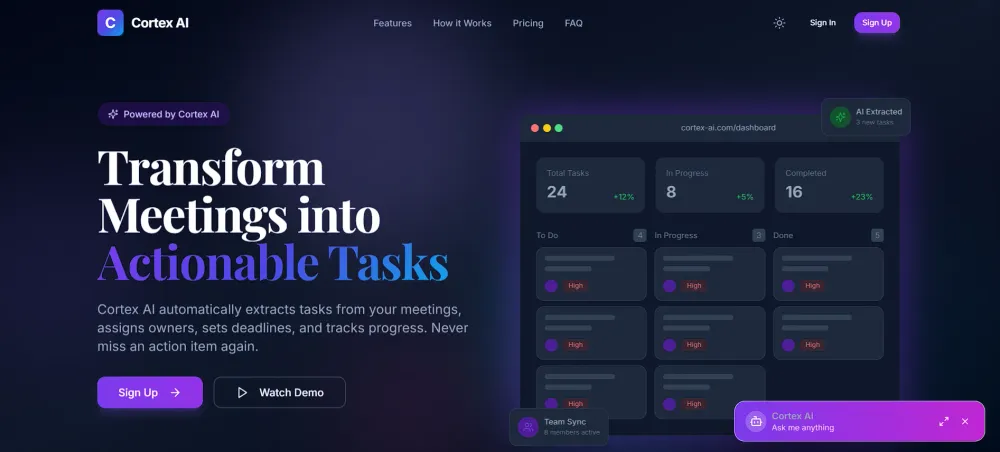
🏠 The Home Page
This is where it all starts. Clean. Focused. One promise — your meetings become action automatically.
This is where it all starts. Clean. Focused. One promise — your meetings become action automatically.

✨ Everything your team needs, built into one platform
AI Task Extraction. Real-time Processing. Smart Assignment. Analytics. Slack Integration. Deadline Management — all connected, all automated.
AI Task Extraction. Real-time Processing. Smart Assignment. Analytics. Slack Integration. Deadline Management — all connected, all automated.

🔗 Works with the tools your team already uses
Zoom. Google Meet. Microsoft Teams. Slack. Notion. Jira. Connect once — Cortex works everywhere you already work.
Zoom. Google Meet. Microsoft Teams. Slack. Notion. Jira. Connect once — Cortex works everywhere you already work.

⚙️ Connect your meetings in one click
Install the Chrome extension. Connect Zoom, Google Meet, or Microsoft Teams. Or upload transcripts manually. Get started in minutes.
Install the Chrome extension. Connect Zoom, Google Meet, or Microsoft Teams. Or upload transcripts manually. Get started in minutes.

🤖 AWS Bedrock extracts every action item automatically
Our AI powered by Amazon Bedrock analyzes conversations and identifies actionable tasks with context. 95% accuracy. Smart assignee suggestions. Automatic deadline detection.
Our AI powered by Amazon Bedrock analyzes conversations and identifies actionable tasks with context. 95% accuracy. Smart assignee suggestions. Automatic deadline detection.

📋 Track and complete on your Kanban board
Tasks appear in your Kanban board automatically. Assign. Track. Complete. Real-time collaboration. Smart reminders and notifications.
Tasks appear in your Kanban board automatically. Assign. Track. Complete. Real-time collaboration. Smart reminders and notifications.

📊 The Dashboard — your team's command center
Every ticket, every priority, every team member's workload — visible in one view. None of this was typed manually. Cortex created every item from real meeting conversations.
Every ticket, every priority, every team member's workload — visible in one view. None of this was typed manually. Cortex created every item from real meeting conversations.

🗓️ Meetings — every conversation logged and processed
Every meeting recorded and transcribed. Chrome Extension captures live captions automatically from Zoom, Google Meet, and Teams. Upload transcripts manually when needed.
Every meeting recorded and transcribed. Chrome Extension captures live captions automatically from Zoom, Google Meet, and Teams. Upload transcripts manually when needed.

📈 Analytics — full visibility into your team's performance
Total tickets. Completion rate. Average resolution time. Tasks from meetings. Ticket trends and status distribution — all in real time, across every time zone.
Total tickets. Completion rate. Average resolution time. Tasks from meetings. Ticket trends and status distribution — all in real time, across every time zone.

💬 The AI Chatbot — powered by AWS Bedrock
Ask anything. Create anything. Find anything. In plain English. Create tickets, show analytics, search tasks, summarize meetings — it doesn't suggest. It acts.
Ask anything. Create anything. Find anything. In plain English. Create tickets, show analytics, search tasks, summarize meetings — it doesn't suggest. It acts.

🎙️ The Chrome Extension — live inside Google Meet
The extension sits invisibly inside your meeting. The moment you join — Cortex is ready. Capturing every decision in real time. No audio recording. No privacy concerns. Zero behavior change.
The extension sits invisibly inside your meeting. The moment you join — Cortex is ready. Capturing every decision in real time. No audio recording. No privacy concerns. Zero behavior change.

What I Learned
The problem I was solving was smaller than the problem I found.
I built Cortex AI because I personally missed a critical task and faced the consequence. What I discovered while building it is that this happens to every professional, every day, at every company — and every tool everyone uses has the same structural blind spot: they all exist around the meeting, never inside it.
🔑 AWS Bedrock changes the AI economics entirely.
Pay-per-use. No idle cost. No vendor renegotiation at scale. When every AI inference is a cost center, building on Bedrock means your unit economics are correct from day one — not something you fix later when the bill arrives.
Pay-per-use. No idle cost. No vendor renegotiation at scale. When every AI inference is a cost center, building on Bedrock means your unit economics are correct from day one — not something you fix later when the bill arrives.
🔑 The Chrome extension is the real product.
The dashboard, board, analytics, and chatbot are all valuable. But the extension is what makes Cortex automatic — it removes the human from the critical path entirely. In B2B software, the tool that requires the least behavior change wins adoption. The tool that requires zero wins the category.
The dashboard, board, analytics, and chatbot are all valuable. But the extension is what makes Cortex automatic — it removes the human from the critical path entirely. In B2B software, the tool that requires the least behavior change wins adoption. The tool that requires zero wins the category.
🔑 The hardest problem was not AI — it was 2 seconds.
Getting a caption from a browser extension into an assigned, categorized ticket reliably under 2 seconds required designing every layer for latency, not just correctness. Caption deduplication, streaming architecture, real-time board updates — those were the engineering problems. The Bedrock call was step 4 of a 6-step pipeline. AI was the easy part.
Getting a caption from a browser extension into an assigned, categorized ticket reliably under 2 seconds required designing every layer for latency, not just correctness. Caption deduplication, streaming architecture, real-time board updates — those were the engineering problems. The Bedrock call was step 4 of a 6-step pipeline. AI was the easy part.
🔑 Institutional knowledge has a half-life. Most teams don't measure it.
Every meeting generates decisions and context that start decaying the moment the call ends. The teams that instrument their meetings the way they instrument their code will have a compounding advantage that only grows over time. Cortex is that instrumentation layer.
Every meeting generates decisions and context that start decaying the moment the call ends. The teams that instrument their meetings the way they instrument their code will have a compounding advantage that only grows over time. Cortex is that instrumentation layer.
🔑 Spec-driven development produces better architecture — not just faster code.
Writing requirements before implementation forces the hard design decisions upfront — before the code makes them for you. The spec is the contract. The code is the output. Every time I was tempted to skip the spec and just build, Kiro pulled me back. Every time, it was right.
Writing requirements before implementation forces the hard design decisions upfront — before the code makes them for you. The spec is the contract. The code is the output. Every time I was tempted to skip the spec and just build, Kiro pulled me back. Every time, it was right.
The gap between what your team discusses and what your team delivers is costing you more than you think.
Every missed ticket is a delayed feature.
Every forgotten follow-up is a broken commitment.
Every "I thought someone else was handling it" is a system failure — not a people failure.
Every forgotten follow-up is a broken commitment.
Every "I thought someone else was handling it" is a system failure — not a people failure.
Cortex AI exists because that system deserves to be fixed.
Not with another reminder app. Not with a better note-taking tool. With AI that lives inside your meeting — capturing every decision, creating every ticket, assigning every task — before you even click Leave.
🎙️ Your meeting starts. Cortex listens.
⚡ AI extracts every action item. Your board updates.
📋 Every task is assigned. Your team is aligned.
💬 Your AI chatbot handles the rest. Nothing falls through.
⚡ AI extracts every action item. Your board updates.
📋 Every task is assigned. Your team is aligned.
💬 Your AI chatbot handles the rest. Nothing falls through.
✨ This is what meetings look like when nothing is forgotten.
Enjoyed reading this content? Let the author know!
Your likes, comments, shares, and saves help creators reach more builders.

Loading recommendations
Loading article