
Taxia - Amazon Nova AI Hackathon
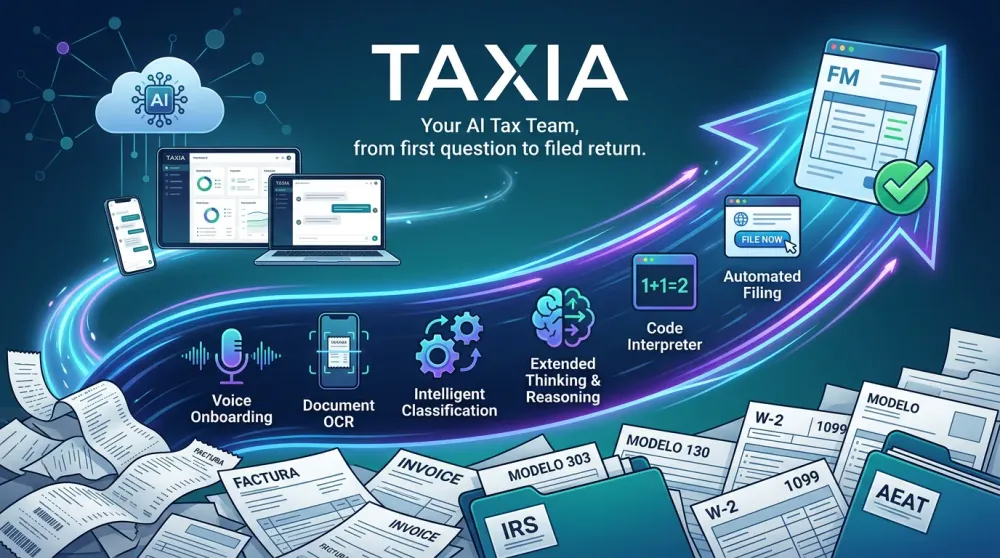
Taxia The AI gestor that handles your taxes end-to-end — for individuals, startups, and finance

How TAXIA is using Amazon Nova to make tax compliance accessible for 500 million self-employed workers worldwide
Tags: Amazon-Nova, AI, Hackathon, Tax-Compliance, Agentic-AI, Voice-AI, Multimodal
Tax compliance is not a technology problem. It is an inequality problem.
Around the world, roughly 500 million people work for themselves — freelancers, gig workers, small business owners, market vendors, independent contractors. In the United States alone, 64 million Americans freelanced in 2023. In Spain, 3.4 million autónomos navigate a tax system that requires quarterly filings across multiple forms. In Brazil, 25 million microempreendedores individuais face obligations they often don't fully understand.
These workers share something in common: they are responsible for their own tax compliance, but they rarely have the knowledge, time, or money to do it correctly. A professional tax advisor in the US charges between $200 and $500 per return. In Spain, a gestoría charges €50 to €150 per month. For a freelance graphic designer earning €18,000 a year, that's a painful percentage of their income.
The consequence is predictable. People file late, file incorrectly, or don't file at all. They overpay because they miss deductions they're entitled to. They underpay and face penalties that can reach 150% of the owed amount. They live with a low-grade anxiety that spikes every quarter when deadlines approach.
We built TAXIA to end that anxiety.
What TAXIA does
TAXIA is an AI-powered tax compliance platform that handles the entire tax lifecycle — from the first question a user asks ("Do I need to file quarterly?") to the final submission on the government portal. It serves three audiences:
Individuals connect their bank accounts, upload their documents, and talk to an AI assistant that understands tax law. TAXIA classifies their transactions, calculates their obligations, generates the required forms, and files them automatically.
Small businesses and startups get a fractional AI tax department. TAXIA onboards the entity, understands its jurisdiction and activity type, monitors deadlines, and handles filings — reducing compliance costs by up to 80% compared to hiring a firm.
Tax professionals (gestores in Spain, accountants elsewhere) use TAXIA as a practice management platform. One login manages all their clients, with AI handling the data processing while the professional reviews and approves. A solo practitioner can scale from 20 clients to 200.
The platform is multilingual (7 languages), voice-first (you can talk to it instead of typing), and real-time (every action streams to your screen instantly).
Why Amazon Nova makes this possible
Before Amazon Nova, building a system like TAXIA would have required stitching together a dozen separate AI services — an OCR tool for receipts, a speech-to-text engine plus a text-to-speech engine for voice, a reasoning model for calculations, a search engine for tax law, and a browser automation framework for filing. Each integration point is a potential failure. Each service has its own pricing model, latency characteristics, and reliability profile.
Amazon Nova changes this equation fundamentally. Four models within a single ecosystem cover every capability TAXIA needs:
Nova 2 Lite is our reasoning core. A single model handles text conversations, image analysis (receipt scanning), PDF understanding (W-2 extraction), video comprehension (consultation summaries), tool calling (transaction classification), web grounding (live tax law updates), code interpretation (precise bracket calculations), and extended thinking (complex optimization like itemized vs. standard deduction analysis). Ten distinct capabilities in one model, accessed through one API.
Nova 2 Sonic delivers voice interactions that feel like calling a real accountant. It's a unified speech-to-speech model — not a chain of speech-to-text, then language model, then text-to-speech. This matters because it preserves tone, emotion, and conversational flow. When a user sounds stressed about an audit notice, Sonic responds with a calmer, more reassuring voice. When they're excited about a refund, it matches their energy. It supports seven languages and can switch mid-conversation without any lag — critical for immigrant communities navigating tax systems in a second language.
Nova Act automates the final mile that no other AI system handles: actually filing the return on the government portal. Traditional approaches stop at "here's your completed form" and leave the user to navigate a confusing government website. Nova Act opens the portal, fills every field, and submits — with a human approval checkpoint before the final click. For tax professionals managing dozens of clients, parallel Nova Act agents can file multiple returns simultaneously.
Nova Multimodal Embeddings powers a tax knowledge base that searches across text, images, documents, video, and audio in a single query. A user can ask "What are the home office deduction requirements?" and the system retrieves relevant IRS publications, related receipt images, and video tutorial segments — all from one unified search.
The cost efficiency is equally important. Nova 2 Lite delivers frontier-level reasoning at a fraction of the cost of comparable models. For a product serving price-sensitive freelancers, this is the difference between a viable business and an unsustainable one.
The communities TAXIA serves
Immigrant entrepreneurs navigating unfamiliar tax systems
When someone moves to a new country to work, the tax system is one of the most intimidating barriers they face. The rules are complex, the language is unfamiliar, the penalties for mistakes are severe, and affordable help is hard to find.
TAXIA's voice-first, multilingual design addresses this directly. A Colombian developer who moved to Spain can call TAXIA and ask, in Spanish, "I just started freelancing here — what do I need to file?" The system conducts a natural conversation, builds their tax profile, identifies their obligations (Modelo 036 for registration, Modelo 303 for quarterly VAT, Modelo 130 for estimated income tax), and walks them through each step. If they switch to English for technical terms, Nova 2 Sonic follows seamlessly.
This is not a convenience feature. It is an accessibility feature. According to the OECD, immigrants are 50% more likely to be self-employed than native-born residents, yet they are significantly less likely to seek professional tax help due to cost and language barriers. TAXIA eliminates both barriers simultaneously.
Freelancers and gig workers living paycheck to paycheck
The gig economy has created tens of millions of workers who are technically self-employed but have none of the infrastructure that self-employment traditionally required. A rideshare driver, a food delivery courier, a freelance writer on Fiverr — they all have tax obligations, but many don't know what those obligations are until a penalty notice arrives.
TAXIA's bank transaction classification is designed for this user. Connect your bank account (or upload a CSV), and Nova 2 Lite's tool-calling capability classifies every transaction: this ride was a business expense, this coffee was personal, this software subscription is deductible. The system builds a complete picture of deductible expenses that most gig workers miss entirely.
In the US, the average freelancer overpays by an estimated $1,200 per year simply because they miss legitimate deductions. For someone earning $35,000 a year, that $1,200 represents groceries for nearly two months.
Small businesses in developing economies
In emerging markets, tax compliance is often the single biggest barrier to formalization. A street vendor in Mexico City or a small shopkeeper in São Paulo may avoid registering their business entirely because the compliance burden seems overwhelming. This keeps them in the informal economy, locked out of business loans, government programs, and legal protections.
TAXIA's voice-first onboarding removes the literacy barrier. You don't need to read a form or navigate a website. You talk to the assistant, answer questions about your business, and it handles the rest. Nova 2 Lite's image analysis means you can photograph handwritten receipts and invoices — common in informal economies — and the system extracts the data accurately.
The cost structure makes this viable. Nova 2 Lite's pricing means we can serve a user's entire annual tax preparation for under $2 in AI costs. Combined with a freemium model for individual users, this puts professional-grade tax compliance within reach of anyone with a smartphone.
Tax professionals scaling their practices
In Spain, a typical gestoría (tax management firm) has 2-3 staff members managing 50-100 clients. Most of their time is spent on data entry — copying numbers from bank statements into spreadsheets, from spreadsheets into tax forms, from tax forms into the Agencia Tributaria portal. It is tedious, error-prone, and low-margin work.
TAXIA transforms this practice model. The AI handles data extraction, classification, calculation, and filing. The gestor reviews, approves, and advises — the high-value work they were trained for. Nova Act's parallel filing capability means 10 client returns can be filed simultaneously, each with its own approval checkpoint.
The impact compounds. A gestor who can serve 200 clients instead of 50 can reduce per-client fees while increasing their own income. Lower fees make professional help accessible to clients who previously couldn't afford it. The entire ecosystem gets more efficient.
Real-world application: how TAXIA works in practice
Scenario 1: Maria, freelance designer in Barcelona
Maria is a 28-year-old UX designer from Colombia who moved to Barcelona two years ago. She works with clients in Spain, the US, and Colombia. She earns approximately €42,000 per year and is registered as an autónoma.
Before TAXIA: Maria pays a gestoría €120/month (€1,440/year) to handle her quarterly filings. She collects receipts in a shoebox, photographs them at the end of each quarter, and emails them to her gestor. She has no visibility into her tax situation until the gestor sends her the quarterly summary. She once missed a deduction for her coworking space membership because she forgot to include the receipt.
With TAXIA: Maria opens the app and photographs receipts as they happen — restaurant meals with clients, coworking invoices, software subscriptions. Nova 2 Lite extracts the data instantly and classifies each expense. At any moment, she can ask (by voice, in Spanish) "How much VAT do I owe this quarter?" and get an accurate answer. When filing day arrives, she reviews the pre-filled Modelo 303, approves it, and Nova Act submits it to the Agencia Tributaria portal in under two minutes. Annual cost: under €200. Annual savings: over €1,200. Deductions captured: 100%.
Scenario 2: James, rideshare driver in Atlanta
James drives for a rideshare platform 40 hours per week and earns approximately $38,000 per year. He receives a 1099-NEC at year end. He has been filing his own taxes using a consumer tax software but consistently misses deductions for vehicle expenses, phone costs, and car washes.
With TAXIA: James connects his bank account. TAXIA classifies his transactions automatically: gas purchases, car maintenance, phone bills (proportional business use), car washes, tolls — all flagged as deductible. Nova 2 Lite's extended thinking calculates his optimal mileage deduction (standard mileage rate vs. actual expenses). His tax preparation happens continuously throughout the year, not in a stressful weekend in April. Estimated additional deductions captured: $3,200 per year. At his marginal rate, that represents approximately $700 in tax savings.
Scenario 3: Antonio, gestor in Madrid
Antonio runs a small gestoría with one assistant. They manage 65 client accounts — a mix of autónomos and small businesses. Every quarter, they spend approximately 4 full days on data entry and portal submissions.
With TAXIA: Antonio onboards his clients into TAXIA's multi-tenant system. Each client uploads their own documents (or TAXIA pulls transactions from their connected bank). The AI classifies, calculates, and prepares filings for all 65 clients. Antonio reviews each one in a dashboard that highlights anomalies and potential issues. When he approves, Nova Act files them — 10 at a time — while he moves on to advisory work. Quarterly filing time: 4 hours instead of 4 days. Capacity to take on new clients: doubled. Revenue impact: +40% annual income at the same workload.
Plan for encouraging adoption
Phase 1: Hackathon to MVP (months 1-3)
Our immediate focus is converting the hackathon prototype into a production-ready MVP targeting Spain's autónomo market. Spain is our beachhead for three reasons: the quarterly filing cadence creates recurring urgency (users need help every 3 months, not once a year), the gestoría ecosystem provides a clear B2B channel, and team members have direct experience with the Spanish tax system.
We will launch a closed beta with 50 freelancers recruited through coworking spaces in Madrid and Barcelona. Success metric: 80% of beta users complete at least one quarterly filing through TAXIA with zero errors.
Phase 2: Open access and community building (months 3-6)
We will launch a freemium tier for individual users: free tax Q&A and transaction classification, paid filing automation. This ensures that anyone can benefit from TAXIA's knowledge capabilities regardless of their ability to pay.
We will partner with freelancer communities and coworking networks — WeWork, Spaces, local independent spaces — to offer onboarding workshops. The voice-first experience makes these workshops immediately engaging: attendees can ask their actual tax questions and get answers on the spot.
We will publish a series of "Tax guides for freelancers" on builder.aws.com and community blogs, using TAXIA to generate jurisdiction-specific guides. This establishes credibility and drives organic discovery.
Phase 3: Gestor network and geographic expansion (months 6-12)
The B2B gestor channel is our growth engine. Every gestor who adopts TAXIA brings their entire client portfolio onto the platform. We will offer a free trial period for tax professionals with a success-based pricing model: they pay only when TAXIA successfully files a return.
Geographic expansion follows the same playbook: identify a market with frequent filing obligations (quarterly VAT is ideal), recruit local tax professionals, localize the knowledge base and Nova Act filing workflows, and launch. Priority markets: Portugal, Germany (ELSTER system), UK (HMRC Making Tax Digital), and Mexico (SAT).
Phase 4: Bank partnerships and embedded distribution (months 12-24)
The ultimate distribution channel is embedded: TAXIA as a feature within banking apps, accounting software, and freelancer platforms. When a freelancer opens their banking app and sees "You have 12 new transactions — TAXIA classified 8 as deductible business expenses. View your estimated quarterly tax," the adoption friction drops to zero.
We will pursue partnerships with neobanks serving freelancers (N26, Revolut, Mercury) and accounting platforms (Wave, FreshBooks) to embed TAXIA's classification and calculation engine via API.
Measuring community impact
We define success not by revenue but by measurable impact on the communities we serve:
- Deductions recovered: Total dollar amount of legitimate deductions that TAXIA identified and users would have otherwise missed. Target: $1M aggregate in year one.
- Filing accuracy: Percentage of TAXIA-prepared returns that pass without errors or audit flags. Target: 99.5%.
- Time saved: Hours of tax preparation time eliminated for individuals and professionals. Target: 100,000 hours in year one.
- Accessibility reach: Number of users filing in a non-native language or using voice as their primary interface. Target: 30% of user base.
- Cost reduction: Average per-user savings compared to traditional tax preparation. Target: 70% reduction.
- Formalization impact: Number of users who register a business or formalize their tax status for the first time with TAXIA's help. This is the hardest metric to measure but the most meaningful — every worker who moves from informal to formal economy gains access to loans, insurance, social security, and legal protections.
Why this matters beyond taxes
Tax compliance is a proxy for a larger challenge: the gap between institutional complexity and individual capability. Governments create rules that are rational at the system level but overwhelming at the individual level. Tax codes, immigration procedures, healthcare enrollment, business licensing — they all share the same structure: critical obligations with severe consequences for non-compliance, buried in complexity that disproportionately burdens those with the fewest resources.
Amazon Nova's multi-model architecture — reasoning, voice, vision, automation, and search working together — is the first AI platform that can address this challenge end-to-end. Not just answering questions about tax law (any chatbot can attempt that), but reading your actual documents, understanding your actual financial situation, calculating your actual obligations, and filing your actual return on the actual government portal. The full loop, closed.
TAXIA starts with taxes because the need is urgent, the market is large, and the impact is measurable. But the architecture we've built — voice-first onboarding, multimodal document processing, knowledge-grounded reasoning, and browser-automated government interaction — applies to any domain where complex institutional requirements meet underserved populations.
If we can make tax compliance feel effortless, we can make a lot of other things feel effortless too.
TAXIA was built during the Amazon Nova AI Hackathon 2026 using Nova 2 Lite, Nova 2 Sonic, Nova Act, and Nova Multimodal Embeddings. The platform is built with NextJS, Rust, and Python (Strands Agents SDK).
#AmazonNova
About the team: We are a full-stack team of engineers and designers with personal experience navigating tax systems across Colombia, Spain, and the United States. We built TAXIA because we needed it ourselves.
Enjoyed reading this content? Let the author know!
Your likes, comments, shares, and saves help creators reach more builders.

Loading recommendations
Loading article