
How ZeroCharge Is Using Amazon Nova to Silently Fight a $273-a-Year Problem Nobody Talks
Stop paying for forgotten free trials. Learn how we built an autonomous agent using Amazon Nova that monitors your inbox and navigates web UIs to cancel subscriptions entirely on your behalf.


Every month, millions of people get charged for something they forgot they signed up for. Not because they wanted the product. Not because they made a conscious decision to keep paying. But because a free trial quietly expired, a calendar reminder got buried, or life simply got in the way. The charge shows up on a statement, they feel a flash of frustration, they mean to dispute it and then they forget to do that too.
This isn't a niche problem. It's a near-universal one. And it's the problem that ZeroCharge was built to solve.
The Quiet Tax on Attention
The subscription economy has grown enormously over the last decade. Streaming services, SaaS tools, newsletters, cloud storage tiers, fitness apps, each one starts with a free trial and ends with a charge if you don't act in time. For individuals, this adds up to an estimated $273 per year in unwanted subscription costs. For small businesses juggling dozens of SaaS tools, the figure is substantially higher.
The mechanism behind this system is deliberate friction. Cancellation flows are buried behind multiple confirmation screens, account settings tabs, and dark patterns specifically designed to increase the cognitive load of leaving. Even motivated users struggle. Distracted ones have no chance.
ZeroCharge flips this dynamic. Instead of requiring users to fight through cancellation flows themselves, it dispatches an autonomous AI agent to do it on their behalf, the moment the trial confirmation email arrives, before a single charge can land.
Who This Is For
The communities that benefit most from ZeroCharge are not the ones you might expect to be the most technically sophisticated:
Students and young adults signing up for free trials of productivity tools, design software, and entertainment services often on tight budgets where a single unexpected $15 charge is genuinely disruptive.
Freelancers and solo operators who evaluate new SaaS tools constantly as part of their workflow. A developer testing three different deployment platforms in a month has three separate billing clocks ticking. ZeroCharge lets them evaluate freely without the cognitive overhead of tracking cancellation windows.
Small and medium businesses where no single person owns the full inventory of active software trials. Finance doesn't know what engineering signed up for last Tuesday. ZeroCharge creates an automatic audit trail of intercepted charges before they become line items to dispute.
How It Works: The Three-Layer Pipeline
ZeroCharge is built on two Amazon Nova models working in sequence, orchestrated by a FastAPI backend and a Next.js dashboard.
Layer 1: Understanding — Amazon Nova 2 Lite
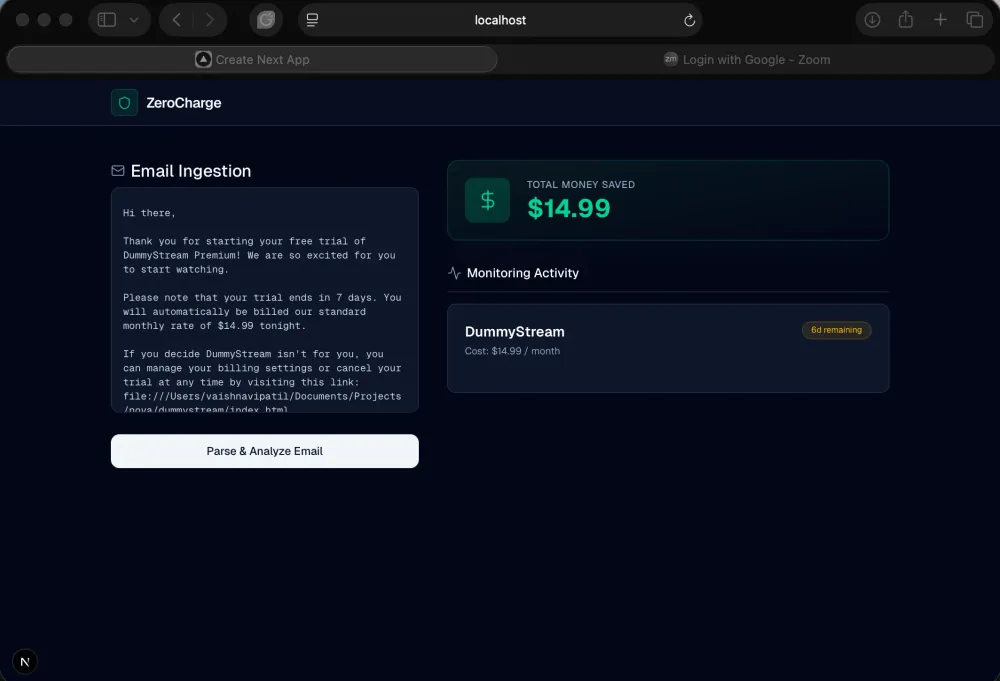
When a trial confirmation email arrives, ZeroCharge sends the raw text to Amazon Nova 2 Lite via Amazon Bedrock. The model parses unstructured marketing language and returns clean structured data: vendor name, monthly cost, cancellation URL, and trial end date - all from a single prompt, with no brittle regex or vendor-specific scrapers to maintain.
Layer 2: Acting — Amazon Nova Act
When the cancellation window arrives, Amazon Nova Act opens the vendor's cancellation page and navigates the flow autonomously. It reads the live DOM, reasons about UI state, clicks the right buttons, handles confirmation modals, and returns a verified success signal, all without a single hardcoded selector.
This is the part that makes ZeroCharge genuinely different from a reminder app or a browser extension. It doesn't ask you to do anything. It acts for you. The cancellation happens whether you're in a meeting, asleep, or simply don't feel like dealing with it.
Layer 3: Confirming — The Feedback Loop
The success signal propagates back to the user dashboard. When Nova Act confirms the cancellation, the card flips green, the "Total Money Saved" counter updates, and the user has a permanent record of every charge that didn't happen. The loop is closed - no ambiguity, no wondering if it worked.
Real-World Applications
The architecture ZeroCharge demonstrates has implications well beyond personal subscription management.
Enterprise SaaS governance. Large organizations routinely pay for software licenses that went unused after an employee left or a project ended. An agentic pipeline that monitors procurement inboxes, extracts trial data, and autonomously manages cancellation flows could save enterprises thousands of dollars annually and create compliance-friendly audit trails automatically.
Consumer financial protection. Banks and fintech apps already flag suspicious charges after the fact. ZeroCharge suggests a different model: prevent the charge before it lands. A "trial guardian" feature built into a banking app powered by inbox monitoring and autonomous cancellation would be a meaningful differentiator in an industry where most innovation is UI-deep.
Accessibility tooling. For users with cognitive disabilities, ADHD, or anyone who struggles with the administrative overhead of modern digital life, autonomous agents that manage recurring obligations represent a genuine quality-of-life improvement. ZeroCharge is an early proof-of concept for a much broader class of "life admin" automation.
The Adoption Plan
Building something that works is the easy part. Getting people to trust an autonomous agent acting on their behalf is a harder problem and one worth thinking carefully about.
Phase 1: Direct User Trust (Now)
The current ZeroCharge dashboard is designed to make the agentic loop legible. Users see the email get parsed. They see the countdown. They watch the amber "Agent navigating UI…" indicator pulse. They see the card flip green with a timestamped confirmation. Every step of the autonomous process is surfaced, not hidden.
This transparency is not just good UX, it's the foundation of user trust. People will delegate to an agent they can watch. They are far less willing to delegate to a black box.
Phase 2: Gmail Integration (Next)
The biggest friction point in the current flow is the email paste. Removing that via Gmail OAuth transforms ZeroCharge from a tool you use into a system that works in the background. A user connects their inbox once, sets their preferences (cancel everything, ask me first, cancel only above $X/month), and ZeroCharge handles the rest.
This is the architecture of a genuinely ambient service: invisible when there's nothing to do, and acting quietly on your behalf when there is.
What Amazon Nova Made Possible
It's worth being direct about what the Amazon Nova stack specifically enabled here because ZeroCharge is not a project that could have been built the same way two years ago.
Nova 2 Lite made email parsing a prompt, not an engineering project. The model handles the full linguistic diversity of marketing emails, different date formats, different phrasings of cost, different ways of describing a trial period without a line of custom extraction code.
Nova Act made cancellation a capability, not a feature. A traditional automation approach would require vendor-specific scripts, hardcoded selectors, and constant maintenance as UIs change. Nova Act reads the live page and reasons about it, which means it generalizes across vendors by default.
Together, they form a pipeline where understanding triggers action which is the fundamental pattern of useful agentic AI. ZeroCharge is a specific instance of that pattern. The pattern itself scales to any domain where an inbox event should autonomously produce a real-world outcome.
Conclusion
The subscription economy is not going away. If anything, the proliferation of AI-powered SaaS tools means the number of free trials the average person encounters is going to increase, not decrease.
ZeroCharge is a small answer to a large problem. It will not change the economics of the subscription industry. But for the student who can't afford an unexpected charge, the freelancer who evaluates tools constantly, the small business that doesn't have a procurement team, and the user who simply wants their digital life managed rather than managed at, it is a meaningful one.
The technology to build this has existed, in pieces, for years. Amazon Nova is what made it possible to assemble those pieces into something that actually works.
ZeroCharge was built during the Amazon Nova AI Hackathon.
Enjoyed reading this content? Let the author know!
Your likes, comments, shares, and saves help creators reach more builders.

Loading recommendations
Loading article