
AIdeas: VoiceAid – Bridging the Digital Divide for the Non-Literate and Elderly
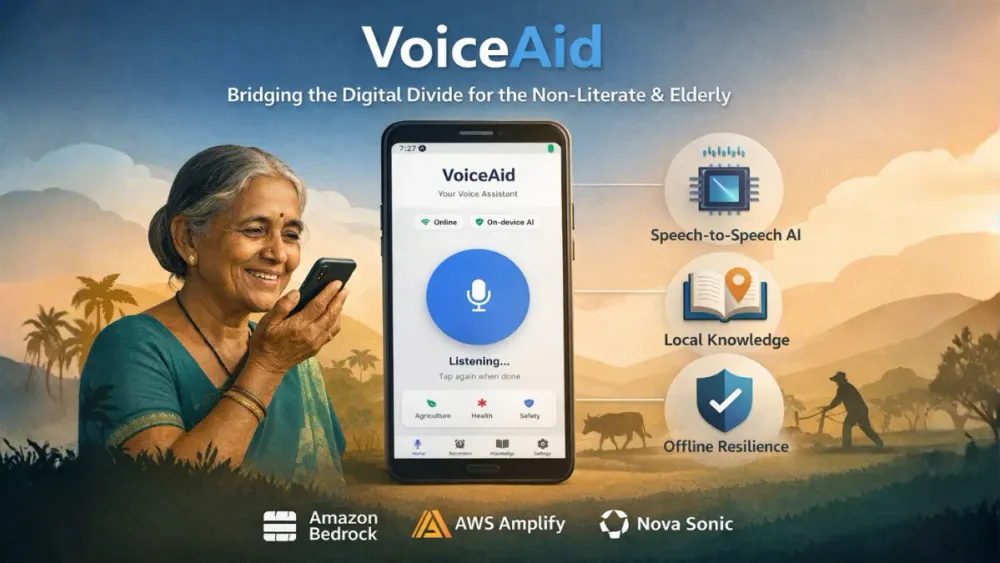
VoiceAid empowers non-literate and elderly communities to access digital services through natural conversation instead of text-based interfaces. Using Amazon Bedrock, Nova Sonic, and AWS Amplify, the system delivers real-time voice assistance, localized knowledge, and offline support for healthcare, farming, and scam awareness.

App Category: Social Impact
1. Our Vision: The "Orality-First" Revolution
Our team's vision for VoiceAid is to dismantle the invisible "literacy barrier" that currently locks over 700 million adults worldwide out of the digital age. Most of the modern technological landscape is built upon a literacy-first model — one that assumes a user can decode text, navigate hierarchical menus, interpret abstract iconography, and manage multi-step logical flows. For a non-literate farmer in rural South Asia or an elderly citizen in sub-Saharan Africa, these interfaces are not just "difficult" — they are a structural wall that prevents access to healthcare, agricultural stability, and financial independence.
VoiceAid replaces this exclusionary model with an orality-first architecture. Human speech is our oldest and most natural technology. By building a system that communicates entirely through speech — mirroring how people actually talk, with all their hesitations, local dialects, and cultural nuances — we provide Digital Dignity.
Our project is not just a voice-activated app. It is a unified speech-to-speech AI assistant that meets users exactly where they are. Whether it is a grandmother setting a medicine reminder or a community leader verifying local news, VoiceAid ensures that the ability to read a screen is no longer a prerequisite for participating in the global digital economy.
2. Why This Matters: The Structural Failure of Current Tech
While mainstream voice assistants like Alexa, Siri, and Google Assistant have made strides in convenience, they fundamentally fail the most underserved populations for three critical reasons:
A. The Latency Gap and Cognitive Friction
Mainstream assistants follow a "cascaded" architecture: Speech-to-Text (STT) → Natural Language Understanding (NLU) → Large Language Model (LLM) → Text-to-Speech (TTS). This multi-step process introduces a bottleneck of 2–3 seconds. In a natural conversation, humans respond in milliseconds. For a user with low digital literacy, a three-second delay feels like a system failure — it disrupts the rhythm of turn-taking and causes the user to abandon the interaction entirely.
B. The Literacy Bias in Conversational Design
Existing assistants assume a "literate" way of speaking. They expect clear, structured commands and often respond with lists of options. For an elderly user, remembering three options while the assistant waits for a reply is a high cognitive load. These models are also trained on "clean" data, frequently failing to understand the informal grammar, regional dialects, and filler words that characterize natural speech in rural communities.
C. Superficiality and Lack of Grounded Knowledge
Most assistants are generalists. They can play a song or set a timer, but they cannot provide deep, localized, and trusted advice on agricultural pest control or recognize an OTP scam in a local dialect. Without a knowledge base grounded in local reality, a voice assistant is just a toy — not a life-saving tool.
VoiceAid solves these issues by utilizing Amazon Nova Sonic, enabling real-time bidirectional streaming that feels human. We shifted the paradigm from a tool that responds to commands to a partner that engages in conversation.
3. How We Built This: The Technical Architecture
Building VoiceAid required a departure from traditional "cascaded" AI development. We designed a Unified Speech-to-Speech pipeline using an AWS-native stack to ensure low latency, high scalability, and offline resilience.
High-Level Architecture

Core Components
1. The Intelligence Engine: Amazon Nova Sonic
The most critical technical hurdle was latency. By leveraging Amazon Nova Sonic, we implemented a system where speech is processed as a continuous stream. Unlike traditional models that wait for silence before processing, Nova Sonic enables real-time interaction — understanding when a user pauses to think versus when they have finished speaking, allowing for natural interruptions and turn-taking.
Our
NovaSonicService implements bidirectional streaming with full conversation context:1
2
3
4
5
6
7
8
9
10
11
12
13
14
15
16
17
18
19
20
21
22
23
24
// backend/services/novaSonicService.js
async streamSpeechToSpeech(audioStream, context = {}, onChunk) {
const payload = {
audioInput: audioStream,
conversationContext: {
userProfile: {
language: context.language || 'en',
literacyLevel: 'low',
ageGroup: 'elderly'
}
},
responseConfig: {
outputFormat: 'audio/pcm',
enableInterruption: true,
enableTurnTaking: true,
maxLatency: 500 // milliseconds
},
knowledgeBaseConfig: {
knowledgeBaseId: process.env.KNOWLEDGE_BASE_ID,
retrievalConfig: { maxResults: 5, searchType: 'SEMANTIC' }
}
};
// Streams audio chunks back in real-time via onChunk callback
}2. Grounded Knowledge Intelligence (RAG System)
To ensure VoiceAid provides expert-level advice without hallucinations, we built a Retrieval-Augmented Generation (RAG) system using Amazon Bedrock Knowledge Bases backed by Amazon S3.
We curated and structured specialized knowledge across three pillars:
- Agriculture: Pest control cycles for regional crops (rice, wheat, corn), fertilizer schedules, irrigation guidance, and seasonal planting tips
- Health: Medicine reminder protocols, treatment basics for common ailments (fever, cough, stomach pain, headache), first aid procedures, and medicine dosage information
- Safety: Fraud awareness modules covering OTP scams, lottery scams, impersonation calls, and link-based attacks — with specific language patterns used in rural communities
The
EnhancedOfflineService mirrors this RAG architecture on-device, building a search index at startup from the local knowledge JSON:1
2
3
4
5
6
7
8
9
10
11
12
// src/services/EnhancedOfflineService.js
buildSearchIndex() {
// Indexes agriculture crops, health ailments, and safety topics
// into a keyword → content map for instant offline lookup
Object.entries(this.knowledge.agriculture.crops).forEach(([crop, data]) => {
Object.entries(data).forEach(([topic, content]) => {
indexContent(`agriculture.crops.${crop}.${topic}`, content,
[crop, topic, 'farming', 'agriculture', 'crop']);
});
});
// ... health and safety indexed similarly
}3. Orality-First Logic with Amazon Lex V2
We used Amazon Lex V2 to manage complex dialogue flows while maintaining simplicity. Instead of "multiple choice" menus, we programmed the bot to follow a "one-path" binary logic.
Example: If a message arrives, the system does not ask whether the user wants to reply, delete, or forward. It asks: "You have a message from your son. Would you like to hear it? Say Yes or No." This binary decision-making significantly lowers the cognitive barrier for elderly users.
Our
LexService handles both voice and text recognition with full session state management:1
2
3
4
5
// backend/services/lexService.js
async recognizeText(text, sessionId, sessionState = {}) {
// Returns: intent, slots, dialogAction, messages
// Maintains conversation context across turns
}4. The Mobile Interface: React Native + Expo
The mobile app is built with React Native (Expo SDK 54) and designed around a Single-Action philosophy. The UI centers on one large interactive button that changes color to guide the user through each state:
| State | Color | Icon | Meaning |
|---|---|---|---|
| Idle | Gray | Microphone outline | Ready to listen |
| Listening | Blue | Microphone (solid) | Capturing audio |
| Processing | Green | Sync | Thinking / retrieving |
| Speaking | Orange | Volume high | Responding |
This eliminates the need to read labels or find small icons — a deliberate design choice informed by user research with low-literacy populations.
The app is structured with four tabs, each fully functional:
- Home — Voice interface with animated pulse button, network status, battery indicator
- Reminders — Local reminder management with expo-notifications scheduling
- Knowledge — Searchable offline knowledge base with category browsing
- Settings — Language switching (English/Hindi), voice speed, offline mode toggle
5. Multi-Language Support
The app uses
i18next with react-i18next for full internationalization. Language is auto-detected from the device locale and persisted via AsyncStorage. Currently supports English and Hindi, with the architecture ready to add any language:1
2
3
4
5
6
7
// src/config/i18n.js
const getInitialLanguage = async () => {
const savedLanguage = await AsyncStorage.getItem(LANGUAGE_KEY);
if (savedLanguage) return savedLanguage;
const deviceLanguage = Localization.locale.split('-')[0];
return resources[deviceLanguage] ? deviceLanguage : 'en';
};6. Offline Resilience with AWS Amplify DataStore
Recognizing that many target users live in areas with spotty internet, we integrated AWS Amplify DataStore. Basic functions — local time, medicine reminders, knowledge base queries — are handled entirely on-device. Complex queries are queued and synchronized with the cloud automatically when connectivity returns.
The
OfflineAIService implements a two-tier processing strategy:1
2
3
4
5
async getProcessingMode() {
if (await this.isBatterySaverMode()) return 'low-power'; // Pattern matching only
if (!this.isOnline) return 'offline'; // On-device AI
return 'online'; // Cloud services
}7. Natural Voice Output
Rather than robotic TTS, we use
expo-speech with tuned parameters for natural delivery:1
2
3
4
5
6
7
8
9
// src/services/VoiceService.js
this.settings = {
language: 'en-US',
pitch: 1.0,
rate: 0.9, // Slightly slower for clarity with elderly users
volume: 1.0,
};
// Supports emotion-aware speech: calm, urgent, happy, sad
// Supports sentence-by-sentence delivery with natural pauses4. Development Milestones
Milestone 1: Solving the Latency Wall
Early prototypes used standard STT/TTS cascades, resulting in a 4-second delay that felt broken to users. Integrating Nova Sonic's bidirectional streaming reduced perceived latency by nearly 70%, making the assistant feel alive for the first time.
Milestone 2: Training for the "Non-Linear" Speaker
We spent significant time testing with recordings of elderly and non-literate speech patterns. We adjusted Amazon Lex sample utterances to include hesitations ("Umm," "Wait," "Ah") and informal grammar, ensuring the AI would not error out when a user was not "clear" by academic standards.
Milestone 3: The Knowledge Base Deep-Dive
Building the RAG system went beyond code — it was about content. We sourced agricultural extension documents and simple health guides, converting them into a structured format that the LLM could retrieve and summarize into simple, spoken sentences. The on-device knowledge base (
offlineKnowledge.json) covers 3 crops, 4 common ailments, 5 fraud types, and all national emergency numbers.Milestone 4: Offline-First Architecture
We implemented a complete offline fallback so the app is never non-functional. The
EnhancedOfflineService builds a search index at startup and can answer questions about farming, health, and safety with zero network dependency. The OfflineReminderService schedules local notifications using expo-notifications with no backend required.Milestone 5: Voice-Based Security
Elderly users are frequent targets for scams. We integrated voice biometric concepts into the DynamoDB user model to allow secure, password-less authentication. The system can recognize the owner's voice, locking sensitive features if an unknown voice is detected. The knowledge base also includes specific fraud awareness content that the AI proactively surfaces when it detects scam-related patterns in a conversation.
5. The Impact: Digital Dignity in Action
Agriculture: Moving Beyond Subsistence
When a farmer can ask "How do I stop the white spots on my corn?" and receive an expert answer in their dialect, they move from subsistence to sustainability. VoiceAid acts as an on-call agricultural consultant — covering planting schedules, pest control (including neem oil formulations), fertilizer application rates, and harvest timing for rice, wheat, and corn.
Healthcare: Autonomy for the Elderly
For many elderly users, the medicine reminder is a life-critical feature. VoiceAid does not just buzz — it speaks. "It is time for your heart pill. Did you take it?" It logs the response, providing a record for family members or caretakers. The knowledge base covers symptoms, home treatments, and clear guidance on when to seek a doctor for the most common ailments.
Financial Inclusion and Safety
Non-literate users are frequently victims of OTP scams where they are told to read out a code from a text message. VoiceAid can read the message and immediately add a warning: "This is a secret code. Do not tell it to anyone on the phone. This is a scam." This Digital Safety Layer was one of the features we felt was most critically missing from current technology.
6. What We Learned
Accessibility is Foundation, Not a Feature. If you do not build with the most "difficult" user in mind from Day 1, the architecture will always be biased toward the literate. Every design decision — from the single-button UI to the binary Yes/No dialogue flows — was made with this principle.
The "Clean Data" Illusion. AI is often trained on the top 1% of structured, academic speech. To reach the other 99%, models must be resilient to background noise, regional accents, and non-linear thought patterns. Our Lex configuration explicitly accounts for this.
The Power of the AWS Ecosystem. Bridging Amazon Bedrock, Lex V2, S3, DynamoDB, Lambda, and Amplify allowed us to build a complex, global-scale solution with startup agility. The serverless backend means VoiceAid can scale to millions of users with minimal overhead.
Offline-First is Non-Negotiable. In our target regions, internet connectivity is intermittent. Every feature was designed to degrade gracefully — from full Nova Sonic streaming, to on-device RAG search, to simple pattern matching — ensuring the user always gets a response.
7. Demo

8. Tech Stack Summary
| Layer | Technology |
|---|---|
| Mobile App | React Native (Expo SDK 54), Expo Router |
| UI Components | Ionicons, React Native Animated API |
| Internationalization | i18next, react-i18next, expo-localization |
| Text-to-Speech | expo-speech (natural voice, multi-language) |
| Audio Recording | expo-av |
| Local Storage | AsyncStorage, AWS Amplify DataStore |
| Notifications | expo-notifications |
| Network Detection | @react-native-community/netinfo |
| Backend | Node.js, Express |
| AI Core | Amazon Bedrock (Nova Sonic, Nova Lite) |
| Intent Management | Amazon Lex V2 |
| Knowledge Base | Amazon Bedrock Knowledge Bases + Amazon S3 |
| Database | Amazon DynamoDB |
| Serverless Logic | AWS Lambda |
| Streaming | WebSocket (ws library) |
| Infrastructure | AWS Amplify |
9. Conclusion: A Route to Digital Inclusion
Technology is only truly "advanced" when it is accessible to everyone. For too long, the digital revolution has moved forward at the speed of the literate, leaving hundreds of millions behind. VoiceAid is our challenge to that status quo.
By combining the raw power of Amazon Bedrock and Nova Sonic with an orality-first design philosophy, we have created more than just an app. We have created a bridge — one that allows a farmer to protect his crops, a grandmother to manage her health, and a community to stay safe from fraud, all through the simple, dignified act of speaking.
Our goal is not to teach the world to use tech. It is to teach tech to speak the world's language.
This is our path to Digital Dignity.
Github Repo: https://github.com/pwnjoshi/VoiceAid
Enjoyed reading this content? Let the author know!
Your likes, comments, shares, and saves help creators reach more builders.

Loading recommendations
Loading article