
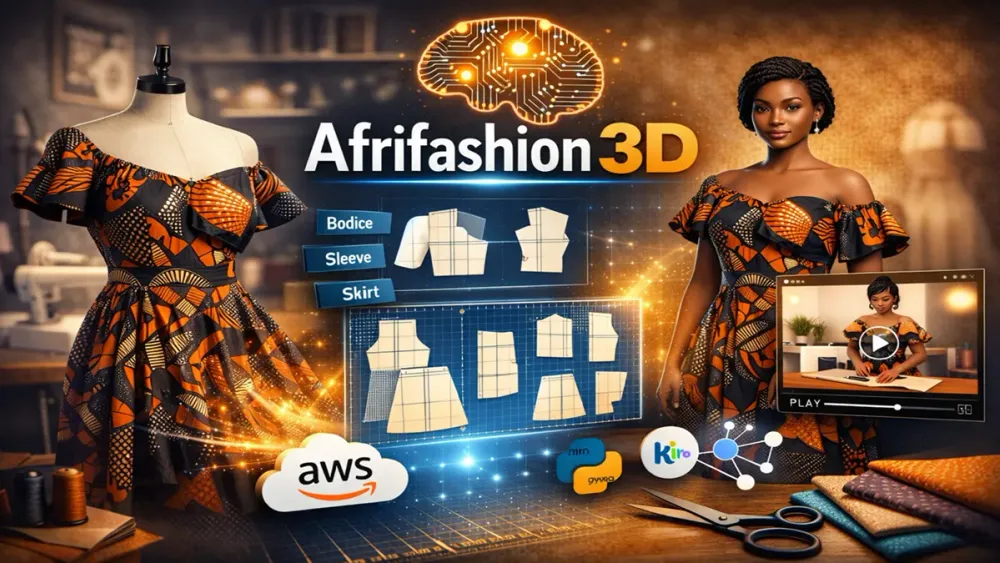
AIdeas: Afrifashion 3D - From Fashion Images to Sewing Patterns with AI
Afrifashion 3D is an AI-powered platform that analyzes garment images to identify clothing components, generate sewing pattern diagrams, and produce explainer videos that guide garment production. By combining generative AI with a scalable cloud architecture on AWS, the system helps designers and fashion businesses accelerate the process of turning garment ideas into manufacturable designs.

My Vision
The vision behind Afrifashion 3D is to transform how garments are designed and reproduced, especially in regions where fashion production is largely manual.
In many fashion markets, designers often recreate garments from reference photos or physical samples. This process is time-consuming, inconsistent, and heavily dependent on experience.
Afrifashion 3D aims to solve this by creating an AI-powered garment intelligence system that can:
- Identify garments from images
- Detect garment components
- Generate sewing pattern diagrams
- Produce explainer videos that show how garments can be made
By combining AI models with cloud infrastructure, Afrifashion 3D acts as a digital assistant for fashion production.
The goal is to make fashion manufacturing faster, smarter, and more accessible for designers and garment makers.
Why This Matters
Fashion is one of the largest industries in Africa, yet many designers still rely on manual methods for garment replication and pattern creation.
This creates several challenges:
- Reproducing garments from photos can take hours or days
- Pattern drafting requires specialized skills
- Training new tailors is slow
- Small fashion businesses struggle to scale
Afrifashion 3D addresses these problems by using AI to automate key parts of the garment production workflow.
With this system:
- Designers can upload a garment image
- The AI identifies the garment
- It detects garment components
- It generates a sewing pattern diagram
- It can even produce an AI-generated explainer video that demonstrates how the garment can be made.
This makes Afrifashion 3D a powerful commercial solution for fashion businesses, helping them move from manual processes to AI-assisted production workflows.
How I Built This
Afrifashion 3D was built using a modern cloud-native architecture on AWS, combining AI services with scalable serverless infrastructure.
Frontend
The frontend application was built using:
- React (Vite) for fast development and performance
- Hosted using AWS Amplify
- Source code managed using AWS CodeCommit
The interface allows users to:
- Upload garment images
- View detected garment components
- Generate pattern diagrams
- Watch AI-generated garment explainer videos
Backend
The backend was developed using:
- Python
- FastAPI
The API is deployed using:
- AWS Lambda
- Amazon API Gateway
This serverless architecture ensures the system can scale efficiently while keeping operational costs low.
Storage and Database
The project uses the following AWS services for storage:
Amazon S3
- Stores uploaded garment images
- Stores generated pattern diagrams
- Stores generated explainer videos
Amazon DynamoDB
- Stores garment metadata
- Stores processing results
- Tracks garment analysis workflows
AI and Machine Learning Services
Several generative AI services power Afrifashion 3D.
Amazon Bedrock
Used for:
- Garment identification
- Garment component detection
This allows the system to analyze garment images and determine structural elements such as sleeves, collars, panels, and seams.
Stable Diffusion 3.5 Large
Used for:
- Generating sewing pattern diagrams
Based on the garment analysis, the model generates visual pattern representations that designers can follow when cutting fabrics.
Amazon Nova Reel
Used for:
- Generating AI explainer videos from the sewing pattern diagram
These videos demonstrate how the garment can be constructed, helping tailors understand the sewing process more easily.
Workflow Orchestration
The entire AI workflow is orchestrated using Kiro.
Kiro manages:
- Image processing workflows
- AI model calls
- Pattern generation pipelines
- Video generation steps
This orchestration layer ensures that the garment processing pipeline runs smoothly from image upload to final output.
Demo
You can watch a demonstration of Afrifashion 3D here:
The demo shows:
- Uploading a garment image
- AI garment identification
- Pattern diagram generation
- AI explainer video creation
This demonstrates how the platform can transform a simple garment image into actionable production instructions.
AWS Services Used and Justification
1. AWS Amplify
Use: Hosting and deployment of the frontend application
Justification:
Amplify enables fast deployment and continuous integration for the React frontend. It simplifies hosting and ensures scalability without managing servers.
Amplify enables fast deployment and continuous integration for the React frontend. It simplifies hosting and ensures scalability without managing servers.
2. AWS CodeCommit
Use: Source code management
Justification:
Provides secure and scalable Git repositories integrated within the AWS ecosystem.
Provides secure and scalable Git repositories integrated within the AWS ecosystem.
3. Amazon API Gateway
Use: API management layer
Justification:
Acts as a secure entry point for all frontend requests, enabling routing, throttling, and authentication.
Acts as a secure entry point for all frontend requests, enabling routing, throttling, and authentication.
4. AWS Lambda
Use: Backend compute (FastAPI handlers)
Justification:
Serverless compute allows automatic scaling and eliminates server management, making it ideal for variable AI workloads.
Serverless compute allows automatic scaling and eliminates server management, making it ideal for variable AI workloads.
5. Amazon S3
Use: Storage for images, patterns, and videos
Justification:
Highly durable and cost-effective storage for large media files generated by the system.
Highly durable and cost-effective storage for large media files generated by the system.
6. Amazon DynamoDB
Use: Metadata and workflow tracking
Justification:
Provides low-latency, scalable NoSQL storage for garment analysis results and processing states.
Provides low-latency, scalable NoSQL storage for garment analysis results and processing states.
7. Amazon Bedrock
Use: Core AI model access
Justification:
Provides access to foundation models for garment analysis, enabling image understanding and structured output generation.
Provides access to foundation models for garment analysis, enabling image understanding and structured output generation.
8. Stable Diffusion 3.5 Large (stability.sd3-5-large-v1:0)
Use: Pattern diagram generation
Justification:
Used to generate visual sewing patterns from garment analysis outputs.
Used to generate visual sewing patterns from garment analysis outputs.
It generates more photorealistic images with better lighting, textures, and depth
9. Amazon Nova Reel (amazon.nova-reel-v1:0)
Use: Video generation
Justification:
Generates explainer videos from garment patterns that demonstrate garment construction workflows.
Generates explainer videos from garment patterns that demonstrate garment construction workflows.
10. Kiro (Workflow Orchestration)
Use: Orchestration of AI pipeline
Justification:
Kiro is used to coordinate the multi-step AI workflow, including garment analysis, pattern generation, and video creation. It simplifies chaining model calls, handling dependencies between steps, and managing execution flow more efficiently than manual orchestration.
Kiro is used to coordinate the multi-step AI workflow, including garment analysis, pattern generation, and video creation. It simplifies chaining model calls, handling dependencies between steps, and managing execution flow more efficiently than manual orchestration.
Resource Optimization Strategies
To ensure efficiency and cost control, the following strategies were implemented:
1. Token Optimization for AI Models
- Reduced max token limits in model requests
- Used smaller models where possible
- Avoided unnecessary retries
2. Serverless Cost Efficiency
- AWS Lambda used with short execution times
- Functions triggered only when needed
- No idle compute costs
3. Storage Optimization
- S3 lifecycle policies used to move old files to cheaper storage tiers
- Compression applied to generated assets
4. Efficient Workflow Execution
- Kiro orchestrates workflows to avoid redundant processing
- Enables structured step-by-step execution of AI tasks
- Supports parallel execution for faster completion
5. Caching and Reuse
- Previously generated patterns stored and reused
- Avoid repeated AI inference for identical inputs
AWS Free Tier Configuration Guide
The application is optimized to stay within AWS Free Tier limits.
- Amazon S3
- 5 GB of standard storage
- 20,000 GET requests per month
- 2,000 PUT requests per month
- 100 GB data transfer out per month
Our Configuration:
- Max file size: 5MB (configurable)
- Image compression before upload
- Lifecycle policy to delete old files after 90 days
1. Amazon DynamoDB
- 25 GB of storage
- 25 provisioned Write Capacity Units (WCU)
- 25 provisioned Read Capacity Units (RCU)
- 200 million requests per month with on-demand pricing
Our Configuration:
- On-demand billing mode (pay per request)
- Efficient queries with proper indexes
- Minimal data storage per item
2.Amazon Rekognition
- 5,000 images per month for label detection
Our Configuration:
- Image validation only on upload
- Cached results in DynamoDB
- Max 20 labels per image
- 70% confidence threshold
3. Amazon Bedrock
- NOT included in Free Tier
- Pay-per-use pricing
Cost Optimization:
- Rate limiting: 30 requests/hour per user
- Max 2000 tokens per request
Monthly Usage Estimates (free Tier Safe)
Conservative Usage
- 100 users
- 10 garment uploads per user per month = 1,000 uploads
- 5 AI analyses per user per month = 500 analyses
- Average image size: 2MB
Costs:
- S3: 2GB storage, 1,000 PUT, 5,000 GET = FREE
- DynamoDB: ~1,000 writes, ~10,000 reads = FREE
- Rekognition: 1,000 images = FREE
- Bedrock: 500 requests × $0.003 = ~$1.50/month
Moderate Usage (Mostly Free)
- 500 users
- 5 uploads per user per month = 2,500 uploads
- 3 AI analyses per user per month = 1,500 analyses
Costs:
- S3: 5GB storage (at limit), 2,500 PUT, 12,500 GET = FREE
- DynamoDB: ~2,500 writes, ~25,000 reads = FREE
- Rekognition: 2,500 images = FREE
- Bedrock: 1,500 requests × $0.003 = ~$4.50/month
Expected Running Costs on Production (Beyond Free Tier)
Estimated monthly costs for a small-scale deployment:
- AWS Amplify: $5 – $20
- API Gateway: $3 – $15
- AWS Lambda: $10 – $50 (depends on usage)
- Amazon S3: $5 – $30 (based on storage volume)
- DynamoDB: $5 – $25
- Amazon Bedrock (AI inference): $50 – $300 (largest cost driver)
Total Estimated Cost:
$80 – $460 per month, depending on usage intensity
Cost is primarily driven by AI inference and media generation.
What I Learned
Building Afrifashion 3D provided several important insights.
1. AI Can Transform Traditional Industries
Fashion production has historically been manual, but generative AI opens the door for automation and intelligent garment analysis.
This project demonstrated that AI can significantly reduce the time required to analyze and reproduce garments.
2. Serverless Architecture Enables Rapid Innovation
Using AWS Lambda, API Gateway, and Amplify allowed me to focus on building the application logic without worrying about server management.
This architecture made it easier to iterate quickly and test AI workflows.
3. AI Workflow Orchestration Is Critical
A single AI model is rarely enough. Afrifashion 3D requires a pipeline of AI steps:
- Garment detection
- Component analysis
- Pattern generation
- Video generation
Using Kiro to orchestrate these workflows helped coordinate these steps efficiently.
4. AI + Fashion Has Huge Commercial Potential
The fashion industry is moving toward digital production pipelines, and AI-powered tools like Afrifashion 3D could become foundational tools for designers and garment manufacturers.
This project reinforced the potential of AI to support creative industries while improving productivity.
Conclusion
Afrifashion 3D demonstrates how generative AI can transform garment production by turning a simple image into structured garment intelligence, sewing patterns, and instructional videos.
By combining React, FastAPI, AWS serverless infrastructure, and generative AI services, the platform provides a scalable solution for fashion designers and garment makers.
The long-term goal is to evolve Afrifashion 3D into a full AI-powered fashion design and manufacturing assistant, enabling designers anywhere in the world to move from inspiration to production faster than ever before.
Enjoyed reading this content? Let the author know!
Your likes, comments, shares, and saves help creators reach more builders.

Loading recommendations
Loading article