
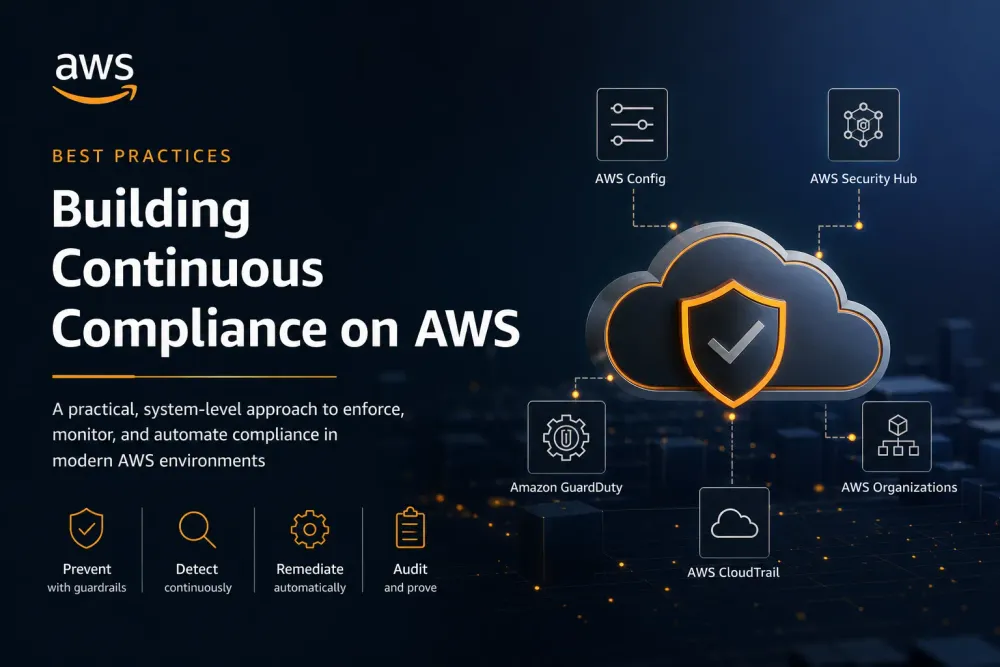
Building Continuous Compliance on AWS: A Practical, System-Level Approach
A practical, system-level approach to implementing continuous compliance on AWS using preventive guardrails, real-time detection, and automated remediation. This article breaks down how modern cloud teams can move from periodic audits to always-on compliance using native AWS services like AWS Organizations, Config, Security Hub, GuardDuty, EventBridge, and CloudTrail.

Introduction
In many organizations, compliance is still treated as an external requirement—validated during audits and documented in reports.
In AWS environments, this approach breaks down quickly.
Infrastructure is:
- Ephemeral
- API-driven
- Continuously deployed
- Owned by multiple teams
This creates a fundamental shift:
Compliance is no longer an audit outcome. It is a continuously enforced property of the system.
This article presents a practical, production-oriented approach to implementing continuous compliance on AWS using native services and real-world architectural patterns.
Architecture Overview
A robust AWS compliance system consists of four layers:
- Preventive Controls → Block non-compliant actions
- Detective Controls → Continuously evaluate system state
- Corrective Controls → Automatically remediate violations
- Observability & Audit → Provide traceability and reporting
Reference Architecture

Figure: Continuous compliance architecture on AWS combining preventive guardrails, real-time detection, automated remediation, and centralized audit visibility.
1. Defining the Problem: Where Systems Actually Fail
1.1 Configuration Drift
Even if infrastructure is deployed securely:
- Manual console changes happen
- Emergency fixes bypass pipelines
- Temporary exceptions become permanent
Example:
An S3 bucket is temporarily made public for testing and never reverted.
An S3 bucket is temporarily made public for testing and never reverted.
1.2 IAM Permission Creep
Over time:
- Roles accumulate permissions
- Wildcards (
*) are introduced - Unused access is not revoked
Result:
Least privilege is violated without visibility.
Least privilege is violated without visibility.
1.3 Lack of Real-Time Feedback
Most teams:
- Detect issues too late
- Depend on dashboards instead of alerts
- Don’t connect detection to action
1.4 Multi-Account Complexity
With AWS Organizations:
- Controls are inconsistently applied
- Visibility becomes fragmented
2. Preventive Controls (Hard Guardrails)
AWS Organizations + Service Control Policies (SCPs)
SCPs define maximum allowed actions across accounts.
Example: Restrict Public S3 ACLs
1
2
3
4
5
6
7
8
9
10
{
  "Effect": "Deny",
  "Action": "s3:PutBucketAcl",
  "Resource": "*",
  "Condition": {
    "StringEquals": {
      "s3:x-amz-acl": "public-read"
    }
  }
}
Key Insight
Start with high-impact controls:
- Prevent public exposure
- Protect logging systems
- Restrict critical actions
Avoid over-restricting early this creates workarounds.
3. Detective Controls (Continuous Evaluation)
AWS Config
Continuously evaluates resource configurations.
Implementation Pattern
- Enable across all accounts
- Use a centralized aggregator
- Store data in a dedicated S3 bucket
Critical Rules
- S3 public access disabled
- Encryption enabled (EBS, RDS)
- IAM users without admin privileges
AWS Security Hub
- Aggregates findings
- Maps to compliance frameworks
- Prioritizes risks
AWS GuardDuty
Provides:
- Threat detection
- Behavioral anomaly identification
4. Corrective Controls (Automated Remediation)
Event-Driven Remediation Flow
- AWS Config detects violation
- EventBridge triggers event
- Lambda executes remediation
- Action is logged
Example: S3 Public Access Fix
- Detect public bucket
- Trigger Lambda
- Remove public ACL
- Enable block public access
Design Principles
- Idempotent actions
- Fast execution
- Full audit logging
When Not to Automate
Avoid auto-remediation when:
- It risks breaking production
- Context is required
5. Observability & Audit
AWS CloudTrail
- Logs all API activity
- Must be centralized
- Should be immutable
Key Challenge
Logs alone are insufficient.
You must be able to:
- Correlate events
- Trace incidents
- Identify root causes
6. Identity as the Security Boundary
Best Practices
- Use IAM roles over users
- Enforce least privilege
- Use temporary credentials
Common Failure
One over-permissioned role can bypass all controls.
7. Shift-Left Compliance in CI/CD
Pipeline Integration
- Validate IaC templates
- Enforce policy checks
- Block non-compliant deployments
Outcome
Issues are prevented before reaching production.
8. Metrics That Matter
Track:
- Mean Time to Detect (MTTD)
- Mean Time to Remediate (MTTR)
- Recurring violations
- Automation coverage
9. Mini Case Study: Public S3 Exposure in Multi-Account AWS
In a multi-account AWS setup, development teams frequently created S3 buckets for temporary workloads.
Despite using Infrastructure as Code, manual console changes during testing led to recurring issues:
- Buckets were made public temporarily
- Changes were not reverted
- No immediate alerts were triggered
Solution Implementation
Preventive Control
- SCP restricted public ACL creation
Detective Control
- AWS Config monitored bucket policies
Corrective Control
- EventBridge triggered Lambda remediation
- Public access was removed automatically
- Actions were logged
Outcome
- Exposure windows reduced from days to seconds
- Human error no longer persisted silently
The real issue was not misconfiguration, it was how long it remained undetected.
10. Personal Perspective
In fast-moving cloud environments, teams rarely fail because they lack security knowledge.
They fail because:
- Systems evolve faster than manual controls
- Processes cannot keep up with deployment speed
This shifts compliance from governance to engineering.
If a control depends on documentation or manual checks, it will eventually fail under production pressure.
The most effective AWS environments embed compliance directly into:
- Infrastructure provisioning
- Deployment pipelines
- Automated remediation
Conclusion
Continuous compliance on AWS is not achieved by enabling services, it requires intentional system design.
Effective systems:
- Enforce controls programmatically
- Monitor continuously
- Automate remediation
- Integrate into engineering workflows
Final Thought
In modern AWS environments, the question is no longer whether a control exists.
The real question is whether that control can hold when infrastructure changes continuously.
Enjoyed reading this content? Let the author know!
Your likes, comments, shares, and saves help creators reach more builders.

Loading recommendations
Loading article