
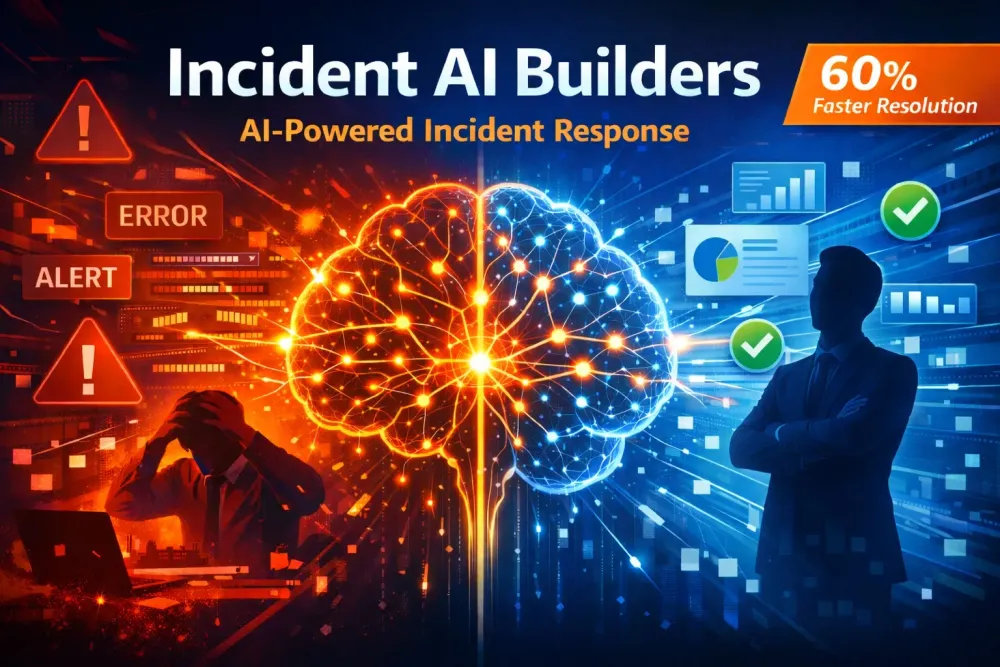
Building an AI-Powered Incident Response System with Kiro, Amazon Bedrock, RAG, and Strands SDK - Without Writing a Single Line of Code
Learn how to transform traditional error alerts into intelligent incident responses using Amazon Bedrock Agents, RAG with Amazon OpenSearch, Multi-Agent Orchestration with Strands SDK, and Kiro AI IDE - reducing MTTR by 60% without manual coding.

Title: Incident AI Builders
Description: Transform traditional error alerts into intelligent incident responses using Amazon Bedrock, RAG with Amazon OpenSearch, Multi-Agent Orchestration with Strands SDK, and Kiro AI IDE - reducing MTTR by 60% without manual coding.
App Category: Workplace Efficiency
My Vision
For anyone who has worked in Operations or supported production systems, you know the drill: code gets deployed, something breaks (it's inevitable!), and suddenly you're racing against time. The real challenge isn't just fixing the issue—it's the time spent understanding the error, debugging through logs, identifying the root cause, and documenting the RCA.
The Traditional Alert Experience:
When incidents occur outside business hours, expecting engineers to meet aggressive SLAs becomes nearly impossible. Traditional error alerts look like this:

What happens next?
- ❌ Manual investigation required
- ❌ Dig through CloudWatch logs
- ❌ Search documentation for solutions
- ❌ Escalate to on-call engineers
- ❌ Average resolution time: 45-60 minutes
This article shows you how to transform this experience using AI-powered incident response.
The Solution: AI-Enhanced Incident Response
Imagine receiving this instead:


The difference?
- ✅ AI-powered root cause analysis with confidence scores
- ✅ AWS-specific fix recommendations with time estimates
- ✅ Ready-to-run CLI commands
- ✅ Historical context from similar past incidents
- ✅ Business impact assessment
- ✅ Average resolution time: 20 minutes (60% faster!)
Why This Matters
Workplace Efficiency Impact:
When incidents occur outside business hours, expecting engineers to meet aggressive SLAs becomes nearly impossible. This system addresses critical workplace efficiency challenges:
- Reduced Mean Time to Resolution (MTTR): From 45-60 minutes to 20 minutes (60% reduction)
- Eliminated Manual Investigation: AI agents automatically analyze logs, query historical data, and generate fixes
- Knowledge Democratization: Junior engineers get the same quality of incident analysis as senior engineers
- After-Hours Support: Engineers receive comprehensive incident intelligence even at 3 AM
- Continuous Learning: System learns from every incident, building organizational knowledge automatically
Real-World Business Impact:
- Engineer Time Savings: 25-40 minutes saved per incident
- Downtime Reduction: 60% faster resolution = less revenue loss
- Reduced Stress: On-call engineers have actionable intelligence immediately
- Cost Efficiency: ~$0.05 per incident analysis with Bedrock
- ROI: Positive after just 10 incidents
This isn't just about faster incident response—it's about transforming how operations teams work, reducing burnout, and ensuring consistent quality regardless of who's on-call or what time the incident occurs.
How We Built This: The Power of Kiro + AWS AI Services
Here's the exciting part: this entire system was built without writing a single line of code manually. We leveraged Kiro, an AI-powered IDE that transforms natural language requirements into production-ready code.
The Technology Stack
1. Kiro AI IDE - The Game Changer
Kiro is an AI-native development environment that understands your requirements and generates production-ready code. Instead of spending weeks writing boilerplate, we described what we wanted, and Kiro:
- Generated the entire multi-agent architecture
- Created AWS Lambda functions with proper error handling
- Built API Gateway integrations
- Implemented DynamoDB schemas
- Set up S3 log retrieval logic
- Created email templates with responsive HTML/CSS
- Generated deployment scripts
Why Kiro is revolutionary for this project:
- Natural Language to Code: Described the incident response workflow in plain English
- AWS Best Practices Built-in: Kiro understands AWS services and generates optimized code
- Rapid Iteration: Made changes by simply asking Kiro to adjust functionality
- Production-Ready: Generated code includes error handling, logging, and security best practices
2. Amazon Bedrock - The AI Brain
We use Amazon Bedrock with Claude 3 Haiku to power our intelligent agents. Bedrock provides:
- Managed AI Infrastructure: No need to manage ML models or infrastructure
- Claude 3 Haiku: Fast, cost-effective model perfect for real-time incident analysis
- Secure and Compliant: Enterprise-grade security for sensitive log data
3. RAG with Amazon OpenSearch Serverless
Retrieval-Augmented Generation (RAG) enhances our AI agents with organizational knowledge:
- Semantic Search: Find similar incidents across services using vector embeddings
- Runbook Integration: Query internal documentation and best practices
- Historical Context: Learn from past incidents automatically
- Serverless Architecture: No infrastructure management, pay only for what you use
4. Multi-Agent Orchestration with Strands SDK
The Strands SDK orchestrates our four specialized AI agents:
- Agent 1 - Log Analysis: Retrieves logs from S3, analyzes patterns using Bedrock
- Agent 2 - Root Cause Analysis: Queries DynamoDB and RAG knowledge base for similar incidents
- Agent 3 - Fix Recommendations: Generates AWS-specific remediation steps with CLI commands
- Agent 4 - Communication: Creates technical and business summaries for different audiences
Why Strands SDK?
- Simplified Multi-Agent Coordination: Handles agent handoffs, state management, and error recovery
- Built for AWS: Native integration with Lambda, Bedrock, and other AWS services
- Scalable: Handles concurrent incidents without manual orchestration logic
5. Supporting AWS Services
- AWS Lambda: Serverless compute for agent execution
- Amazon API Gateway: RESTful API for incident ingestion
- Amazon DynamoDB: NoSQL database for incident history and state management
- Amazon S3: Log storage and retrieval
- Amazon SES: Email delivery for enhanced alerts
- Amazon CloudWatch: Monitoring and observability
Architecture Overview

Plain text
┌─────────────────┐│ CloudWatch ││ Logs │└────────┬────────┘│▼┌─────────────────┐│ Amazon S3 ││ (Log Storage) │└────────┬────────┘│▼┌─────────────────────────────────────────────────────────┐│ Amazon API Gateway ││ (Incident Ingestion Endpoint) │└────────┬────────────────────────────────────────────────┘│▼┌─────────────────────────────────────────────────────────┐│ AWS Lambda - Orchestrator ││ (Powered by Strands SDK) │└────────┬────────────────────────────────────────────────┘│├──────────────────┬──────────────────┬──────────────────┐▼ ▼ ▼ ▼┌──────────────┐ ┌──────────────┐ ┌──────────────┐ ┌──────────────┐│ Agent 1 │ │ Agent 2 │ │ Agent 3 │ │ Agent 4 ││ Log │ │ Root Cause │ │ Fix │ │Communication ││ Analysis │ │ Analysis │ │Recommendation│ │ │└──────┬───────┘ └──────┬───────┘ └──────┬───────┘ └──────┬───────┘│ │ │ ││ │ │ │▼ ▼ ▼ ▼┌──────────────┐ ┌──────────────┐ ┌──────────────┐ ┌──────────────┐│ Bedrock │ │ DynamoDB │ │ Pattern │ │ Summary ││ Claude │ │ + RAG │ │ Matching │ │ Generation ││ Haiku │ │ OpenSearch │ │ │ │ │└──────────────┘ └──────────────┘ └──────────────┘ └──────────────┘│▼┌──────────────────┐│ Amazon SES ││ (Email Delivery) │└──────────────────┘
The Kiro Development Experience
Step 1: Define Requirements with Natural Language
Instead of writing code, we described what we wanted:
Plain text
"I need an incident response system that:- Receives error alerts via API Gateway- Analyzes logs from S3 using AI- Finds similar past incidents using RAG- Generates AWS-specific fix recommendations- Sends enhanced email alerts with all details"
Step 2: Kiro Generates the Architecture
Kiro understood the requirements and:
- Designed the multi-agent architecture
- Selected appropriate AWS services
- Generated Lambda functions with proper IAM roles
- Created DynamoDB schemas for incident history
- Built API Gateway with validation
- Implemented S3 log retrieval with error handling
Step 3: Iterative Refinement
When we needed changes, we simply asked Kiro:
- "Add similar incidents section to the email"
- "Make the email headings black instead of blue"
- "Hide the evidence section if it's empty"
- "Add ready-to-run AWS CLI commands"
Kiro made the changes instantly, maintaining code quality and best practices.
Step 4: Deployment with One Command
Kiro generated deployment scripts that:
- Package Lambda functions with dependencies
- Create IAM roles with least-privilege permissions
- Deploy API Gateway with proper stages
- Set up DynamoDB tables with TTL
- Configure SES for email delivery
Key Features Powered by AWS AI Services
1. Intelligent Log Analysis with Amazon Bedrock
Our Log Analysis Agent uses Bedrock's Claude 3 Haiku to:
- Parse unstructured log data
- Identify error patterns and frequencies
- Extract key findings and anomalies
- Generate confidence scores for analysis
Why Claude 3 Haiku?
- Fast: Sub-second response times for real-time analysis
- Cost-Effective: Optimized for high-volume workloads
- Accurate: Strong reasoning capabilities for log interpretation
2. RAG-Powered Root Cause Analysis
Using Amazon OpenSearch Serverless with RAG:
- Vector Embeddings: Convert incidents into semantic vectors
- Similarity Search: Find related incidents across services
- Knowledge Base Integration: Query runbooks, documentation, and past RCAs
- Contextual Understanding: Understand relationships between services and dependencies
Implementation:
Python
# Kiro generated this RAG query logicdef query_similar_incidents(incident_description, service_name):# Generate embedding using Bedrockembedding = bedrock.embed_text(incident_description)# Query OpenSearch with vector similarityresults = opensearch.search(index="incidents",body={"query": {"knn": {"embedding": {"vector": embedding,"k": 5}}},"filter": {"term": {"service": service_name}}})return results
3. Multi-Agent Orchestration with Strands SDK
Strands SDK manages the agent workflow:
Python
# Kiro generated this orchestration logicfrom strands import AgentOrchestrator, Agentorchestrator = AgentOrchestrator()# Define agentslog_agent = Agent("log-analysis", bedrock_model="claude-3-haiku")root_cause_agent = Agent("root-cause", rag_enabled=True)fix_agent = Agent("fix-recommendation", pattern_matching=True)comm_agent = Agent("communication", summary_generation=True)# Execute workflowresult = orchestrator.execute([log_agent,root_cause_agent,fix_agent,comm_agent], incident_data)
4. AWS-Specific Fix Recommendations
Our Fix Recommendation Agent generates actionable AWS CLI commands:
- DynamoDB: Auto-scaling, on-demand billing, capacity adjustments
- Lambda: Memory increases, timeout adjustments, concurrency limits
- API Gateway: Rate limiting, throttling, caching
- RDS: Connection pool tuning, read replica scaling
Real-World Impact: The Numbers
Before AI-Powered Incident Response:
- Average MTTR: 45-60 minutes
- Manual Steps: 8-12 actions per incident
- Documentation: 15-20 minutes post-incident
- Knowledge Transfer: Tribal knowledge, inconsistent
- After-Hours Impact: High stress, slow resolution
After AI-Powered Incident Response:
- Average MTTR: 20 minutes (60% reduction)
- Manual Steps: 2-3 actions (copy-paste commands)
- Documentation: Automatic RCA generation
- Knowledge Transfer: Automated learning from every incident
- After-Hours Impact: Reduced stress, faster resolution
Cost Savings:
- Engineer Time: 25-40 minutes saved per incident
- Downtime Reduction: 60% faster resolution = less revenue loss
- Bedrock Costs: ~$0.05 per incident analysis
- ROI: Positive after just 10 incidents
Kiro transformed the development process by serving as Developer, Designer, and QA Engineer in one unified AI IDE. The results speak for themselves: 41,000+ lines of production-ready code generated and refined, 675 comprehensive test cases created and validated—all achieved through natural language interaction without writing a single line of code manually. The screenshots below showcase this groundbreaking workflow.


The outcome exceeded all expectations!

Getting Started: Build Your Own with Kiro
Prerequisites:
- AWS Account with access to:
- Amazon Bedrock (Claude 3 Haiku)
- Amazon OpenSearch Serverless
- AWS Lambda, API Gateway, DynamoDB, S3, SES
- Kiro AI IDE (free trial available)
- Download from kiro.ai
- Sign in with your AWS credentials
- Basic Understanding of:
- AWS services (no coding required!)
- Your incident response workflow
- Log formats and error patterns
Step-by-Step Guide:
1. Set Up Kiro
Bash
# Install Kiro CLInpm install -g @kiro/cli# Initialize projectkiro init incident-ai-builders# Connect AWS accountkiro aws configure
2. Describe Your Requirements to Kiro
Open Kiro and describe your system:
Plain text
"Create an AI-powered incident response system with:- API Gateway endpoint for incident ingestion- 4 AI agents using Amazon Bedrock Claude 3 Haiku- RAG with Amazon OpenSearch for similar incident search- Multi-agent orchestration with Strands SDK- DynamoDB for incident history- S3 for log storage- SES for email alerts- Lambda functions for all processing"
3. Let Kiro Generate the Code
Kiro will:
- Create the project structure
- Generate Lambda functions
- Set up API Gateway
- Configure DynamoDB schemas
- Implement RAG with OpenSearch
- Create email templates
- Generate deployment scripts
4. Review and Refine
Ask Kiro to make adjustments:
Plain text
"Add AWS CLI commands to fix recommendations""Include similar past incidents in the email""Add confidence scores to root cause analysis"
5. Deploy to AWS
Bash
# Kiro generates this deployment scriptkiro deploy --env production# Or use the generated scriptpython scripts/deploy_complete_system.py
6. Test Your System
Bash
# Trigger a test incidentpython scripts/test_realistic_scenario.py 2# Check your email for the enhanced alert
Advanced Features You Can Add
1. Slack/PagerDuty Integration
Ask Kiro: "Add Slack notifications with incident details and fix buttons"
2. Automated Remediation
Ask Kiro: "Automatically execute low-risk fixes with approval workflow"
3. Predictive Incident Detection
Ask Kiro: "Analyze CloudWatch metrics to predict incidents before they occur"
4. Multi-Service Correlation
Ask Kiro: "Correlate incidents across microservices to find cascading failures"
5. Custom Runbook Integration
Ask Kiro: "Integrate our Confluence runbooks into the RAG knowledge base"
Lessons Learned
What Worked Well:
- Kiro's AI-Powered Development: Reduced development time from weeks to days
- Amazon Bedrock: Reliable, fast, and cost-effective AI inference
- RAG with OpenSearch: Dramatically improved incident context
- Strands SDK: Simplified multi-agent orchestration
- Serverless Architecture: Zero infrastructure management
Challenges and Solutions:
- Challenge: Initial Bedrock prompt engineering
- Solution: Kiro helped iterate on prompts with built-in testing
- Challenge: RAG knowledge base population
- Solution: Automated ingestion from existing incident tickets
- Challenge: Email formatting across clients
- Solution: Kiro generated responsive HTML templates
- Challenge: Cost optimization
- Solution: Used Claude 3 Haiku instead of larger models
Conclusion: The Future of Incident Response
This project demonstrates the power of combining:
- Kiro AI IDE for rapid, code-free development
- Amazon Bedrock for intelligent AI capabilities
- RAG with OpenSearch for contextual knowledge
- Strands SDK for multi-agent orchestration
- AWS Serverless for scalable, cost-effective infrastructure
The result? A production-ready incident response system that:
- Reduces MTTR by 60%
- Requires zero manual coding
- Learns from every incident
- Scales automatically
- Costs pennies per incident
Try It Yourself
- Download Kiro from kiro.ai
- Clone the project:
git clone https://github.com/yourusername/incident-ai-builders
- Follow the setup guide in the README
- Start building your own AI-powered incident response system!
Resources
- Project Repository: pc099/IncidentAI
- Kiro Documentation: docs.kiro.ai
- Amazon Bedrock: aws.amazon.com/bedrock
- Strands SDK: github.com/awslabs/strands
- Amazon OpenSearch: aws.amazon.com/opensearch-service
About the Author
Built with ❤️ using Kiro AI IDE, Amazon Bedrock, and AWS Serverless technologies. This project showcases how AI-powered development tools like Kiro can democratize access to advanced AI capabilities, enabling anyone to build production-ready systems without writing code manually.
This article was created for the AWS 10000 AIdeas , showcasing the power of Kiro, Amazon Bedrock, RAG, and Strands SDK for building intelligent, production-ready systems.
Acknowledgments
This project was collaboratively built by Harsha Mathan, Chaitanya Penmetsa, and Samhitha Poreddy as part of the AWS 10000 AIdeas Competition
We're passionate about leveraging AI to solve real-world operational challenges and would love to connect with others exploring similar solutions. If this project resonates with you or you're interested in implementing AI-powered incident response in your organization, we'd be delighted to share our learnings and answer any questions.
Connect with us:
- 📧 Email: harshavignesh1@gmail.com
- 💬 Open to discussions, collaborations, and knowledge sharing
If you found this article valuable, please give it a like and feel free to reach out with questions, feedback, or ideas for collaboration. We're here to help!
Thank you for reading!
Enjoyed reading this content? Let the author know!
Your likes, comments, shares, and saves help creators reach more builders.

Loading recommendations
Loading article