
AIdeas: VetVoice — Turning Voice Notes into SOAP Drafts for Large-Animal Veterinarians
Farm vets shouldn’t spend their evenings catching up on paperwork. VetVoice turns post-visit voice notes into SOAP drafts for cattle veterinarians.

App category
Workplace Efficiency
My vision
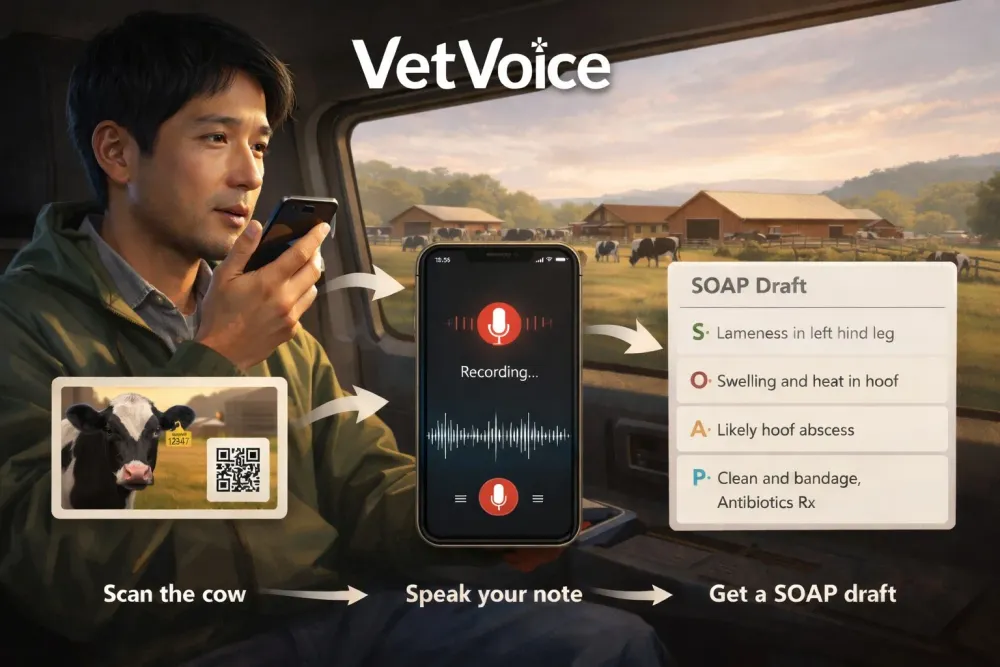
Large-animal veterinarians often record notes in the car after a farm visit. VetVoice turns those spoken notes into a structured SOAP draft, helping reduce paperwork and making documentation easier to start.
VetVoice is a documentation support app for large-animal veterinarians, especially those working with cattle.
In large-animal practice, the work does not end when treatment ends. A single visit includes travel to the farm, work on site, and then the task of documenting what was observed and done. That documentation often happens not in a quiet office, but at the farm, in the car, or in the limited time left after the visit.
By turning voice notes into a SOAP draft, it reduces the initial burden of manual documentation and allows veterinarians to spend more time on clinical judgment, treatment, and follow-up care.
Why this matters
Large-animal veterinarians, especially those working with cattle, do more than treat animals. They support farm continuity and animal health, and they also play an important role in the food supply. WOAH also positions veterinary services and animal health and welfare as essential foundations for food security and society.
In Japan, this work is hard to streamline in practice. According to a survey by Japan’s Ministry of Agriculture, Forestry and Fisheries (MAFF), the average time required for one farm visit was 4.3 hours, including 1.7 hours spent on travel. In other words, a substantial part of each visit is consumed not by treatment itself, but by getting to the site before documentation even begins.
That is why VetVoice focuses on one of the most repetitive administrative burdens in this workflow: record creation after the visit. It does not replace veterinary judgment. Instead, it helps transform spoken field notes into a structured starting point for documentation, reducing after-hours paperwork and freeing up more time for clinical work.
In addition, many regions face shortages of large-animal veterinarians, particularly in rural areas. This means that each veterinarian must cover wider geographic areas and more farms, increasing travel time and administrative workload. Reducing documentation overhead can help veterinarians spend more time on clinical work and less time on paperwork.
How I built this


I designed VetVoice as a proof of concept that connects the full workflow from identifying an animal to drafting the visit record. The process starts with a QR code: the veterinarian scans the code to open the cow’s profile, records a voice note after the visit, and sends that note into an analysis pipeline that produces a SOAP-style draft.
On the technical side, I built the frontend with React 18, TypeScript, and Vite, and used AWS Amplify Gen 2 for the backend. The system uses AppSync (GraphQL), Lambda, DynamoDB, Cognito, S3, Amazon Transcribe, and Amazon Bedrock. My goal was to keep the experience simple enough for field use while still supporting a complete end-to-end workflow.
The core pipeline does more than transcribe audio. After speech recognition, VetVoice applies dictionary files, normalization rules, and master-data matching to expand abbreviations and handle domain-specific veterinary language. I also split the LLM pipeline into separate roles: structured extraction and SOAP generation. This made the system easier to improve step by step and helped keep a better balance between output quality and per-run cost. In the final configuration, Claude Haiku 4.5 worked best for extraction, while Amazon Nova Lite worked best for SOAP generation.
The key design choice was not to rely on prompts alone. Instead, I combined transcription, dictionaries, normalization, master-data matching, and role-specific LLM steps so the output would be closer to something a veterinarian could actually use in practice.
For evaluation, I worked with a practicing large-animal veterinarian who helped provide anonymized voice notes collected in real farm settings. I evaluated the system on 40 internal test cases. As I improved the overall pipeline—including dictionaries, normalization rules, and structured extraction design—the CLEAN rate of SOAP output, our internal measure of usable draft quality, improved from 0.0375 to 0.8000. I also compared multiple model configurations and found that Claude Haiku 4.5 for extraction and Amazon Nova Lite for SOAP generation provided the best balance of quality and cost for this PoC.
Identify the cow

Run the pipeline

Extract structured data

Generate the SOAP draft

What I learned
The biggest lesson from this project was that the quality of a voice AI workflow is not determined by the model alone. In large-animal veterinary care, abbreviations, shorthand, and field-specific language are everywhere, so raw transcription is not enough. What mattered most was the overall pipeline: dictionary files, normalization rules, domain master data, and output design. To make the system usable in practice, I had to build not just an AI feature, but a workflow that could handle the language actually used in the field.
I also learned that splitting responsibilities across models works better than asking one model to do everything. Preserving structured information is a different task from turning that information into a readable clinical draft. Separating extraction from generation made it easier to identify where quality was breaking down and how to improve it, while also making the system more practical from a cost perspective.
Another important lesson was that without field-like evaluation data, it is easy to optimize for the wrong thing. Because I was able to test the system on anonymized voice notes collected in real farm settings, I could see more clearly where the pipeline failed and which fixes actually mattered.
I also came to see that in Japanese large-animal practice, documentation has value beyond the clinical record itself. Because records often connect to insurance-related administrative work, even small improvements in structure and completeness can reduce downstream burden.
Finally, I learned the importance of not trying to solve everything at once. Large-animal veterinary care has many pain points, including travel, documentation, terminology, and operational complexity. If I had tried to build a full integrated system from the start, the project would have become too heavy. By focusing on one narrow but high-friction task—turning post-visit voice notes into SOAP-style draft records—I was able to build something much more concrete and testable. In AI projects, deciding what not to build can be just as important as deciding what to build.
Acknowledgements
This PoC was developed with the support of a practicing large-animal veterinarian.Special thanks to Dr. Dai Ishiyama.
This PoC was developed with the support of a practicing large-animal veterinarian. Special thanks to Dr. Dai Ishiyama .
References & Further Reading
Veterinary services and food security
World Organisation for Animal Health (WOAH), Improving Veterinary Services — View resource
World Organisation for Animal Health (WOAH), Improving Veterinary Services — View resource
Veterinary practice in Japan
Ministry of Agriculture, Forestry and Fisheries (MAFF), 獣医事をめぐる情勢 — View report
Ministry of Agriculture, Forestry and Fisheries (MAFF), 獣医事をめぐる情勢 — View report
Travel as a structural burden in livestock practice
Ministry of Agriculture, Forestry and Fisheries (MAFF), 家畜の遠隔診療(情報通信機器を活用した産業動物診療の効率化) — View report
Ministry of Agriculture, Forestry and Fisheries (MAFF), 家畜の遠隔診療(情報通信機器を活用した産業動物診療の効率化) — View report
Farm-visit workload and travel time
Ministry of Agriculture, Forestry and Fisheries (MAFF), 往診に関する調査結果 — View data
Ministry of Agriculture, Forestry and Fisheries (MAFF), 往診に関する調査結果 — View data
Clinical record documentation requirement
e-Gov Law Search, 獣医師法 第21条 — View law
e-Gov Law Search, 獣医師法 第21条 — View law
Enjoyed reading this content? Let the author know!
Your likes, comments, shares, and saves help creators reach more builders.

Loading recommendations
Loading article