
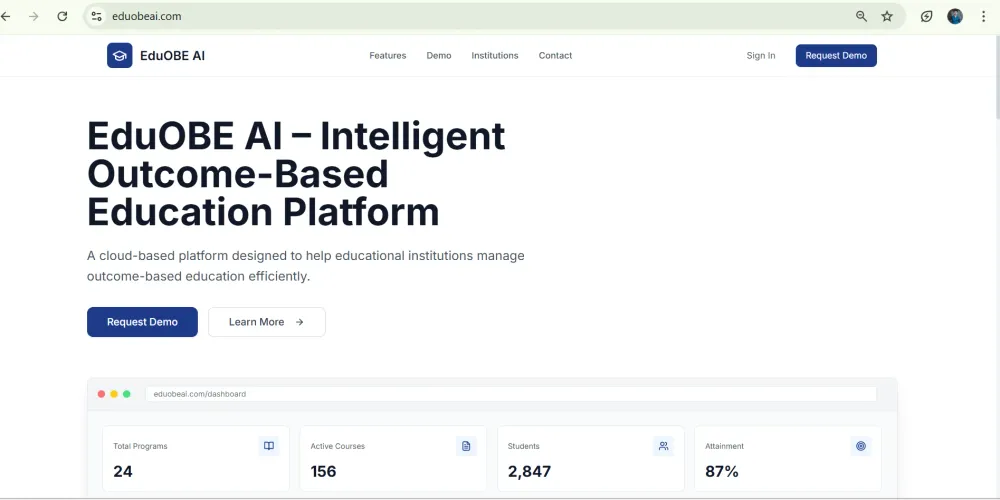
AIdeas: EduOBE AI Transforming Outcome-Based Education with AI and AWS
EduOBE AI addresses a major challenge in higher education by modernizing how universities manage Outcome-Based Education (OBE) systems. By combining AI with AWS cloud technologies, the platform reduces manual administrative workload and improves academic quality assurance for institutions across developing regions.

Team Name: Avenger
App Category: Social Impact
Region: APJC
Our Vision
Every semester, thousands of faculty members across universities spend weeks manually calculating Outcome-Based Education (OBE) attainment using Excel spreadsheets.
These spreadsheets are difficult to maintain, error-prone, and time-consuming. In many universities across Pakistan and Azad Kashmir, OBE documentation still depends on manual calculations that affect accreditation readiness and educational quality monitoring.
EduOBE AI transforms this process into an AI-powered cloud platform that automates the entire OBE lifecycle.
Instead of manually calculating attainment and mapping learning outcomes, faculty can upload course information and assessment data, while the system intelligently analyzes outcomes and generates insights.
The platform enables universities to:
- Automate CLO-PLO-PEO mapping
- Compute attainment automatically
- Generate accreditation-ready reports
- Monitor learning outcomes in real time
- Identify learning gaps early using predictive insights
EduOBE AI is designed as a secure multi-tenant SaaS platform, allowing multiple universities and departments to manage their academic quality assurance processes efficiently.

Why This Matters
Before the development of EduOBE AI, there was no centralized digital platform available to manage the Outcome-Based Education (OBE) system within the university. Most processes relied on scattered Excel sheets and manual documentation.
As a result, faculty members faced difficulties maintaining consistent records, and students had no direct way to track their achieved Program Learning Outcomes (PLOs) or monitor their academic progress. There was also limited visibility for students to evaluate their performance and coordinate with instructors to improve their learning outcomes.
Higher education institutions in developing regions often rely on manual Excel-based systems for OBE documentation.
This approach leads to:
- Administrative overhead for faculty
- Human errors in outcome mapping
- Delayed accreditation reports
- Lack of real-time academic insights
Faculty members frequently spend 40-60% of their time on documentation rather than teaching and research.

Impact
Institutional Workflow and Stakeholder Impact
EduOBE AI is designed to support the complete academic quality assurance process by involving all key stakeholders within a university’s Outcome-Based Education ecosystem. Each role contributes to a structured workflow that ensures efficient semester operations, accurate outcome tracking, and meaningful academic insights.
EduOBE AI provides meaningful improvements across the academic ecosystem.
Department Admins, ensuring that all institutional stakeholders are properly onboarded into the system. The platform further supports this process with AI-assisted creation and mapping of CLOs, PLOs, and PEOs, helping universities design well-aligned outcome frameworks and maintain consistency across programs.
For Faculty
- Reduces OBE administrative workload by up to 70%
The platform enables universities to:
- Automate PLO-PEO Creation and PLO-PEO mapping
- PEO Creation Through AI

- PLO Creation Through AI

- PLO-PEO MAPPING THROUGH AI

- Automate CLO-PLO Creation and mapping


Focal Person: Serves as the institutional owner and primary coordinator for the university within EduOBE AI. The focal person first submits a request to the EduOBE AI Super Admin to register their university on the platform.
After approval, they configure university-level information such as the university motto, logo, academic policies, and accreditation requirements. They then establish the institutional structure by creating departments and appointing Department Admins, ensuring that all academic stakeholders are properly onboarded into the system.


For Students
- Identifies learning gaps early and provides performance insights

- Student Track their Grades & Marks

Automated Final OBE Sheet Export: The platform automatically generates the final OBE sheet after attainment calculations, allowing faculty to export structured reports ready for accreditation and departmental documentation.
For Institutions
- Director CQI: manages vision/mission, PEOs/PLOs, and creates and manages Surveys.
- Ensures accurate accreditation documentation and compliance
- Compute attainment automatically
- Identify learning gaps early using predictive insights

- Monitor learning outcomes in real time

- Generate accreditation-ready reports

Semester Control Committee (SCC): Oversees semester operations by creating and locking semesters, assigning teachers to courses, registering students, defining academic timelines, and managing semester lock/unlock policies to ensure smooth academic workflow.


Teachers: Use the teacher dashboard to manage course activities such as creating assessments, entering marks, mapping assessment items to CLOs, submitting course OBE sheets, and adding course review comments.


EduOBE AI enhances this workflow with AI-powered CLO management, enabling instructors to generate CLOs, receive Bloom’s Taxonomy validation, and ensure learning outcomes are clear, measurable, and aligned with academic standards.


Automated Final OBE Sheet Export: EduOBE AI automatically compiles assessment data, CLO mappings, and attainment calculations to generate a final OBE sheet, which can be exported for accreditation documentation and departmental records.
Super Admin: Manages the overall platform and approves universities to join the system, ensuring secure onboarding and system governance.


For Education Systems EduOBEAI Improves quality assurance frameworks across universities.
At scale, EduOBE AI can support thousands of students across multiple institutions, ensuring explainability and academic control, improving learning outcomes.
How We Built This
EduOBE AI was developed through a structured multi-phase approach using AWS Free Tier infrastructure and AWS AI services Amazon Bedrock and Kiro.
AWS Services Used
- Amazon EC2 (t2.micro) - Application hosting
- Amazon RDS PostgreSQL - Database management
- Amazon S3 - File storage and static assets
- Amazon Bedrock (Claude 3 Sonnet) - AI-powered analysis
- Amazon Cognito - User authentication
- AWS Certificate Manager - SSL/TLS certificates
- Amazon CloudWatch - Monitoring and logging

Phase 1 – University Requirement Analysis
Before building the platform, we analyzed how our university manages OBE documentation. Most departments relied heavily on manual Excel sheets, which created inconsistencies and errors.
We collaborated with our university’s department focal person and faculty members to gather requirements and document the existing academic workflows used for managing Outcome-Based Education (OBE).
To better understand the broader educational landscape, we further conducted research across several universities in Azad Kashmir and Pakistan. Our findings revealed that many institutions still rely heavily on manual Excel sheets and disconnected documentation processes to manage OBE data, which often leads to inconsistencies, calculation errors, and administrative overhead.
Based on these insights, we designed a scalable system architecture that could support multiple institutions while maintaining structured academic workflows.
The platform was built around three key architectural foundations:
- A normalized CLO–PLO–PEO relational data model to accurately represent outcome mappings and maintain consistency across academic programs.
- A secure multi-tenant architecture, allowing multiple universities and departments to operate on the same platform while keeping their data fully isolated and secure. This enables EduOBE AI to function as a Software-as-a-Service (SaaS) platform that can scale across institutions.
- Role-based academic workflows that reflect real university structures, ensuring that each stakeholder from administrators to students interacts with the system according to their responsibilities.
This approach allowed EduOBE AI to evolve from a single-university solution into a scalable platform capable of supporting multiple institutions and academic programs.
Phase 2 Core Platform Development
The goal was to replace manual spreadsheets with an automated digital platform.
We Develop a scalable web application capable of processing academic data and generating outcome insights.
We built a full-stack cloud application using modern AWS and AI technologies.
Frontend
- Next.js
- React
- TypeScript
- TailwindCSS
- Chart.js
Backend Architecture
EduOBE AI’s backend is built using a modular Node.js architecture with TypeScript to ensure scalability, maintainability, and type safety.
The backend follows a layered architecture:
- Controller Layer: Handles incoming API requests and validates input data
- Service Layer : Implements business logic such as CLO mapping, attainment calculations, and report generation
- Repository Layer : Interacts with the PostgreSQL database through Prisma ORM
- Middleware Layer : Manages authentication, authorization, and request validation
This structure ensures that the platform remains maintainable as new features and institutions are added.
- Node.js
- Express
- Prisma ORMDatabase:
- PostgreSQL on Amazon RDS
Storage:
AWS S3
Infrastructure
- Docker containers
- Nginx reverse proxy
- AWS EC2 deployment
This architecture enabled a scalable SaaS platform capable of supporting multiple universities.
AI Workflow with Amazon Bedrock
EduOBE AI integrates Amazon Bedrock to provide intelligent assistance in academic outcome design.
AI functionality is powered by:
- Kiro AI IDE for development acceleration
- Amazon Bedrock for CLO-PLO-PEO mapping analysis
The AI pipeline works as follows:
- Instructor creates or uploads CLO descriptions
- The system analyzes the CLO text
- Bloom’s taxonomy level is identified
- Bedrock generates recommended PLO mappings
- Confidence scores are returned to the instructor
- Instructor validates or modifies the mapping
This human-in-the-loop AI workflow ensures both accuracy and faculty control.
File Storage with Amazon S3
Amazon S3 is used for scalable storage of:
- Excel assessment uploads
- Generated reports
- User profile images
- Supporting course documents
S3 provides:
- durable storage
- secure access control
- scalable file management
Files are referenced in the database while the actual content is securely stored in S3 buckets.
Containerized Deployment
The application is deployed using Docker containers, enabling consistent environments between development and production.
Three main containers are used:
- Frontend Container Next.js application
- Backend Container Node.js API
- Nginx Container Reverse proxy and request routing
Docker Compose orchestrates these services on the EC2 instance.
Benefits include:
- consistent deployments
- simplified scaling
- easier maintenance
Authentication and Role-Based Access
EduOBE AI implements role-based access control (RBAC) to ensure secure academic workflows.
EduOBE AI supports seven academic roles, reflecting real university structures.
Roles include:
- Super Admin
- Focal Person
- Department Admin
- Director CQI
- Teacher
- Student
Authentication is handled through Amazon Cognito, which provides:
- secure user registration
- login authentication
- token-based authorization
- session management
Each API request validates the user role before allowing access to specific features.
Phase 3 Testing and Faculty Validation
Validate system accuracy by coordinating with university faculty members.
Phase4 : Monitoring and Observability
The system was deployed using AWS Free Tier infrastructure.
Application monitoring is implemented using Amazon CloudWatch.
CloudWatch collects:
- application logs
- system metrics
- performance data
- error tracking
Alerts are configured to notify when:
- CPU usage exceeds thresholds
- database connections increase
- application errors occur
This helps maintain platform reliability and stability.
Demo
Live Application Demo
What We Learned:
Building EduOBE AI provided several important technical and product insights.
AI Requires Domain Context : Generic AI prompts initially produced inconsistent results.
By incorporating Bloom’s taxonomy and accreditation terminology, AI accuracy improved significantly.
AWS Free Tier Encourages Efficient Architecture:
Designing within Free Tier limits required:
- database query optimization
- connection pooling
- efficient storage management
Human-in-the-Loop AI Improves Trust:
Faculty can review and approve AI recommendations, ensuring transparency and reliability.
Kiro Accelerates Development: Using Kiro significantly improved productivity by helping with:
- API scaffolding
Overall development time improved by approximately 40%.
- debugging deployment issues
- optimizing Docker configurations
- generating code structures
Beta Testing Program:
EduOBE AI is now inviting universities and educational institutions to participate in a limited beta testing program.
What Participants Receive
- Free platform access during beta period
- onboarding and training sessions
- data migration support from Excel
- opportunity to influence future platform features
Selection Model
The first institutions will be selected on a first-come, first-served basis.
Our goal is to gather feedback and improve the system before launching the full MVP.
Interested institutions can explore the platform at:
We welcome suggestions, feedback, and collaboration as we continue developing new AI capabilities.
Future Roadmap
Planned enhancements include:
- CI/CD pipelines using AWS CodePipeline
- automated report generation using AWS Lambda
- email alerts using Amazon SES
- global content delivery using Amazon CloudFront
- AI-powered curriculum optimization
- LMS integrations (Moodle, Canvas)
These improvements will transform EduOBE AI into a complete AI-driven quality assurance Framework for universities.
Conclusion
EduOBE AI demonstrates how AI and AWS cloud infrastructure can modernize higher education quality assurance.
By replacing manual spreadsheets with intelligent automation, the platform enables universities to:
- improve accreditation compliance
- reduce administrative burden
- enhance student learning outcomes
Built with Kiro and AWS Free Tier services, EduOBE AI showcases how innovative solutions can create meaningful social impact.
Connect With Our EduOBEAITeam on LinkdeIn:
Enjoyed reading this content? Let the author know!
Your likes, comments, shares, and saves help creators reach more builders.

Loading recommendations
Loading article