
Amazon Quick: Disaster Recovery & Resiliency Guide
How Amazon Quick achieves continuous resilience through Active/Active multi-AZ architecture, layered data protection, and automated recovery. Covers hosting architecture, business continuity objectives (RTO/RPO), failure scenarios, data durability, cross-region constraints, and compliance alignment.


Purpose
This article provides enterprise risk, resiliency, and compliance teams with the
technical details needed to assess Amazon Quick's disaster recovery
capabilities against organizational requirements. It covers the hosting
architecture, physical separation model, business continuity objectives, failure
response scenarios, data durability strategy, regional constraints, and
validation practices that underpin the platform's resilience posture.
technical details needed to assess Amazon Quick's disaster recovery
capabilities against organizational requirements. It covers the hosting
architecture, physical separation model, business continuity objectives, failure
response scenarios, data durability strategy, regional constraints, and
validation practices that underpin the platform's resilience posture.
If you are evaluating Amazon Quick for deployment in a regulated or
business-critical environment, this document maps the platform's architecture to
the questions your risk team will ask.
business-critical environment, this document maps the platform's architecture to
the questions your risk team will ask.
TL;DR Amazon Quick runs Active/Active across at least 3 Availability Zones
in each supported region (us-east-1, us-west-2, eu-west-1, ap-southeast-2).
All zones are live, there is no passive standby. Single-node or
single-AZ failures cause zero service interruption. RPO is near-zero under
normal operations (1 hour maximum in catastrophic scenarios). RTO is under 24
hours. Data durability is layered: live replication across AZs plus immutable
snapshots with index metadata backed up in DynamoDB every 5 minutes (retained 35
days) and parsed content retained in S3 until index deletion for automatic
recovery. Cross-region failover is not natively supported. Organizations
requiring multi-region DR must architect it independently. Resilience is
validated through bi-annual Game Days and continuous path testing inherent to
the Active/Active design.
in each supported region (us-east-1, us-west-2, eu-west-1, ap-southeast-2).
All zones are live, there is no passive standby. Single-node or
single-AZ failures cause zero service interruption. RPO is near-zero under
normal operations (1 hour maximum in catastrophic scenarios). RTO is under 24
hours. Data durability is layered: live replication across AZs plus immutable
snapshots with index metadata backed up in DynamoDB every 5 minutes (retained 35
days) and parsed content retained in S3 until index deletion for automatic
recovery. Cross-region failover is not natively supported. Organizations
requiring multi-region DR must architect it independently. Resilience is
validated through bi-annual Game Days and continuous path testing inherent to
the Active/Active design.
| Specification | Value |
|---|---|
| Hosting Model | Active/Active (at least 3 Availability Zones per region) |
| Supported Regions | us-east-1 (N. Virginia), us-west-2 (Oregon), eu-west-1 (Ireland), ap-southeast-2 (Sydney) |
| Geo-Separation | Up to 100 km / 60 miles (meaningful distance) |
| Recovery Time Objective (RTO) | < 24 Hours |
| Recovery Point Objective (RPO) | Near Zero (standard) / 1 Hour (max) |
| Index Metadata Backup | Every 5 minutes / Retained 35 days |
| Parsed Content Backup | Retained until index deletion (for automatic recovery) |
| Resilience Testing | Bi-annual Game Days |
| Cross-Region Failover | Not currently supported (manual setup required) |
1. Hosting Architecture: Active/Active Multi-AZ
Amazon Quick is deployed across at least 3 Availability Zones (AZs) in an
Active/Active configuration in each supported region. Each AWS Region
consists of a minimum of three, isolated, and physically separate AZs. Some
regions have more (for example, us-east-1 has 6 AZs and us-west-2 has 4).
There is no passive DR site. All zones are live and processing traffic
simultaneously. Traffic is load-balanced across three physically distinct data
centers, and the loss of any single node results in zero service interruption.
The remaining two availability zones automatically absorb the workload.
Active/Active configuration in each supported region. Each AWS Region
consists of a minimum of three, isolated, and physically separate AZs. Some
regions have more (for example, us-east-1 has 6 AZs and us-west-2 has 4).
There is no passive DR site. All zones are live and processing traffic
simultaneously. Traffic is load-balanced across three physically distinct data
centers, and the loss of any single node results in zero service interruption.
The remaining two availability zones automatically absorb the workload.
Source: AWS Availability Zones :
"Each Region has at least three Availability Zones."
This matters for enterprise risk assessments because the architecture eliminates
the "failover event" entirely. There is no switchover to test, no runbook to
execute under pressure, and no recovery window during which the service is
degraded. Every path is a production path, every zone is a production zone, and
every failure is absorbed in real time.
the "failover event" entirely. There is no switchover to test, no runbook to
execute under pressure, and no recovery window during which the service is
degraded. Every path is a production path, every zone is a production zone, and
every failure is absorbed in real time.

2. Availability Zones & Physical Separation
Each AWS Region consists of multiple Availability Zones that are physically
separated by a meaningful distance, many kilometers apart, while remaining
within 100 km (60 miles) of each other. Each AZ has independent power,
cooling, and networking infrastructure.
separated by a meaningful distance, many kilometers apart, while remaining
within 100 km (60 miles) of each other. Each AZ has independent power,
cooling, and networking infrastructure.
Source: AWS Regions and Availability Zones :
"AZs are physically separated by a meaningful distance, many kilometers, from
any other AZ, although all are within 100 km (60 miles) of each other."
This physical separation protects against correlated infrastructure failures
such as floods, power grid outages, and natural disasters. At the same time,
the proximity between AZs provides the low-latency connectivity required for
synchronous replication, which is what enables Amazon Quick to achieve
near-zero RPO during normal operations.
such as floods, power grid outages, and natural disasters. At the same time,
the proximity between AZs provides the low-latency connectivity required for
synchronous replication, which is what enables Amazon Quick to achieve
near-zero RPO during normal operations.
The result is that all three AZs maintain identical, real-time copies of the
data. A failure in one AZ does not affect the data or availability of the
other two.
data. A failure in one AZ does not affect the data or availability of the
other two.

3. Business Continuity Objectives: RTO & RPO
Two metrics define any disaster recovery posture: how much data you can afford
to lose (RPO) and how long you can afford to be down (RTO). Amazon Quick's
Active/Active architecture delivers strong numbers on both.
to lose (RPO) and how long you can afford to be down (RTO). Amazon Quick's
Active/Active architecture delivers strong numbers on both.
Recovery Point Objective (RPO): Data Loss
RPO measures the maximum acceptable amount of data loss, measured in time.
| Scenario | RPO | Mechanism |
|---|---|---|
| Standard operations | Near zero | Continuous synchronous replication across all 3 AZs |
| Catastrophic failure (worst case) | < 1 hour | Restoration from immutable S3 snapshots |
Recovery Time Objective (RTO): Downtime
RTO measures the maximum acceptable downtime before services are fully restored.
Amazon Quick targets full service restoration within 24 hours through
automated restoration from S3 snapshots and infrastructure-as-code
redeployment.
automated restoration from S3 snapshots and infrastructure-as-code
redeployment.
It is worth noting what these numbers mean in practice. Under normal operations,
the Active/Active architecture means there is no data loss and no downtime for
single-component or single-AZ failures. The RPO and RTO targets above apply to
catastrophic scenarios, the kind of event that would require rebuilding from
snapshots. For the vast majority of failure modes, the answer is simpler: zero
data loss, zero downtime.
the Active/Active architecture means there is no data loss and no downtime for
single-component or single-AZ failures. The RPO and RTO targets above apply to
catastrophic scenarios, the kind of event that would require rebuilding from
snapshots. For the vast majority of failure modes, the answer is simpler: zero
data loss, zero downtime.
4. Resilience in Action: Failure Scenarios
Architecture diagrams describe what should happen. Failure scenarios describe
what actually happens. The Active/Active architecture provides distinct,
well-defined responses to three categories of failure.
what actually happens. The Active/Active architecture provides distinct,
well-defined responses to three categories of failure.
Scenario A: Component Failure
A single server, process, or service instance fails.
Response: Traffic automatically re-routes to healthy instances.
Impact: Zero service interruption. Users do not notice.
Impact: Zero service interruption. Users do not notice.

Scenario B: Availability Zone Failure
An entire AZ experiences power loss, network failure, or a regional disaster
affecting that specific facility.
affecting that specific facility.
Response: The remaining two AZs automatically handle the full load through
load rebalancing. No manual intervention required.
Impact: Zero service interruption.
load rebalancing. No manual intervention required.
Impact: Zero service interruption.

Scenario C: Data Corruption
A corrupted index, bad data push, or integrity failure affects the live data
layer.
layer.
Response: The system restores from immutable S3 snapshots. The corruption
cannot propagate to the snapshot layer because snapshots are logically isolated
and immutable.
Impact: RPO < 1 hour. Service restored from the last clean snapshot.
cannot propagate to the snapshot layer because snapshots are logically isolated
and immutable.
Impact: RPO < 1 hour. Service restored from the last clean snapshot.

The key insight across all three scenarios is that Scenarios A and B, which
represent the vast majority of real-world failures, result in zero interruption.
Scenario C, which is rarer and more severe, is bounded by the snapshot frequency
and the RTO target.
represent the vast majority of real-world failures, result in zero interruption.
Scenario C, which is rarer and more severe, is bounded by the snapshot frequency
and the RTO target.
5. Data Durability & Protection: Three Layers Deep
Amazon Quick decouples "service uptime" from "data safety" through a
layered protection strategy. This is a deliberate architectural decision. The
mechanisms that keep the service running are separate from the mechanisms that
keep data safe. A failure in one layer does not compromise the other.
layered protection strategy. This is a deliberate architectural decision. The
mechanisms that keep the service running are separate from the mechanisms that
keep data safe. A failure in one layer does not compromise the other.
Automatic Recovery from Index Corruption
In the event of index corruption, Amazon Quick automatically recreates the index
from parsed content backups stored in S3. This recovery process is transparent
to customers and does not require resyncing from original data sources. The
parsed content remains in S3 until the index is deleted, enabling seamless
recovery without customer intervention.
from parsed content backups stored in S3. This recovery process is transparent
to customers and does not require resyncing from original data sources. The
parsed content remains in S3 until the index is deleted, enabling seamless
recovery without customer intervention.
This means that for data corruption scenarios (Scenario C), the service can
restore itself using the backed-up parsed content, maintaining business
continuity without requiring customers to re-ingest data from their source
systems.
restore itself using the backed-up parsed content, maintaining business
continuity without requiring customers to re-ingest data from their source
systems.
Addressing the "Offsite" Requirement
Many enterprise compliance frameworks require offsite data storage, meaning data
that is physically separated from the primary processing environment. Amazon
Quick addresses this through the combination of multi-AZ distribution and S3
isolation:
that is physically separated from the primary processing environment. Amazon
Quick addresses this through the combination of multi-AZ distribution and S3
isolation:
- Data is physically distributed across AZ infrastructure separated by up to
100 km (60 miles) - Data is logically isolated in Amazon S3, which provides its own
independent durability guarantees (11 nines) - S3 snapshots are immutable and cannot be modified or corrupted by
processes in the service layer
This meets the intent of offsite protection without physical tape transport or
secondary-site replication. The data is both physically separated (across AZs)
and logically separated (in S3), providing two independent dimensions of
isolation.
secondary-site replication. The data is both physically separated (across AZs)
and logically separated (in S3), providing two independent dimensions of
isolation.

6. Regional Constraints & Cross-Region Strategy
Current State
Amazon Quick does not provide native automated Cross-Region
Replication (CRR). The Active/Active architecture operates within a single AWS
region. If the entire region were to become unavailable, with all three
Availability Zones down simultaneously, there is no automatic failover to a
secondary region.
Replication (CRR). The Active/Active architecture operates within a single AWS
region. If the entire region were to become unavailable, with all three
Availability Zones down simultaneously, there is no automatic failover to a
secondary region.
Risk Assessment
A total region loss affecting all 3 AZs simultaneously is an extremely rare
event given AWS's operational track record. However, organizations with strict
multi-region requirements, whether driven by regulatory mandates, contractual
SLAs, or internal risk tolerance, must account for this limitation.
event given AWS's operational track record. However, organizations with strict
multi-region requirements, whether driven by regulatory mandates, contractual
SLAs, or internal risk tolerance, must account for this limitation.
Multi-Region Considerations
Amazon Quick does not support cross-region data replication or automated failover. Organizations requiring multi-region availability would need to maintain separate Quick instances in multiple regions, each with independently configured knowledge bases and data sources.
In the event of a total region loss, customers would need to manually redirect users to a Quick instance in another region. This secondary instance would not contain the same indexed data, chat history, or configurations unless separately maintained.
Organizations evaluating whether cross-region DR is necessary should weigh the
probability of a total region loss against the cost and complexity of maintaining
a secondary region deployment.
probability of a total region loss against the cost and complexity of maintaining
a secondary region deployment.

7. Validation & Testing Rigor
An architecture is only as good as its testing. Amazon Quick validates its
resilience through two complementary mechanisms, one deliberate and one inherent.
resilience through two complementary mechanisms, one deliberate and one inherent.
Game Day Protocol
Amazon Quick conducts simulated failure events ("Game Days") to test
service resilience and team response protocols. These exercises simulate
real-world failure scenarios including component failures, AZ outages, and data
corruption events. These exercises validate that the architecture responds as
designed and that the operations team can execute recovery procedures under
pressure.
service resilience and team response protocols. These exercises simulate
real-world failure scenarios including component failures, AZ outages, and data
corruption events. These exercises validate that the architecture responds as
designed and that the operations team can execute recovery procedures under
pressure.
Game Days are conducted at service launch and then approximately every 6
months thereafter.
months thereafter.
Continuous Validation Through Active/Active Design
The Active/Active design validates all network paths 24/7/365 through normal
operation. Every path is continuously tested simply by virtue of handling live
traffic. There is no "cold" path that might fail when activated for the first
time during an actual disaster.
operation. Every path is continuously tested simply by virtue of handling live
traffic. There is no "cold" path that might fail when activated for the first
time during an actual disaster.

8. Compliance Alignment
The architecture is designed to meet or exceed common compliance requirements
including SOC2, HIPAA, and ISO 27001. The following table maps specific
compliance requirements to the architectural capabilities that address them.
including SOC2, HIPAA, and ISO 27001. The following table maps specific
compliance requirements to the architectural capabilities that address them.
| Compliance Requirement | How It Is Met |
|---|---|
| Offsite backup | Index metadata backed up in DynamoDB every 5 minutes (retained 35 days); parsed content retained in S3 until index deletion for automatic recovery |
| Geographic separation | Multi-AZ deployment with up to 100 km (60 miles) physical separation between zones (source ) |
| Business continuity | RTO < 24 hours, RPO near-zero to 1 hour maximum |
| Data integrity | Immutable S3 snapshots protect against corruption and ransomware |
| Redundancy | Triple-redundancy across at least 3 Active Availability Zones (source ) |
| Testing & validation | Bi-annual Game Days plus continuous path validation through Active/Active design |
A Note on Immutability and Ransomware Protection
The immutable snapshot layer in Amazon S3 deserves specific attention in the
context of ransomware and data integrity threats. Because snapshots are
write-once and cannot be modified by processes in the service layer, a
ransomware event or malicious data corruption that compromises the live service
layer cannot propagate to the snapshot layer. Recovery from a clean snapshot is
always possible within the retention window (35 days for index metadata). Parsed
content is retained in S3 until index deletion, enabling automatic index
recreation without requiring customers to resync from their original data
sources.
context of ransomware and data integrity threats. Because snapshots are
write-once and cannot be modified by processes in the service layer, a
ransomware event or malicious data corruption that compromises the live service
layer cannot propagate to the snapshot layer. Recovery from a clean snapshot is
always possible within the retention window (35 days for index metadata). Parsed
content is retained in S3 until index deletion, enabling automatic index
recreation without requiring customers to resync from their original data
sources.
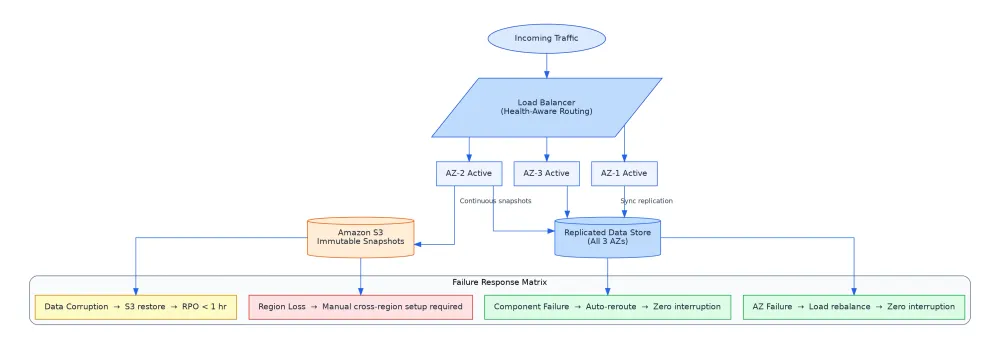
9. End-to-End Resilience Flow
The following diagram summarizes the complete resilience architecture, from
traffic ingestion through failure detection, automated response, and data
recovery.
traffic ingestion through failure detection, automated response, and data
recovery.

10. Conclusion: Built for Continuity
Amazon Quick replaces the legacy model of "Disaster Recovery" with a
modern standard of Continuous Resilience. The distinction is not semantic.
It reflects a fundamental architectural difference.
modern standard of Continuous Resilience. The distinction is not semantic.
It reflects a fundamental architectural difference.
The Active/Active architecture runs everything live, absorbs failures
automatically, loses no data during normal operations, and reserves the recovery
playbook for truly catastrophic scenarios that are orders of magnitude less
likely.
automatically, loses no data during normal operations, and reserves the recovery
playbook for truly catastrophic scenarios that are orders of magnitude less
likely.
By leveraging triple-redundancy across meaningful distances and decoupling data
durability from service availability, the architecture ensures that compliance
standards are not just met but architecturally surpassed.
durability from service availability, the architecture ensures that compliance
standards are not just met but architecturally surpassed.
For organizations requiring additional cross-region capabilities, the platform
provides a solid foundation upon which secondary region architectures can be
built to meet the most stringent enterprise requirements.**
provides a solid foundation upon which secondary region architectures can be
built to meet the most stringent enterprise requirements.**
Glossary
| Term | Definition |
|---|---|
| Active/Active | A deployment model where all nodes or sites handle live traffic simultaneously. There is no idle standby. Failures are absorbed by the remaining active nodes without a switchover event. |
| Availability Zone (AZ) | A physically distinct, independent data center facility within an AWS Region. Each AZ has its own power, cooling, and networking. AZs within a region are connected by low-latency links. |
| Cross-Region Replication (CRR) | Copying data from one AWS Region to another for geographic redundancy. Typically asynchronous due to the distances involved. |
| Game Day | A planned exercise that simulates real-world failure scenarios to validate system resilience and team response procedures. |
| Immutable Snapshot | A point-in-time copy of data that cannot be modified or deleted after creation. Protects against corruption and ransomware. |
| RPO (Recovery Point Objective) | The maximum acceptable amount of data loss measured in time. An RPO of 1 hour means up to 1 hour of data could be lost in a worst-case recovery. |
| RTO (Recovery Time Objective) | The maximum acceptable duration of downtime before services must be restored. An RTO of 24 hours means the service must be back online within 24 hours of a failure. |
| Synchronous Replication | Data is written to multiple locations at the same time, and the write is only confirmed once all copies are stored. Guarantees zero data loss but requires low-latency connections between sites. |
| Asynchronous Replication | Data is written to the primary location first and then copied to secondary locations afterward. Faster writes but introduces a lag window where data could be lost if the primary fails. |
| S3 (Amazon Simple Storage Service) | AWS object storage service designed for 99.999999999% (11 nines) durability. Used for snapshot and backup storage. |
| Load Balancer | A service that distributes incoming traffic across multiple targets (e.g., AZs or instances) to ensure no single target is overwhelmed and to route around failures. |
Enjoyed reading this content? Let the author know!
Your likes, comments, shares, and saves help creators reach more builders.

Loading recommendations
Loading article