
AIdeas: CarbonZero
AI-Powered Carbon Accounting & Gamified Compliance for African Businesses and Individuals. Built with Kiro and AWS, CarbonZero helps African SMEs and exporters track emissions, achieve EU CBAM compliance, and turn sustainability into a competitive advantage and save our planet in the process!

App Category
Social Impact
My Vision
Africa's industrial sector is booming, but there's a problem most people aren't talking about. The EU's Carbon Border Adjustment Mechanism (CBAM) kicks in fully in 2026, and it will charge up to €100 per ton of embedded carbon on imported goods. For a Nigerian cement factory exporting 50,000 tons a year, that could mean millions of naira in penalties. The worst part? Most African SMEs and exporters don't even know their carbon footprint, let alone have the tools to manage it.
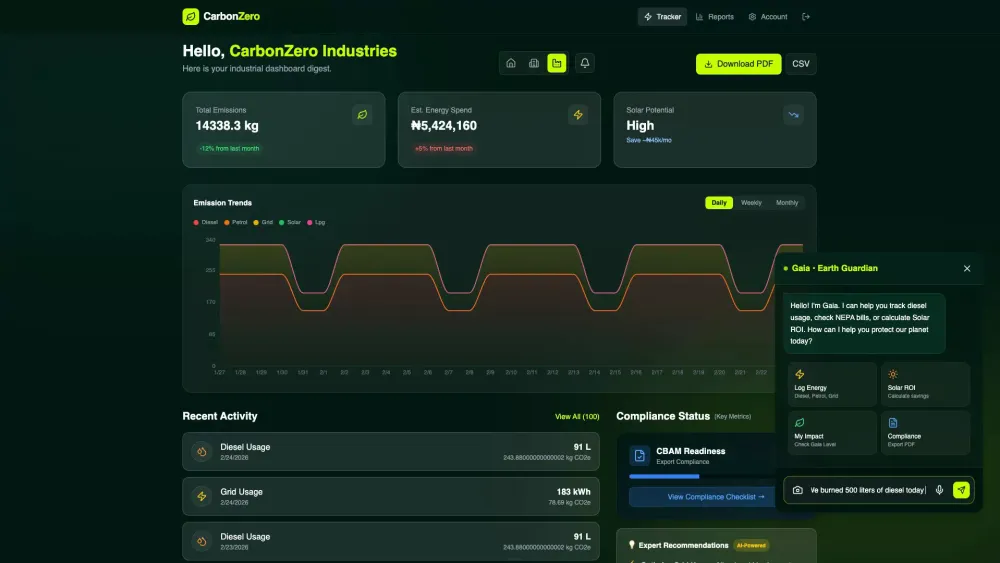
That's why I built CarbonZero. It's an AI-powered carbon accounting platform designed specifically for the African energy landscape. The core of the app is Gaia, an AI assistant that solves the biggest bottleneck in carbon accounting: getting the data in. Instead of filling out complex forms or wrestling with spreadsheets, a factory manager just types something like "We burned 500 liters of diesel in the backup generator today" and Gaia handles everything. It extracts the fuel type, applies the correct IPCC emission factor (2.68 kg CO₂e/L for diesel), logs the entry, and updates the compliance dashboard in real time.
CarbonZero serves three distinct user segments. Residential users can track their generator and grid usage at home. SMEs like hotels and logistics companies can monitor their daily fuel consumption and costs. And Industrial enterprises get full CBAM compliance reporting with audit-ready PDF exports. Each segment gets a tailored dashboard, realistic baseline data pulled from real Kaggle datasets, and actionable recommendations.
Why This Matters
Here's the reality on the ground in Nigeria: over 60% of our electricity comes from generators. with constant grid crashes, people seek alternatives for power. The average hotel spends about ₦1.5M every month on fuel alone. And yet, most of these businesses have zero visibility into their carbon footprint. When CBAM enforcement starts, they'll be caught completely off guard.
CarbonZero makes carbon accounting accessible to everyone, not just big enterprises that can afford sustainability consultants:
- A hotel owner can type "80 liters of diesel yesterday" to Gaia and instantly see what that means for their emissions
- A factory compliance officer can generate an audit-ready PDF report for their EU importer with one click
- A household tracking their generator usage earns Eco Reward badges and competes on a community leaderboard
I also built an Eco Rewards system with points, badges like "Solar Saver" and "Century Club", and a community leaderboard. The idea is to turn climate action from a boring regulatory checkbox into something people actually want to engage with. CarbonZero doesn't just help businesses survive the carbon transition. It gives them a reason to lead it.
How I Built This
CarbonZero is a full-stack application I built using Kiro and the AWS Free Tier:
Development with Kiro
Kiro was my primary IDE throughout the project. Its AI-powered coding assistance helped me move fast across the entire stack, from scaffolding React components to debugging emission factor calculations to writing AWS CDK infrastructure. Kiro's spec-driven development approach was particularly useful for keeping requirements clear while I iterated on features rapidly.
Frontend: React + TypeScript + Vite + Tailwind CSS
- Responsive dashboards with segment-specific views (Residential, SME, Industrial)
- Glassmorphic dark-mode UI with smooth Framer Motion animations
- Real-time activity updates via custom DOM events
- GamificationPanel component with badges, points, and live leaderboard
- ComplianceChecklist with interactive CBAM task tracking
Backend and AWS Architecture
- Python Flask REST API handling user management, activity logging, chat, compliance tracking, and report generation
- AWS Lambda for serverless compute (calculation engine, profiling agent, strategy agent)
- Amazon DynamoDB for low-latency storage of user profiles and emission logs
- Amazon S3 for storing generated CBAM-compliant PDF/CSV reports
- AWS CDK for infrastructure-as-code deployments
- SQLite local database for rapid prototyping and offline capability
AI Integration: Gemini 3
- Powers the Gaia natural language assistant
- Parses conversational inputs into structured emission data (fuel type, quantity, unit)
- Recognizes Nigerian energy terminology (PMS for petrol, AGO for diesel, NEPA/PHCN for grid electricity)
- Context-aware responses that reference user segment, historical consumption, and compliance status
- Smart fallback: a built-in regex parser handles common logging patterns even without API connectivity
Real-World Data
Baseline data generated from 3 actual Kaggle datasets:
- CO2 Emission Africa (Victor Aiyewumi) for industrial sector patterns
- Global Data on Sustainable Energy (2000-2020) for residential per-capita metrics
- Ship Fuel Consumption and CO2 Emissions for SME fuel patterns
Each user segment gets 12 months of historically accurate, Kaggle-derived activity data on first login.
Key Development Milestones
- Used Kiro to scaffold the project and set up the Flask API with user auth and SQLite persistence
- Built the Gaia AI chat system with Gemini 3 integration and a local NLP fallback
- Integrated 3 Kaggle datasets to generate realistic baseline data for all segments
- Implemented the gamification engine (points, 3 badge types, community leaderboard)
- Created CBAM compliance tracking with auto-generated PDF/CSV export reports
- Built a local AWS simulator (aws_local.py) so I could develop without cloud dependencies
- Polished the frontend with segment-specific dashboards, dark mode, and responsive design
Demo
Watch the full demo walkthrough:
Screenshots:


What I Learned
Building CarbonZero during this competition taught me a lot. Here are the five biggest takeaways:
1. Kiro changed how I build software. Having AI-powered coding assistance inside the IDE made me significantly faster. Whether I was scaffolding React components, debugging Flask endpoints, or writing CDK stacks, Kiro's spec-driven approach kept the project organized while its AI handled the boilerplate. That let me focus on the parts that actually required domain knowledge, like emission factor logic and CBAM compliance rules.
2. AI works best as an accessibility layer. The biggest insight was using AI not as a chatbot, but as a data collection interface. By letting users describe activities in plain language, including local Nigerian terms like "PMS" for petrol and "NEPA" for grid electricity, we removed the friction that makes carbon accounting feel impossible for non-technical users. Getting the prompt engineering right for structured data extraction was hard, but worth it.
3. Serverless on AWS scales beautifully. Building with AWS Lambda and DynamoDB taught me how to design truly stateless applications. The CDK made infrastructure changes feel as natural as code commits. And building a local simulator that mocks Lambda, DynamoDB, and S3 was crucial for iterating quickly without racking up cloud costs.
4. Regulatory tech is hard but necessary. Implementing CBAM compliance meant deep-diving into EU Regulation 2023/956, IPCC emission factor methodologies, and IEA country-specific grid data. Translating all of that into an interactive checklist that a non-expert can actually follow was one of the most rewarding challenges of the project.
5. Gamification makes compliance fun. Adding Eco Rewards, competitive badges, and a community leaderboard completely changed how the app feels. It went from a dry compliance tool to something people actually want to open. The psychology of competitive sustainability, seeing yourself climb the leaderboard, is a surprisingly powerful motivator.
Enjoyed reading this content? Let the author know!
Your likes, comments, shares, and saves help creators reach more builders.

Loading recommendations
Loading article