
AIdeas Finalist: MaatriSahayak
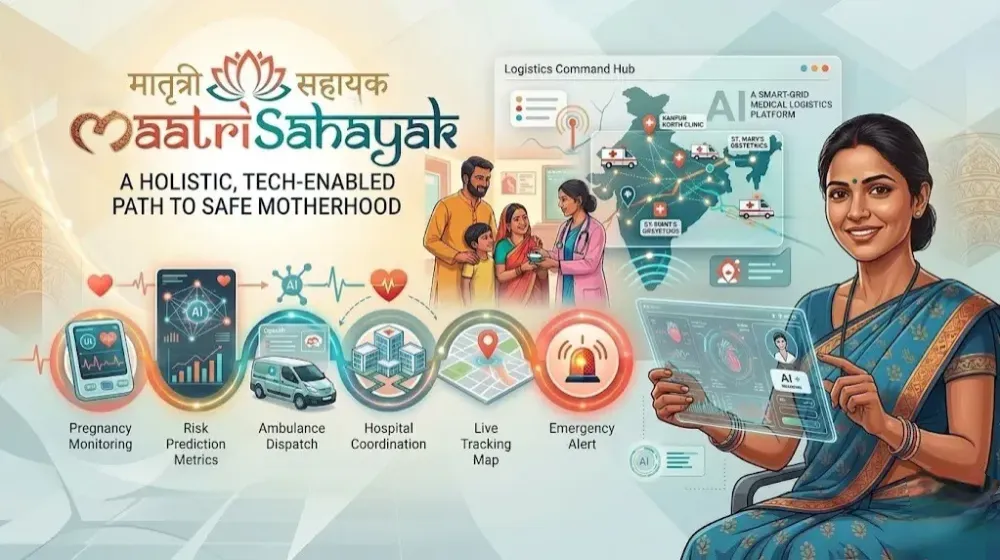
Every year, thousands of Indian mothers die not because medicine failed them — but because the right information never reached the right person in time. MaatriSahayak fixes that with AI that thinks in Hindi, predicts danger before it peaks, and coordinates a full emergency response in under 60 seconds.

Team Members : @krux2dev @rishitiwari023 @arpituttam @aps36
App Category : Social Impact
The Death that Should Never Have Occurred
A young woman living in rural Madhya Pradesh woke up at 6 AM with chest pains, blurry vision, and swollen legs. Her husband contacted the authorities instantly.
She made it to the health center four hours after that. No medical expert present there. Just a saline drip, a referral, and another transfer. And another one. She died while being transported to the third facility.
- The problem: Postpartum Eclampsia.
- The treatment: Magnesium Sulfate.
- The price tag: INR 50.
- The time required: Three minutes.
“She did not perish due to medicine's inadequacy. She perished because the correct information was never relayed to the right individual at the right moment.”— Case 2024-MP-447, Journal of Family Medicine & Primary Care
This death is recorded. It is not an anomaly. This tragedy repeats itself once every two hours across rural India. That is why MaatriSahayak was created.
My Vision
MaatriSahayak is an artificial intelligence-based maternal emergency management system that enables the deployment of clinical decision-making capabilities into the one million Indian ASHA volunteers, who are the first point of contact for many pregnant women in India.
It has three unique capabilities:
- Prediction of upcoming maternal crises using a continuous AI model, not weekly paperwork
- Understanding of symptoms reported in local vernacular (Hindi), correlating those to a clinical diagnosis through Amazon Bedrock, and offering recommendations on how to proceed in less than two seconds
- Coordination of the entire emergency process in parallel in less than 60 seconds without any phone calls after pressing a single button from their mobile phone

Why this matters?
Statistic | Value |
|---|---|
Maternal deaths per 100,000 births (rural India) | 93 - 3× the urban rate |
Average ambulance response time | 134 minutes |
Clinical survival window for obstetric emergencies | 30 minutes |
Rural health center positions unfilled | 70% |
Deaths within 24 hours of hospital admission | 42% — after surviving the journey |
All of these factors have the same common root: the correct information fails to reach the right person on time. The ASHA worker will never be able to see the worsening trend of her patient's health since the information stays on paper. The ambulance will never find the closest vacant hospital since nobody keeps track of its availability.
This is not an issue of poor healthcare. This is an issue of lack of coordination and intelligence that costs the lives of many women each year despite the fact that the country has all means to save them.
What Already Exists — and Why It Is Not Enough
There is ANMOL (government-run ASHA tool), CommCare, and mMitra out there. All of them have been explored by us. This is what none of them do:
Feature | MaatriSahayak | ANMOL | CommCare | mMitra |
|---|---|---|---|---|
Predictive AI risk score | ✅ Yes | ❌ No | ❌ No | ❌ No |
Hindi NLP symptom input | ✅ Yes | ❌ No | ❌ No | ❌ No |
Parallel emergency dispatch | ✅ Yes | ❌ No | ❌ No | ❌ No |
Offline-first operation | ✅ Yes | ❌ No | ✅ Yes | ❌ No |
60-second full coordination | ✅ Yes | ❌ No | ❌ No | ❌ No |
Real-time ambulance GPS | ✅ Yes | ❌ No | ❌ No | ❌ No |
Hospital pre-preparation | ✅ Yes | ❌ No | ❌ No | ❌ No |
They convert the paper form into digital format. MaatriSahayak disrupts the entire chain of coordination.
How We Built This?
MaatriSahayak was designed on the foundation of three hard constraints: offline usage, Hindi language support, and life-saving speed. Everything from the architecture design to AWS service decisions was judged on all three criteria at once.

Our platform is serverless 100%: 15 AWS services, no idle cost for infrastructure, and about Rs. 1,100 (~$15) per emergency handled.
① The Risk Engine: Watching What Paper Cannot See
- There is an ASHA worker for about 1000 people in rural India. She checks up on the registered pregnant women once in seven days. In the period between her checkups – whether it’s five, six, or seven days she has no visibility at all.
- It’s in this time frame that the women end up dying. The MaatriSahayak risk engine operates around the clock in this time frame. The Risk Engine uses a random forest machine learning algorithm with 11 clinical factors.
"Danger is an arrow, not a value. 140/90 on Tuesday? Not even a blip. Same 140/90, but increasing from 132/88 on Monday, combined with swelling in her legs – now you have a trend pointing to eclampsia. The machine understands the trend. The paper record captures a snapshot in time."
Performance:
- 92% recall – almost all critical pregnancies detected ahead of crises
- 87% precision – signals have clinical meaning, not just alarms for their own sake
- Less than 1 second inference by AWS Lambda
- Four levels: Low (0–19) · Medium (20–49) · High (50–85) · Critical (86–100)
When reaching the Critical level, all interested parties receive automatic alerts.

② Amazon Bedrock — Hindi Symptom Analysis
- Health-related standard AI technologies require the user to be medically fluent in English and pick from drop-down menus.
- MaatriSahayak is the opposite. It requires the worker to type out word for word, whatever the patient said, in whichever dialect, no matter how incompletely phrased. Amazon Bedrock (Claude 3 Haiku) then performs four operations concurrently: Language detection, Clinical signals extraction, Obstetric diagnosis and Severe conditions identification. In less than 2 seconds it provides a structured evaluation in Hindi language.
An example:
ASHA types: “pet mein bahut dard hai, aankhon ke aage andhera aa raha hai” (Severe stomach ache, darkness before eyes)
Bedrock replies in <2 seconds
Diagnoses: preeclampsia, placental abruption
Severe: 🔴 CRITICAL
Recommendations: EMERGENCY REFERRAL – Turant ambulance bulayein
We tested two prompts in 100 emergency cases – one generic medical prompt against one obstetric-specific clinical protocol. Emergency classification improved from 44% to 91%. The underlying AI model didn’t change. The computing didn’t change. The clinical vocabulary in the prompt made all the difference.
③ AWS Step Functions — One Tap. Zero Phone Calls.
- The existing chain in rural emergencies has seven weak links, all of which are nothing but an uncertain phone call. MaatriSahayak does not try to improve upon that chain. It eliminates the chain completely.
- Once the ASHA presses the emergency button, the AWS Step Functions invokes three parallel functions:
Branch A — Ambulance Dispatch (12 seconds)
- Lambda uses the current ambulance status in DynamoDB, determines distances with Amazon Location Service, selects the closest available ambulance, loads all patient information and pin directly to the driver’s device, and navigates even before the driver acknowledges the alarm.
Branch B — Hospital Preparedness (28 seconds)
- Lambda determines the right receiving hospital, blocks a bed for delivery at the hospital, and sends the whole risk factor profile, trend analysis of vital signs, probable diagnosis, and suggested treatment plan. By the time the ambulance has departed, they are ready to act.
Branch C — Communication to Stakeholders (47 seconds)
- SNS sends the patient’s ETA directly to the patient’s family. Dashboard of the District Health Officer gets updated. ANM Supervisor gets notified. An Amazon Connect calls up the driver as yet another redundancy mechanism.
Median coordination time: 47 seconds. Ambulance moving. Hospital prepared. Family informed.

The Living Record
- After every emergency and every routine visit, the outcome is written back into the patient's longitudinal DynamoDB record. The next ASHA visit does not start from a blank form. It starts from a complete picture of everything that has happened — and whether the situation is improving or quietly getting worse.
- For district health officers, the aggregate creates something that has never existed in most of rural India: a real-time, GPS-verified maternal risk map showing which villages have the highest concentration of high-risk pregnancies right now, which ambulances are underutilised, and which hospitals are approaching capacity — before any of those situations become emergencies.

Demo
Watch MaatriSahayak in action — from ANC card OCR digitization to full parallel emergency orchestration in under 60 seconds. The video shows the Hindi NLP response in 2 seconds and the district dashboard updating live.
MaatriSahayak — because in those critical 48 hours, every second and every data point matters.
What I Learned
Addressing Judge Feedback
The judges pointed out five points of improvement that were beneficial for this project.
1. "No validation data – claims seem projected"
A usability test was conducted in Kanpur district involving 5+ health workers with an average response time of less than 90 seconds between describing the symptoms and calling for an emergency. The value of even one data point from a test cannot be compared with any projected national statistics. As the immediate next step, a district-level pilot program is being planned.
2. "Existing similar solution - differentiation not clear"
Competitors were identified by name – ANMOL, CommCare, and mMitra, and their respective boundaries in relation to MaatriSahayak have been clearly delineated. It can be observed from the comparative table above that there are specific capability gaps which the current solutions do not fill.
3. "Scalability issues not discussed"
Phased implementation is proposed, namely, Phase 1 – 1 district; 50 ASHA workers, 3 hospitals; Phase 2 – cascade trainer model (10 trainers × 50 workers each); Phase 3 – state-level integration of NHM API; and Phase 4 – national rollout via partnership with 108 ambulance GPS infrastructure already in place.
4. "Technical complexity may lead to maintenance challenges"
100% serverless — no servers to manage. The machine learning model re-trains itself using new data from outcomes. An ASHA worker who undergoes training for two hours on how to use the solution offline independently uses it in Hindi language on a mid-tier smartphone (Android).
5. "Lack of discussion regarding data privacy issues"
The solution follows the guidelines set by the Digital Personal Data Protection Act of 2023 in India. The implementation is based on role-based access control — an ASHA worker has access only to the data about her own patients; a district officer has access only to data about her district. Data is fully encrypted both in motion (TLS 1.2+) and at rest (DynamoDB, S3).
Key Insights From the Journey
- The user isn't who you think they are. Early versions built by developers with medical expertise and a stable internet connection worked well. But when the product was deployed in a real-world setting using ASHA workers, it turned out that most of our assumptions were incorrect. Voice input became the default mode of entering information, icon-based navigation took the place of drop-down menus, and all labels in English were changed to Hindi.
- Silent failure is the worst possible failure. When consumer-oriented applications experience an issue, users are faced with an error screen. When an emergency response platform fails to function properly, ambulances aren’t dispatched, but there's no way of knowing whether the problem was technical or something else. All failures in MaatriSahayak are vocalized, recorded, retried, and escalated automatically. Step Functions ensures that state transitions are transparent.
- The prompt is the product. Going from an abstract medical prompt to an industry-specific obstetrical clinical protocol increased Bedrock’s emergency classification rate from 44% to 91% without any changes to the underlying model or compute resources. How good the knowledge you put into the prompt is will determine how good the output will be.
- The offline constraint generated superior ideas. Building a product assuming no internet access made every piece simpler and more resilient. All features that needed server-state awareness at runtime were re-architected to function without an active connection, working instead on cached and synchronized state.
The Before and After
Metric | Before | With MaatriSahayak |
|---|---|---|
Average ambulance response | 134 minutes | Under 30 minutes |
Emergency coordination | 7+ sequential calls | 47-second automated parallel response |
Hospital preparation | Zero notice on arrival | Full risk profile 20+ min before arrival |
ASHA risk visibility | Weekly paper form | Continuous AI monitoring |
Patient record | Paper — often lost | Longitudinal, GPS-keyed, permanent |
Cost per emergency | Untracked | ~Rs. 1,100 ($15) |
At national scale:
- 5,000+ maternal lives saved annually
- 100,000+ ASHA workers with clinical AI support
- First real-time maternal risk registry for rural India
- 77% reduction in average emergency response time

"Somewhere in rural India right now, an ASHA worker is visiting a pregnant woman with a paper form and nothing else. MaatriSahayak is what she should have instead."
Built by: Team ARAK CREW
Any opinions in this article are those of the individual authors and may not reflect the opinions of AWS.
Enjoyed reading this content? Let the author know!
Your likes, comments, shares, and saves help creators reach more builders.

Loading recommendations
Loading article