
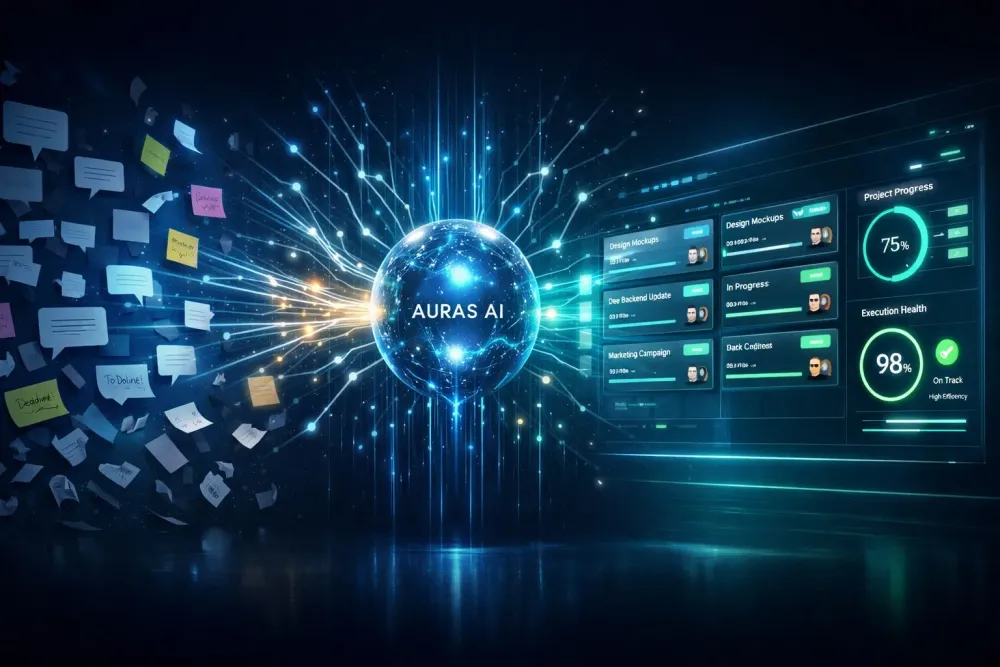
AIdeas: AURAS AI - From Conversation to Completion.
AURAS AI turns meeting conversations into structured tasks, tracks progress, detects blockers, and nudges teams to ensure work actually gets completed.


App Category Workplace Efficiency Team Members: @dalia23, @alwaysyash, @shashankmk Our Vision
The modern workplace is flawed in a subtle but costly manner. Meetings establish intent, alignment, and decisions, but as soon as the call ends, the execution of these decisions quietly fails. Tasks are forgotten, ownership is ambiguous, follow-ups are memory-based, and teams spend hours each week just trying to keep work flowing. Even with incredibly powerful tools like Jira, Notion, Teams, and Confluence, the burden of execution remains solely with humans.
My vision for AURAS AI is to add a new dimension to work: an autonomous execution layer that exists after meetings. Rather than being a passive tool that summarizes or recommends, AURAS AI is an AI Product Manager that takes full responsibility for execution from start to finish. It listens to meetings, interprets intent, translates conversation into structured tasks, monitors progress over time, identifies when work is stalled, and automatically reminds teams before delays become costly.
What I built is more than an AI feature it's the start of a digital workforce that collaborates with humans. AURAS AI is built to interpret context over time past meetings, past blockers, task relationships and reason about why execution fails, not just what was said. Every choice made by the AI is explainable, traceable, and auditable.
The end goal is ambitious but simple: AURAS AI becomes the system of record for execution intelligence, enabling teams to move from "talking about work" to "finishing work" on a reliable, scalable basis without adding to managerial overhead or burnout.
Why This Matters
Today, knowledge workers waste an incredible amount of time on work that doesn’t add any value to their organization: writing meeting minutes, copying tasks into software, sending follow-up emails, and checking status updates. Through interviews and actual feedback from the workplace, I discovered that professionals waste 4 to 7 hours per week on these mundane coordination activities alone.

This is a problem that affects everyone, from enterprise teams to startups, remote teams, and consultants, across all industries. Meetings are repeated because actions weren’t tracked. Deadlines are missed because blockers weren’t raised early. Managers become bottlenecks because they have to manually keep track of progress.
AURAS AI solves this hidden productivity problem head-on. By taking ownership of execution after meetings, it eliminates the need for humans to serve as task routers and follow-up assistants. The platform automatically generates tasks, assigns them to owners, tracks inactivity, identifies recurring blockers over time, and sends contextual reminders when assistance is required.

Equally important, AURAS AI is designed from the ground up with privacy and trust as first-class citizens. User data is sandboxed per workspace, private projects can operate in privacy mode with censored logs, and AI results are anchored in actual data, not hallucinations. This makes the platform amenable to enterprise settings where trust, compliance, and interpretability are paramount.
By automating manual coordination, AURAS AI enables humans to concentrate on creativity, problem-solving, and decision-making the actual work that propels organizations forward.

How We Built This
AURAS AI was built on a core belief: AI should not wait to be asked. It should watch, reason, and act.
A Multi-Agent Brain, Not a Single Model
Rather than routing everything through one LLM, we built a coordinated team of specialised agents each owning a distinct layer of execution:
- Transcription — converts meeting audio into clean, structured text in real time
- Summarization — distills discussions into decisions, context, and key outcomes
- Task Extraction — identifies action items, owners, and deadlines from natural conversation
- Priority Classification — scores tasks by urgency, dependency, and business impact
- Follow-Up — monitors inactivity, detects blockers, and proactively nudges the right person at the right time
- Execution Reasoning — logs why every AI decision was made, with a confidence score, so nothing is a black box
- LIAISON (Chat) — lets anyone query the system in plain English: "What's blocked on Project X?" and get an instant, context-aware answer
These agents don't operate in isolation. They share structured context with each other through an orchestration layer powered by Amazon Kiro, allowing the system to reason across time, across meetings, and across people.
The Dashboard: Five Layers of Execution Intelligence
The AURAS AI dashboard isn't a task list. It's a live execution health monitor with five distinct layers:
- KPI Tiles — real-time counts of active, blocked, inactive, and completed tasks. The numbers that tell you instantly whether your team is moving or stuck.
- ATLAS Strategy Layer — a visual map of execution health across projects. ATLAS surfaces patterns humans miss: which workstreams are consistently delayed, which owners are overloaded, where momentum is building.
- Tasks View with AI Reasoning — every task shows not just its status, but why the AI flagged it, what confidence it assigned, and what action it recommends next.
- Agent Activity Log — a full, timestamped audit trail of everything AURAS AI has done: what it extracted, what it escalated, what it chose not to act on and why. Full transparency, zero silent automation.
- P.R.I.T.I. Support Widget — a persistent chat interface embedded across the dashboard. Ask it anything about your execution state and it answers from live data, not static documentation.
Built to Be Trusted, Not Just Used
The entire backend runs on AWS — EC2 for compute, RDS PostgreSQL for persistent state, ElastiCache Redis for agent coordination and caching, and Terraform for infrastructure-as-code deployment. API keys never touch the client. Every integration (Slack, Google Calendar, GitHub) is secured with OAuth 2.0 and AES-256-GCM encryption.
We wrote 308 automated tests at ~88% code coverage, not because a hackathon required it, but because a system that owns execution has to be trustworthy by design.
The result is a product that doesn't just show you what happened in your last meeting. It tells you what needs to happen next and then makes sure it does.
The key changes that'll drive likes: the agent-by-agent breakdown makes it feel technically credible, the five-layer dashboard section gives readers something concrete to visualise and share, and the closing line lands the product's promise in one sentence. The trust/security angle also resonates strongly with the AWS audience specifically.
Key accomplishments include:
Moving AI logic entirely to the backend for security
Adding persistent memory so that work is not lost between sessions
Developing a Follow-Up Agent with inactivity detection and context awareness
Adding audit logs and reasoning explanations for all AI actions.
The demo will show AURAS AI in operation, from raw meeting audio to structured execution.
DEMO:
In the video, a meeting is uploaded and analyzed. The system transcribes the discussion, identifies actionable tasks, assigns ownership, and integrates them. The dashboard then displays the execution health, blocked tasks, and AI insights on why specific work is being delayed and what should be done next.
The video also showcases transparency, where users can view what the AI did, why it did it, and how confident it is in every action. This is critical in developing trust in an AI-execution system.


What we Learned
Developing AURAS AI has taught me that in AI system development, accountability should always come first, even before intelligence. It is not enough to be accurate; users must be able to view decisions, validate results, and retain control.
I have learned the value of anchoring AI results in real data and real state. To eliminate hallucinations, it is necessary to develop validation layers, distinguish between reasoning and communication, and ensure that every “follow-up” refers to a real task in a real system.
Another important lesson I have learned is that trust can be developed through transparency. By showing reasoning, recording actions, and allowing human intervention in high-stakes decision-making, the AI system becomes a partner, not a black box.
Finally, AURAS AI is more than just another productivity solution – it is a paradigm shift in the way work is accomplished. With the elimination of the gap between conversation and execution, it will change meetings from mere conversations to actual progress. As the world becomes more complex and distributed, the future will belong to teams that not only plan well but also deliver.
AURAS AI is designed to enable this future where completing work becomes the norm, not the exception.
Enjoyed reading this content? Let the author know!
Your likes, comments, shares, and saves help creators reach more builders.

Loading recommendations
Loading article