
NovaFlow Ops: Deterministic Agentic Browser Automation with Audit Trails Using Amazon Nova 2 Lite
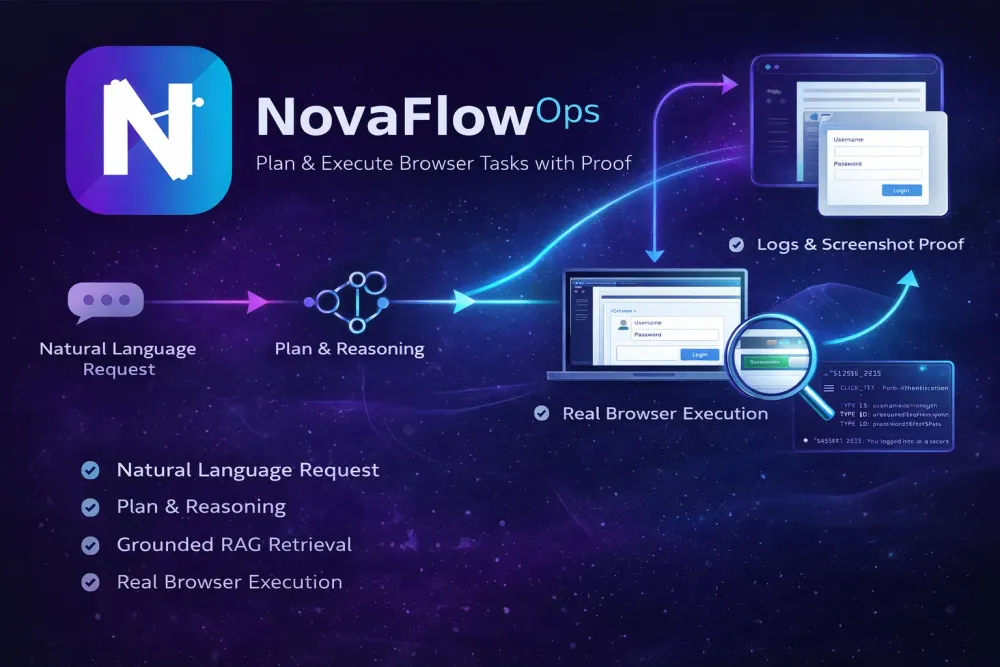
NovaFlow Ops converts natural-language tasks into deterministic browser automation with structured planning, RAG grounding, and auditable execution. It combines Amazon Nova 2 Lite, Titan Text Embeddings v2, and Playwright to produce verifiable logs and screenshot artifacts.

NovaFlow Ops: Deterministic Agentic Browser Automation with Audit Trails Using Amazon Nova 2 Lite
This article presents NovaFlow Ops, a technical exploration of deterministic browser automation using Amazon Nova 2 Lite for planning, Amazon Titan Text Embeddings v2 for retrieval (RAG), and Playwright for verifiable browser execution.
The goal of this project is to demonstrate how natural-language tasks can be transformed into controlled, auditable browser workflows with structured execution and evidence artifacts.
This content reflects the author’s independent implementation and analysis. It does not imply official endorsement by Amazon Web Services.
The Problem: Trust in Agentic Automation
Modern teams still perform repetitive browser-based operations manually: logging into dashboards, updating configurations, submitting forms, and validating outcomes.
While AI systems can generate instructions, many lack:
- Controlled execution boundaries
- Deterministic step-by-step behavior
- Full audit trails
- Verifiable evidence of actions performed
NovaFlow Ops focuses on making automation reliable and inspectable rather than opaque.
Architecture Overview
The system is structured into three clearly separated layers:
- Planning and reasoning (Amazon Nova 2 Lite)
- Grounded retrieval (Amazon Titan Text Embeddings v2)
- Deterministic browser execution (Playwright)
This separation of responsibilities improves reliability and transparency.
Step 1 — Planning with Amazon Nova 2 Lite
Amazon Nova 2 Lite is used via Amazon Bedrock Converse for:
- Task interpretation
- Structured reasoning
- JSON plan generation
Given a request such as:
“Log in to the admin portal and capture a screenshot after successful authentication.”
Nova 2 Lite produces a bounded JSON plan composed of strict UI primitives:
plaintext
{"steps": ["CLICK_TEXT: Login","TYPE_ID: username=admin","TYPE_ID: password=********","CLICK_TEXT: Submit","ASSERT_TEXT: Welcome","SCREENSHOT: after_login"]}
The model performs reasoning and structured planning only. It does not directly execute browser actions.
This bounded plan design prevents arbitrary tool execution and enforces deterministic execution rules.
Step 2 — Grounded Retrieval with Titan Text Embeddings v2
To reduce hallucination risk and enforce contextual consistency, NovaFlow Ops includes a lightweight RAG layer.
Internal documentation (a “Brand Kit”) is indexed using:
Amazon Titan Text Embeddings v2
For each task:
- The query is embedded
- Relevant context chunks are retrieved
- Retrieved content is injected into the planning prompt
Embeddings are used exclusively for retrieval, not generation.
This approach improves:
- Policy alignment
- Tone consistency
- Planning reliability
- Reduced hallucination risk
Step 3 — Deterministic Execution with Playwright
Execution is performed using Playwright with a stateful Chromium session.
Each step in the generated plan:
- Executes atomically
- Has explicit timeouts
- Produces structured metadata
- Can optionally generate a screenshot artifact
The system does not simulate execution. It performs real browser interactions.
Each run maintains session state to support multi-step workflows.
Auditable Output: Logs and Screenshot Artifacts
Every execution run produces:
- Structured, timestamped logs
- Final URL and page title metadata
- Screenshot artifacts stored and served via API endpoints
Artifacts are exposed under a dedicated route:
/artifacts/...
This enables full inspection of what was executed and what the browser displayed at each step.
Auditability is treated as a first-class design requirement.
Safety and Execution Controls
Agentic browser systems require strict guardrails.
NovaFlow Ops implements:
- Starting URL policies (STARTING_URL_MODE)
- Domain allowlists
- HTTP/HTTPS sanitization
- SSRF protections
- A strict DSL (one action per step)
These constraints reduce navigation risk and limit potential misuse.
Runtime Modes
The system supports two provider modes:
Bedrock Mode
- Nova 2 Lite for planning
- Titan Text Embeddings v2 for retrieval
- Live AWS infrastructure
Mock Mode
- Deterministic local planner
- Deterministic embedding behavior
- No AWS dependency
Mock mode ensures reproducibility in development environments.
Design Principles
NovaFlow Ops is based on five architectural principles:
- Clear separation between reasoning and execution
- Bounded execution primitives
- Retrieval grounding before planning
- Evidence-first automation (logs + screenshots)
- Explicit navigation controls
The resulting workflow:
Natural Language → RAG → Nova Plan → Playwright Execution → Audit Evidence
Key Learnings
- RAG improves consistency, but auditability builds trust.
- Deterministic primitives outperform unconstrained autonomy.
- Observability is critical in agentic systems.
- Clear architectural separation reduces fragility.
Conclusion
NovaFlow Ops demonstrates how Amazon Nova 2 Lite and Titan Text Embeddings v2 can be combined with deterministic browser automation to create a verifiable agentic workflow.
The emphasis is not on autonomous behavior alone, but on structured reasoning, controlled execution, and audit-ready outcomes.
In agentic systems, reliability depends on evidence.
Enjoyed reading this content? Let the author know!
Your likes, comments, shares, and saves help creators reach more builders.

Loading recommendations
Loading article