AWS Builder Center
AIdeas: AgriNexus AI — An AI Agronomist for 100M+ Smallholder Indian Farmers on WhatsApp

AIdeas: AgriNexus AI — An AI Agronomist for 100M+ Smallholder Indian Farmers on WhatsApp

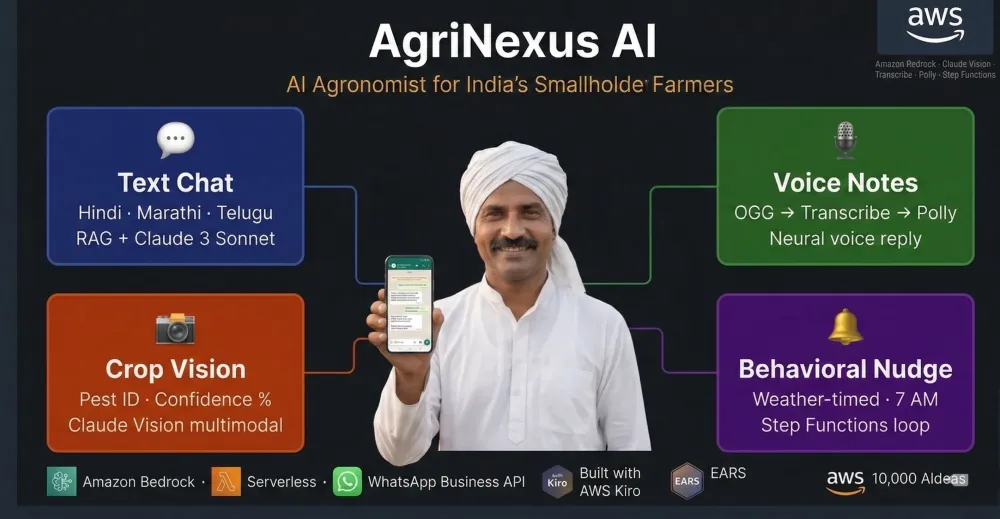
A serverless WhatsApp advisor for India's smallholder farmers: voice notes transcribed, crop photos diagnosed, and weather-timed nudges sent — all in Hindi, Marathi, or Telugu, built with AWS Bedrock and Kiro. Built for the AWS Builder 10,000 AIdeas competition -

Solution architect. Winner, Innovation Award (APJC), AWS 10,000 AIdeas Competition.

 See AgriNexus AI in action first — full end-to-end demo below

End-to-end demo: Onboarding · Voice · Vision · Behavioral Nudge Loop — built serverless on AWS

My Vision

Every year, Indian cotton farmers lose 30-40% of their crops to pests and diseases. Not because they don't know what to do — but because they don't know when to do it, or in which language to ask.
Meet Ramesh. He grows cotton in Latur, Maharashtra. Three days ago, he noticed something wrong with his leaves — a pattern he's never seen before. He asked the village agronomist, who visits once a month. He searched online, but results came back in English. Meanwhile, his crop is getting worse. The 3-day window for bollworm treatment is closing.
This is the daily reality for over 100 million smallholder farmers across India. The information exists — ICAR (Indian Council of Agricultural Research) produces world-class research, FAO (Food and Agriculture Organization) manuals are comprehensive. The failure is the last mile: that knowledge rarely reaches Ramesh in Latur, in Marathi, in time to make a difference.
AgriNexus AI bridges that gap using WhatsApp, Amazon Bedrock, and a fully serverless AWS stack.
No app to download. No English required. No IVR menus to navigate. Ramesh sends a voice note, a photo of a sick leaf, or a Hindi text — and gets cited, actionable advice back within seconds. When weather conditions are optimal for spraying, AgriNexus sends him a nudge at 7 AM, waits for his "हो गया" (done) confirmation, then cancels the reminder. If he doesn't respond, a follow-up arrives 24 hours later. The loop closes only when Ramesh acts.
This isn't just an app. It's a digital extension agent in every farmer's pocket — 24/7, in their language, timed to the weather.
Indian farmer struggling to find crop advice vs receiving instant Hindi advice via AgriNexus AI on WhatsApp
Knowledge exists. It just never reaches Ramesh — until now

Why Current Solutions Fail

There are already agricultural AI tools in the market. Farmer.Chat (Digital Green), iSDA Virtual Agronomist, AgriChat.AI, WeatherInbox — all real, funded, deployed. They all share the same fundamental limitation: they stop at information delivery.
They tell Ramesh what to do. None of them know whether he did it.
  • Agricultural AI chatbots: Answer questions well. No behavioral follow-up, no closed-loop confirmation, no verified action.
  • Generic apps: One-size-fits-all advice ignores local weather, specific crops, and timing windows
  • SMS alerts: Text-only, passive, no conversation, no follow-up
  • Call centers: IVR (Interactive Voice Response) menus in Hindi that don't serve Marathi or Telugu speakers; limited hours; chronically under-resourced
  • YouTube videos: Passive learning, no accountability, no personalization
The gap isn't information. It's the distance between knowing what to do and actually doing it — and every existing system leaves that gap open.
AgriNexus closes it.
Competing tools stop at information delivery; AgriNexus closes the loop only when Ramesh confirms action
Every other tool stops at delivery. AgriNexus follows up until Ramesh acts.
WhatsApp has 500+ million users in India — it's already on every farmer's phone. No new habit to form. Ramesh already sends voice notes to family. He can use AgriNexus the same way from day one.

Why Behavioral Nudges Work

Thaler and Sunstein's nudge theory (Nobel Prize 2017) is clear: timing matters. The right advice at the wrong time produces no action. AgriNexus's weather-triggered nudges align with farmer decision-making precisely when conditions are optimal — and the closed-loop accountability ("हो गया" — done) is what turns advice into behavior change, not just information delivery.
Extension agents are chronically under-resourced: one agent for 800-1,000 farmers in many districts. AgriNexus doesn't replace them — it scales their reach. One agent managing the system serves thousands of farmers simultaneously, with consistent advice, in their language, at the right moment.

Why This Matters

The Numbers

  • 100+ million smallholder farmers in India
  • 1:1,000+ extension agent-to-farmer ratio in many districts
  • 30-40% annual crop loss to pests and diseases
  • $15-20 billion economic impact per year
  • 10,000+ farmer suicides annually — debt from crop loss is a leading driver

What Changes for Ramesh

ScenarioBefore AgriNexusWith AgriNexus
Pest adviceWait for monthly agronomist visitInstant RAG response with cited sources
Spray timingFixed calendar, regardless of weatherNudge fires when wind < 15 km/h
LanguageEnglish/Hindi IVRNative Hindi, Marathi, or Telugu
AccountabilityNoneClosed-loop DONE confirmation
Crop loss (projected)35%~15%
Season incomeBaseline+Rs. 30,000 (~$360)
Crop loss reduction is projected based on ICAR/FAO research on timely pest intervention and spray timing adherence.
Infographic comparing agricultural practice adoption rates. Left panel: current state shows 20–30% practice adoption with zero accountability and unverified implementation. Right panel: AgriNexus impact    shows 30% higher practice adoption rates, closed-loop DONE confirmation as audit trail, and less preventable crop loss with higher verified income.
20–30% adoption with no accountability. AgriNexus closes the loop — advice confirmed, behavior changed.
Scale that to 1,000 farmers: Rs. 30 million ($360,000) additional income per season.

How AgriNexus Compares to Existing Solutions

There are well-funded, deployed agricultural AI systems in India and globally. Here is an honest comparison:
CapabilityFarmer.ChatiSDA AgronomistAgriChat.AIAgriNexus AI
AI-powered Q&AYesYesYesYes
WhatsApp deliveryPartialYesYesYes
Multi-lingual textYesNoNoYes
Voice input + outputNoNoNoYes
Behavioral nudge engineNoNoNoYes
Closed-loop DONE confirmationNoNoNoYes
Weather-triggered proactive alertsNoPartialYesYes
Verified practice adoptionNoNoNoYes
Cost per farmer at scaleNot publicNot publicNot public<$0.70/year
The top row is roughly even. Everything below it is unique to AgriNexus. The compound advantage — voice-first accessibility, weather-triggered nudges, and closed-loop behavioral tracking together — is not replicable by adding a single feature to a competitor. It requires a fundamentally different architecture and a different philosophy: outcomes, not information.

How AgriNexus Works: A Continuous Advisory Cycle

AgriNexus operates across three interconnected stages: Onboarding, Conversational Advisory, and Behavioral Nudges. Together they form a closed loop — from first contact to crop protected.
See the Onboarding / profiling and Conversational Advisory in action

Ramesh onboards in Hindi in under 30 seconds, then gets cited crop advice via Amazon Bedrock RAG

Stage 1: Onboarding & Profiling

Ramesh sends "Namaste" or "Hello" or "Namaskar" ... to the AgriNexus WhatsApp number — his first message, any greeting. No profile exists yet in DynamoDB, so the system replies with a multilingual welcome and a scrollable language list (WhatsApp's list message type is used here because it supports 4 options — one more than the 3-button cap on reply buttons):
1
2
3
4
5
6
7
8
Welcome to AgriNexus AI! 🌾

नमस्ते! AgriNexus AI में आपका स्वागत है।
नमस्कार! AgriNexus AI मध्ये आपले स्वागत आहे.
నమస్కారం! AgriNexus AI కి స్వాగతం.

Please choose your language / कृपया अपनी भाषा चुनें:
[Select Language ▼] → English / हिंदी / मराठी / తెలుగు
From there, every step uses WhatsApp reply buttons rendered in the farmer's chosen language and script:
StepAgriNexus asks (Hindi)Farmer sees
LanguageMultilingual welcome — all 4 languagesEnglish / हिंदी (Hindi) / मराठी (Marathi) / తెలుగు (Telugu)
Districtबढ़िया! आप किस जिले में हैं? (Great! Which district are you in?)[लातूर] [जालना] [नागपुर] *(*Latur / Jalna / Nagpur)
Cropधन्यवाद! कौन सी फसल उगाते हैं? (Thank you! Which crop do you grow?)[कपास] [गेहूं] [सोयाबीन] (Cotton / Wheat / Soybean)
Consentमौसम सलाह चाहते हैं? (Want weather-based advice?)[हाँ ✅] [नहीं ❌] (Yes / No)
Completeबधाई हो! प्रोफाइल तैयार है। (Congratulations! Profile ready. Ask any question.)—
The entire state machine (language → location → crop → consent → complete) runs inside the MessageProcessor Lambda, with each state stored in DynamoDB as onboarding_state. No typing required at any step — a farmer who can't read can tap through buttons and be fully onboarded in under two minutes.
Smart shortcut: if the very first message is already a language keyword ("Hindi", "हिंदी", "mr", etc.), the system skips the welcome screen and jumps straight to district selection. Both paths handled gracefully.
Once onboarding_complete: true is written to DynamoDB, Ramesh is profiled: Hindi dialect, Latur district, Cotton crop, nudge consent active. Every subsequent interaction — advice, nudges, reminders — is personalized against that profile.
See it in action: Full onboarding in under 30 seconds — no app download, no account creation. Ramesh picks Hindi, selects Latur district, chooses Cotton, and opts in to weather nudges. Every message from this point arrives in his language.

Stage 2: Conversational Advisory

Ramesh types a question in Hindi, Hinglish, or Marathi. Within 3-5 seconds, AgriNexus responds in his language with a specific, cited answer drawn from FAO and ICAR research manuals. Not a generic tip — a response that knows he grows cotton in Latur and answers accordingly.
Farmer sends Hindi question via WhatsApp, AgriNexus returns cited agronomic advice in seconds
Hindi question in. Cited ICAR advice out. 3–5 seconds end-to-end

Flow 2: Voice

Typing in Devanagari on a basic Android is slow. Ramesh sends a 30-second voice note instead — describing his crop symptoms in natural spoken Hindi. AgriNexus transcribes it, runs the same AI analysis as a text message, and replies with both a voice note and text. He hears the answer while walking his field.
See the Voice conversational flow in action

Voice note in → Amazon Transcribe → Bedrock RAG → Amazon Polly → answer spoken back

Flow 3: Vision / Image Analysis

Ramesh photographs a yellowing leaf and sends the photo. In seconds, AgriNexus returns a structured diagnosis — not a generic tip, but a specific prescription for his crop:
> 🔍 कपास बॉलवर्म (Cotton Bollworm — Helicoverpa armigera)
> विश्वास: 87% | गंभीरता: अधिक (Confidence: 87% | Severity: High)
>
> उपचार: Chlorpyrifos 50% + Cypermethrin 5% EC (Treatment)
> मात्रा: 2ml प्रति लीटर पानी (Dosage: 2ml per litre of water)
> समय: सुबह या शाम को छिड़काव करें (Spray in early morning or evening)
> ⚠️ सुरक्षा: दस्ताने और मास्क पहनें। 48 घंटे बच्चों को दूर रखें।
> (Wear gloves and mask. Keep children away for 48 hours.)
>
> Source: ICAR-CICR Pest Advisory 2024, NIPHM Cotton Advisory 2022
No agronomist visit. No guessing from a YouTube thumbnail.
See the Vision Analysis in action

Diseased leaf photo → Claude Vision on Amazon Bedrock → pest diagnosis with dosage and safety warning in under 10 seconds

Flow 4: Nudge Loop (The Behavior-Change Engine)

AgriNexus doesn't send nudges blindly. Before any message fires, four conditions must pass: wind below 15 km/h, no rain forecast, no duplicate nudge already sent today, and confirmed farmer consent. The nudge is crop-specific — a wheat farmer gets a fungicide alert, not a generic spray reminder.
When conditions are right, at 7 AM, Ramesh receives:
> "आज गेहूं में फफूंदनाशक स्प्रे के लिए अच्छा मौसम है। हवा 8 km/h।"
> (Today is good weather for fungicide spray on wheat. Wind: 8 km/h.)
>
> [हो गया ✓] (Done)    [अभी नहीं] (Not now)
He taps "हो गया" (done) — the system knows instantly, all pending follow-ups cancelled, loop closed. If he doesn't respond, a follow-up arrives at 24 hours, then 48 hours.
See the Behavioral Nudge loop in action

Weather check → nudge sent → Not Yet acknowledged → Done detected via DynamoDB Streams → reminders cancelled. Loop closed.

Every other agricultural advisory system in this space ends at message delivery. AgriNexus doesn't. It follows up until Ramesh confirms. That is the structural difference between an advice bot and a behavior-change engine.
Beyond Weather: The Nudge Engine's Future Potential
The current MVP focuses on weather-triggered spray nudges. But the same closed-loop architecture applies to any intervention that needs a trigger, a message, and a confirmation: market timing alerts when Mandi (local Market) prices spike, crop stage reminders tied to planting dates, area-wide pest outbreak warnings aggregated from Vision analysis, subsidy application deadlines from government scheme calendars.
The architecture is already built for this. Each nudge type needs exactly three things:
  1. A trigger condition (weather API, price API, crop calendar, aggregated Vision data)
  2. A message template in the farmer's language
  3. A confirmation keyword for closed-loop tracking
The MVP proves the pattern works. The roadmap is about expanding the trigger library — not rebuilding the engine.

How I Built This

The Stack

AgriNexus is fully serverless on AWS, designed with EARS (Easy Approach to Requirements Syntax) methodology (100+ traceable requirements) and built using Kiro AI (spec-to-code):
LayerTechnology
MessagingWhatsApp Business API + API Gateway
IntelligenceAmazon Bedrock (Claude 3 Sonnet) + RAG
Knowledge BaseBedrock Knowledge Bases + OpenSearch Serverless
Voice InAmazon Transcribe (hi-IN, mr-IN, te-IN, en-IN)
Voice OutAmazon Polly (Aditi/Kajal neural voices)
VisionClaude 3 Sonnet multimodal
Nudge EngineEventBridge Scheduler + Step Functions + DynamoDB Streams
StorageDynamoDB single-table + S3
OrchestrationAWS SAM, Lambda (Python 3.11)
Full AgriNexus serverless architecture on AWS — API Gateway, Lambda, Bedrock, DynamoDB, EventBridge
Fully serverless. Zero instances to manage. Scales from 10 to 10,000 farmers without re-architecture.

Foundation: Onboarding State Machine

Before any of the four flows are accessible, Ramesh completes onboarding — a five-state machine (language → location → crop → consent → complete) running entirely inside MessageProcessor Lambda. No typing required at any step: language selection uses a WhatsApp list message (supports 4 options — one more than the 3-button reply cap), every subsequent step uses reply buttons rendered in the farmer's chosen script, and the complete profile is written to DynamoDB in under two minutes. Every downstream interaction — RAG responses, nudge targeting, Polly voice selection — is personalised against this profile.
AgriNexus onboarding state machine — language, district, crop, consent steps stored in DynamoDB
Five states. One Lambda. Profile written to DynamoDB in under 2 minutes.

How Each Flow Traverses the Architecture

The four flows share common infrastructure — one API Gateway, one WebhookHandler Lambda, one MessageProcessor Lambda — but route differently depending on message type. Each diagram below traces a complete closed-loop round-trip: from Ramesh's phone into AWS and back.

Flow 1: Text Chat

AgriNexus text flow — API Gateway through HMAC validation, SQS, MessageProcessor, Bedrock RAG to WhatsApp
Flow 1: Hindi text → HMAC validation → SQS → RAG → Claude 3 Sonnet → WhatsApp reply.
1
2
3
4
5
6
7
8
9
① Ramesh sends Hindi text via WhatsApp
② API Gateway receives HTTPS POST
③ WebhookHandler Lambda validates HMAC-SHA256 signature, checks DynamoDB idempotency (wamid)
④ Message queued to SQS FIFO (per-phone deduplication)
⑤ MessageProcessor Lambda retrieves farmer profile from DynamoDB
⑥ Bedrock Knowledge Base queried with RAG (FAO + ICAR manuals)
⑦ Retrieved context + farmer profile passed to Claude 3 Sonnet
⑧ Claude generates response in farmer's dialect with source citations
⑨ WhatsApp Business API delivers text reply to Ramesh

Flow 2: Voice

AgriNexus voice flow — WhatsApp OGG audio through Transcribe, re-queued to RAG, Polly TTS reply
Flow 2: Voice note → Transcribe → same RAG pipeline as text → Polly → audio reply back.
1
2
3
4
5
6
7
8
9
10
① Ramesh sends OGG/OPUS voice note via WhatsApp
② API Gateway → WebhookHandler detects media type, routes to Voice Queue (SQS FIFO)
③ VoiceProcessor Lambda downloads audio from WhatsApp media servers
④ Audio file stored temporarily in S3
⑤ Amazon Transcribe job launched (dialect-matched: hi-IN, mr-IN, te-IN, en-IN)
⑥ Transcribed text returned from Transcribe
⑦ Transcript re-queued to MessageProcessor (same RAG pipeline as text)
⑧ Claude 3 Sonnet generates response
⑨ Amazon Polly converts response to speech (Aditi/Kajal neural voices)
⑩ Ramesh receives both audio reply and text (for reference)

Flow 3: Vision / Image Analysis

AgriNexus vision flow — crop photo through S3 to Claude Vision multimodal pest diagnosis
Flow 3: Crop photo → S3 → Claude Vision → structured pest diagnosis with dosage and safety warning.
1
2
3
4
5
6
7
8
① Ramesh photographs a diseased leaf and sends it via WhatsApp
② API Gateway → WebhookHandler detects image media type
③ MessageProcessor Lambda downloads image from WhatsApp media servers
④ Image re-uploaded to S3 with temporary public URL
⑤ S3 URL + agronomic system prompt sent to Claude 3 Sonnet Vision
⑥ Claude identifies pest/disease, confidence level, severity
⑦ Response includes: identification, recommended pesticide, dosage, application timing, safety warning
⑧ Reply delivered to Ramesh; S3 image cleaned up

Flow 4: Nudge Loop — Behavioral Engine

AgriNexus nudge loop — EventBridge Scheduler triggers WeatherPoller, Step Functions, NudgeSender, ResponseDetector
Flow 4: 7 AM weather check → nudge → T+24h/T+48h reminders → DONE confirmation → loop closed.
1
2
3
4
5
6
7
8
9
10
11
12
13
14
15
16
① EventBridge Scheduler triggers WeatherPoller Lambda daily at 7 AM
② WeatherPoller checks conditions: wind speed, rain forecast, temperature
③ If wind \< 15 km/h and no rain: Step Functions nudge workflow starts
④ Step Functions queries DynamoDB for farmers by region + crop + nudge consent
(also checks: no nudge already sent today — duplicate prevention)
⑤ NudgeSender Lambda sends WhatsApp message with crop-specific nudge + interactive buttons:
"आज गेहूं में फफूंदनाशक स्प्रे के लिए अच्छा मौसम है। हवा 8 km/h। [हो गया] [अभी नहीं]"
(Today is good weather for fungicide spray on wheat. Wind: 8 km/h. [Done ✓] [Not now])
⑥ EventBridge Scheduler records T+24h and T+48h reminder targets
⑦ [If no response] ReminderSender Lambda fires at T+24h with follow-up
⑧ [If no response] ReminderSender fires again at T+48h — final reminder
⑨ Ramesh taps "हो गया" (done)
⑩ DynamoDB Streams triggers ResponseDetector Lambda
⑪ ResponseDetector detects DONE keyword (हो गया / झाला / అయ్యింది / DONE)
(done in Hindi / Marathi / Telugu)
⑫ Pending T+48h schedules deleted from EventBridge; nudge marked COMPLETED in DynamoDB
Flow 4 is the only flow with no human-initiated trigger. Flows 1–3 wait for Ramesh to ask a question. Flow 4 proactively finds him — at 7 AM, when conditions are right — and doesn't close until he confirms he acted.

Key Architecture Decisions

Five decisions shaped the system. They fall into two themes: how data flows and persists, and how the AI handles human language.

Data & Orchestration

1. Single-Table DynamoDB Design
One table handles user profiles, message idempotency, and nudge tracking. Composite keys (PK=USER#\<phone\>, SK=PROFILE|MSG#\<timestamp\>|NUDGE#\<id\>) with GSI (Global Secondary Index) indexes for region-based targeting. The access patterns were defined before the schema was designed — that discipline is the only reason it works cleanly at query time.
2. EventBridge Scheduler Instead of Step Functions Wait States
Keeping a Step Functions execution alive for 72 hours to fire T+24h/T+48h reminders would be expensive at scale — state transition costs accumulate fast. Instead: Step Functions workflow completes in seconds, creating EventBridge Scheduler targets for each reminder. When Ramesh responds, ResponseDetector deletes those schedules. Event-driven cleanup, no long-running executions.
3. DynamoDB Streams for Real-Time Response Detection
Real-time "हो गया" detection without polling. The stream triggers ResponseDetector Lambda, which checks for DONE keywords across all supported languages, updates status, and cancels pending reminders. Reactive architecture that scales linearly with message volume.
Side-by-side comparison of expensive Step Functions wait states vs efficient EventBridge Scheduler pattern
Long-running Step Functions accumulate cost. Short-lived execution + EventBridge targets scale cleanly.

AI & Language

4. Code-Switching (Hinglish) Support
Farmers naturally mix scripts: "Mere cotton mein pests hain." Script detection (Devanagari/Telugu/Latin) handles routing, but Claude 3 Sonnet handles the linguistic nuance. The lesson: don't over-engineer language detection — let the model handle what it's trained for.
5. Voice Latency Trade-off
Current batch transcription adds 20-34 seconds of latency. Acceptable for async WhatsApp — farmers aren't expecting sub-second voice responses. Post-MVP will migrate to Amazon Transcribe Streaming (<2s). Ship the MVP first; optimize based on actual user feedback, not speculation.
Hinglish code-switching handled by Claude 3 Sonnet vs rule-based failure; voice latency roadmap current vs future
Don't over-engineer language detection. Let Claude handle what it's trained for.

Technical Challenges Solved

ChallengeSolution
Duplicate WhatsApp deliveries (race condition)Conditional DynamoDB put with wamid as idempotency key
Long-wait Step Functions at scaleEventBridge Scheduler pattern: short-lived execution + scheduled targets
Multi-language prompt inconsistencyLanguage-specific system prompts + explicit output format instructions
Nudge duplicate preventionQuery for existing pending nudges before creating new ones
Orphaned reminder schedules after completionDynamoDB Streams triggers cleanup on DONE detection
S3 temporary image access for VisionBucket policy + public access block settings in SAM template

How Kiro and EARS Shaped the Build

I used Kiro AI throughout: EARS requirements → auto-generated design specs → code stubs → iterative deployment. The EARS format produced requirements like:
  • "WHEN a farmer sends a voice note, the system SHALL transcribe it using Amazon Transcribe in the farmer's registered dialect and process it identically to a text message."
  • "WHEN wind speed exceeds 15 km/h, the system SHALL NOT send a spray nudge."
  • "WHERE the farmer's crop is wheat, the nudge message SHALL reference fungicide, not generic 'spray'."
100+ structured requirements made architecture decisions obvious — each requirement mapped directly to a Lambda, a DynamoDB pattern, or an EventBridge rule. EARS prevented scope creep; Kiro generated SAM boilerplate. The hardest work was business logic, not scaffolding.
EARS requirement in requirements.md mapped directly to deployed Lambda handler and SAM template
100+ EARS requirements. Each one traceable to a Lambda, a DynamoDB pattern, or an EventBridge rule.

The Build Journey: Week by Week

AgriNexus went from zero to a production-deployed, end-to-end system in four weeks. Here's how each week stacked.
AgriNexus project Gantt chart — 4 weeks, 8 milestones from RAG foundation to production deployment
Four weeks. Eight milestones. One end-to-end system live on WhatsApp.
Week 1 — Intelligence First
RAG Foundation*:* Loaded FAO + ICAR-CICR + NIPHM knowledge base, ran golden question tests. RAG accuracy started at ~60%, reached 95% after prompt refinement and chunking optimization. Every response includes source citations — without them, there's no way to catch a hallucination.
Multi-Lingual Support: Language-first onboarding — Hindi, Marathi, Telugu, English — with code-switching detection for Hinglish. Telugu has no native Polly voice; documented as text-only fallback, not a hidden gap.

Week 2 — Multi-Modal Pipelines

Voice*:* OGG → S3 → Transcribe → RAG → Polly → audio + text reply. Batch transcription adds 20-34s latency — acceptable for async WhatsApp. Transcribe Streaming (<2s) is on the roadmap.
Vision*:* Leaf photo → S3 → Claude 3 Sonnet Vision → pest ID, dosage, timing. 85%+ confidence across bollworm, leaf curl, spider mite. Main challenge: S3 temporary public access configuration for Vision API URLs.

Week 3 — The Nudge Engine

Behavioral Nudge Engine: WeatherPoller → Step Functions → NudgeSender. Key decision: Short-lived Step Functions (seconds) + EventBridge Scheduler targets instead of 72-hour wait states. Cleaner, cheaper, scalable.
Closed-Loop Accountability: ResponseDetector on DynamoDB Streams detects DONE keywords across all four languages in real time. Idempotency via wamid conditional put — first write wins, duplicates rejected.

Week 4 — Testing, Hardening, Deployment

E2E test suite across all flows. 100+ golden question tests. SAM deployment with HMAC-SHA256 webhook verification, CloudWatch custom metrics, Secrets Manager for all WhatsApp credentials — no secrets in env vars or code.

Performance & Cost

System Metrics

MetricValue
API response time3-5 seconds (p95, including Bedrock)
Lambda cold start<2 seconds (Python 3.11)
RAG accuracy95% on golden question test set
Vision confidence85%+ on pest identification
Voice transcription accuracy87%+ (Hindi/English)
DynamoDB query latency<10ms

Cost for 1,000 Active Farmers/Month

Fixed infrastructure (always-on):
ServiceMonthly CostNotes
OpenSearch Serverless (Bedrock Knowledge Base)~$174Minimum 0.5 OCU × 2 at $0.24/OCU-hr; always-on regardless of query volume
Variable costs (~3,000 queries + 500 voice minutes/month across 1,000 farmers):
ServiceMonthly Cost
Amazon Bedrock (Claude 3 Sonnet — RAG + Vision)~$25
Amazon Transcribe (~500 voice minutes at $0.024/min)~$12
Amazon Polly (neural TTS voice replies)~$1
Amazon DynamoDB (on-demand)~$1
Amazon EventBridge Scheduler~$1
API Gateway, SQS, Step Functions, S3, Lambda~$0 (free tier / minimal)
WhatsApp Business API~$0 (first 1,000 conversations/month free)
Variable total~$40/month
Total (fixed + variable)~$214/month
OpenSearch Serverless is the dominant cost — it's always-on infrastructure, not pay-per-query. The key insight is that this fixed cost amortizes sharply with scale.
AgriNexus cost breakdown — $214/month for 1,000 farmers scaling to $0.70/farmer/year at 10,000 farmers
Fixed OpenSearch infrastructure dominates at small scale. Amortises sharply — under $0.70/farmer/year at 10,000.
At 10,000 farmers, fixed infrastructure stays at ~$174/month while variable costs scale to ~$400/month — total ~$574/month, or under $0.70/farmer/year. Serverless isn't just an engineering choice — it's the economic model that makes this viable for NGO (Non-Governmental Organization) and government deployment at scale.
> Cost optimization path: Replacing OpenSearch Serverless with Aurora PostgreSQL + pgvector or Pinecone free tier reduces the fixed floor to near-zero, bringing 1,000-farmer cost down to ~$40/month for teams with cost constraints.

MVP Built Within Competition Budget

The complete AgriNexus MVP — all four flows deployed to production, end-to-end tested — was built within the AWS Builder 10,000 AIdeas competition budget:
ResourceAmountUsed for
AWS Credits$200All AWS infrastructure: Lambda, Bedrock, Transcribe, Polly, DynamoDB, SQS, EventBridge, Step Functions, OpenSearch Serverless, API Gateway, S3
Kiro Credits2,000 (Pro+ equivalent)Spec-to-code: EARS requirements → design specs → Lambda stubs → SAM templates
Building a production-deployed, multi-modal, serverless AI system on $200 of AWS credits was possible because of three decisions: architecture-first (define access patterns before writing code), test early and tear down (OpenSearch Serverless is expensive when idle — spin up for testing, evaluate costs, tear down), and Kiro eliminated boilerplate so credits went to actual service invocations, not iteration cycles.

What I Learned

Six key lessons from building AgriNexus — voice, nudge loops, context, prompt engineering, event-driven, serverless economics
4 weeks of real builder lessons — from 60% RAG accuracy to $0.70/farmer/year at scale.
Voice is the interface, not a feature.
When I first built AgriNexus, voice was an add-on. Testing changed my thinking. Typing in Devanagari on a basic Android phone is slow and error-prone. Sending a voice note is natural — it's what farmers already do to communicate. Voice needs to be the primary interface, not a bonus feature.
Behavioral nudges require closed loops.
Sending a spray reminder is easy. Knowing whether it worked is hard — and it matters. The T+24h/T+48h reminder chain with interactive DONE/NOT YET buttons came from thinking about what actually changes behavior. An advice bot is useful; a behavior-change loop is transformative.
Crop-specific context builds trust.
Early nudges said "spray करने के लिए" (time to spray). Farmers found it vague. When the message said "गेहूं में फफूंदनाशक" (fungicide for wheat) — specific to their crop — engagement increased immediately. Context is credibility.
Prompt engineering is iterative, not one-shot.
Initial prompts produced ~60% accuracy. Structured prompts with explicit format instructions and language-specific system messages reached 95%. Treat the AI as a collaborator that needs clear instructions — not a magic oracle.
Event-driven architecture beats polling.
DynamoDB Streams for DONE detection, EventBridge Scheduler for delayed reminders, SQS for async processing — events scale better than polling loops. Embrace async patterns from day one.
Serverless economics work for social impact.
The full stack runs ~$214/month for 1,000 active farmers — 81% of that is fixed OpenSearch Serverless infrastructure that barely moves as you add users. At 10,000 farmers, total cost reaches ~$574/month, or under $0.70/farmer/year. Serverless isn't just a deployment choice here — it's the economic model that makes this viable for NGOs and government programs.
Kiro + EARS accelerated everything.
Writing requirements in EARS format before touching code sounds slow. It was actually the fastest path. Clear requirements eliminated rework, prevented gold-plating, and made architecture decisions obvious. The hardest work became business logic — not boilerplate.

What's Next

AgriNexus roadmap — immediate 30-day actions, medium-term NGO pilot, long-term 1 million farmer goal
From MVP to 1 million farmers. The engine is built — the roadmap is expanding the trigger library.
Immediate (next 30 days):
  • Real weather API integration (IMD — India Meteorological Department / Open-Meteo) replacing mock data
  • Expanded knowledge base: maize and soybean disease corpus
  • Market price queries (mandi prices from public APIs) — conversational first, nudges later
  • SMS fallback for farmers without WhatsApp data access
  • Amazon Transcribe Streaming migration for <2s voice latency
Medium-term (3-6 months):
  • Pilot with 2-3 NGOs in Maharashtra and Telangana (target: 500 farmers)
  • Expanded nudge triggers: market timing alerts, crop stage reminders, area-wide pest outbreak warnings
  • Group broadcast for extension agents (one agent to 50 farmers in a village)
  • Seasonal calendar: pre-emptive advice by crop stage and historical patterns
  • Analytics dashboard: nudge completion rates by region/crop, pest outbreak detection
  • Gamification: streak rewards and priority access for farmers who consistently act on nudges
Long-term:
  • Government integration: state agricultural department helpline routing
  • IoT: soil moisture sensors triggering irrigation nudges
  • Yield tracking: closed-loop from advice to action to outcome
  • Expansion to Bangladesh and sub-Saharan Africa (same last-mile problem)
  • Goal: 15-20% crop loss reduction across 1 million farmers

Final Thought

The technology to help Ramesh already exists. Amazon Bedrock provides world-class AI. WhatsApp provides distribution at 500 million users. Serverless AWS provides economics that NGOs and governments can sustain. The only thing missing was putting them together in a way that actually reached the farmer — in Hindi, at 7 AM, when the wind is low and the conditions are right.
AgriNexus is proof that the last mile problem is solvable today.
Vast golden cotton field at sunrise with AgriNexus closing statement — the last mile problem is solvable today
The technology exists. The distribution exists. AgriNexus puts them together — in Hindi, at 7 AM, when the wind is right.
Vote for AgriNexus AI — your vote helps this reach 600M farmers who have no agronomist on speed dial

Resources

  • GitHub: https://github.com/prasadt1/agrinexus-ai
  • Knowledge Base Sources: FAO Cotton Production Manual, FAO IPM (Integrated Pest Management) Guide, ICAR-CICR Pest Advisory 2024, NIPHM Cotton Advisory 2022, PAU (Punjab Agricultural University) Package of Practices (Kharif 2024)

Built with Kiro AI, EARS requirements methodology, Amazon Bedrock (Claude 3 Sonnet, Transcribe, Polly, Bedrock Knowledge Bases), AWS Lambda, DynamoDB, EventBridge Scheduler, Step Functions, SQS FIFO, and WhatsApp Business API.
Any opinions in this article are those of the individual author and may not reflect the opinions of AWS.
Enjoyed reading this content? Let the author know!

Your likes, comments, shares, and saves help creators reach more builders.

Loading recommendations

Loading article