
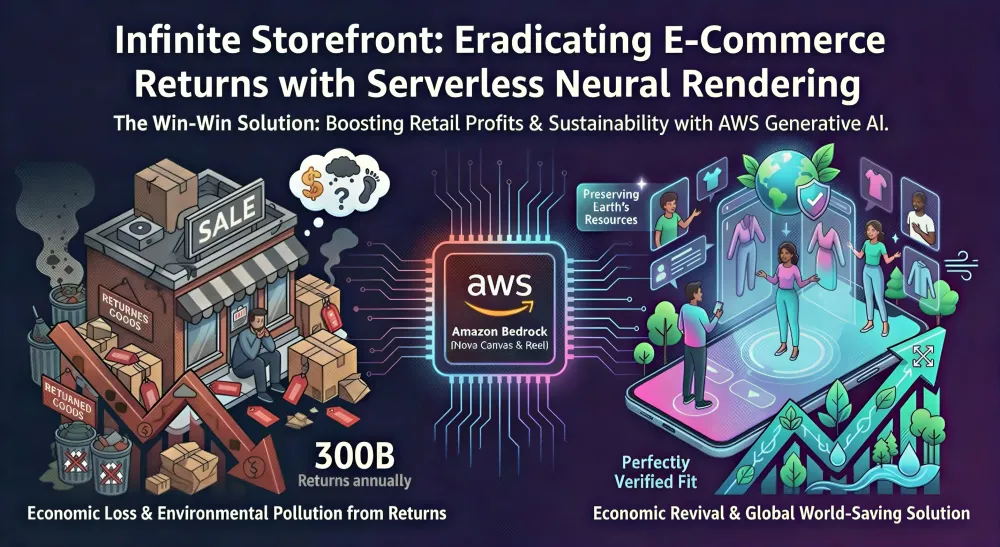
AIdeas: Infinite Storefront – Eradicating the E-Commerce Return Crisis
Buying clothes online is a guessing game. Sizes are unpredictable, leading to billions in lost retail profits and massive environmental waste from returns. Infinite Storefront eliminates this friction. Powered by Amazon Bedrock, it transforms any smartphone into an enterprise-grade virtual fitting room, photorealistically draping digital garments onto user selfies. Shopping becomes confident, profit margins are protected, and the massive environmental cost of fast fashion is eradicated.

In 2024, nearly 6 billion pounds of returned clothing were dumped into landfills or incinerated. These garments weren't defective, torn, or worn out—they simply didn't fit. The e-commerce industry isn't destroying the planet because people don't care; it is doing so because reverse logistics is now so expensive that burning a returned shirt is often cheaper than restocking it. This catastrophic waste happens for one single reason: customers are forced to guess how a flat image on a screen will drape across their unique physical body. We are paying for that guesswork with crushed retail margins and millions of tons of carbon emissions. Infinite Storefront exists so that guesswork never happens again.
App category
Commercial Solutions · Social Impact
Description: Infinite Storefront is an AI-powered virtual fitting room built entirely on AWS. It uses advanced neural rendering to photorealistically drape digital garments onto shoppers in real-time, making online retail perfectly personalized and zero-waste.
The Vision: A Trillion-Dollar Crisis
"I ordered a medium. It doesn't fit."
Every online clothing retailer hears this thousands of times a day. When customers cannot visualize how a digital garment will actually drape, fold, and fit across their unique physical body types, they are forced to guess.
The resulting financial and environmental devastation is staggering. In 2024, shoppers in the US alone returned an estimated $743 billion in merchandise, and projections for 2025 suggest this number will surge to nearly $890 billion—representing 17% of all retail sales. Globally, the cost of returns is an escalating hemorrhage that cripples retail profit margins.
But the financial loss is only half the story. The environmental impact of these returns is catastrophic. Up to 24 million metric tons of CO2 emissions are generated globally by reverse logistics each year. Furthermore, because processing returns is so expensive, retailers frequently opt to discard them; an estimated 5 to 9.5 billion pounds of returned goods are dumped into landfills annually.
I built Infinite Storefront to eradicate this guesswork. By transforming any smartphone into an enterprise-grade, zero-return virtual fitting room, we can empower local retailers, protect profit margins, and drastically reduce the environmental impact of fast fashion.
Why This Matters & Our Expected Impact
Over 70% of fashion returns occur simply because the item didn't fit or look as expected. Current AR (Augmented Reality) try-on filters look like flat, cartoonish stickers, or require retailers to spend thousands of dollars perfectly 3D-scanning their inventory.
Infinite Storefront flips the model. By leveraging Amazon Bedrock's state-of-the-art Generative AI, we provide photorealistic try-ons from flat images.
Our Targeted Reductions:
- Financial: By eliminating sizing guesswork, Infinite Storefront is designed to reduce clothing return rates by 30% to 40%. For a mid-sized retailer, this translates to hundreds of thousands of dollars saved annually in reverse logistics and restocking fees.
- Environmental: A 30% reduction in global fashion returns would eliminate millions of tons of carbon emissions and divert billions of pounds of textile waste from landfills.
The User Experience
To ensure commercial viability, the application needed to look and feel like a premium, top-tier retail product, not just a backend experiment.
Secure, session-based authentication managed by Amazon Cognito.

The intuitive configuration dashboard where users upload a selfie and the target garment.

Real-time processing state polling via DynamoDB to keep the user engaged during asynchronous inference.

The final, high-fidelity neural composite featuring automated brand-safety watermarking.

The History Vault, where users can securely view past generations stored in Amazon S3.

The Live Demo
How I Built This: Deep Dive Architecture
Phase 1: Spec-Driven Development with AWS Kiro
Most developers write code first and figure out the architecture later. I built Infinite Storefront the other way around.

I used AWS Kiro to define my strict architectural constraints, user stories, and state machine logic in a requirements.md file before a single line of application code was written. By feeding Kiro the exact specifications for a serverless pipeline, it helped scaffold the React frontend and AWS Lambda backend seamlessly. This "Architecture Before Code" approach cut my implementation time in half and eliminated entire categories of integration bugs.
Phase 2: The Event-Driven State Machine
To achieve global scalability while remaining entirely within the AWS Free Tier, the architecture relies heavily on DynamoDB and event triggers.

- Authentication: Amazon Cognito secures the frontend, granting JWTs for API access.
- Upload & Record: The upload Lambda generates the S3 presigned URLs and simultaneously creates a record in DynamoDB with a STATUS: PENDING.
- The Generation Trigger: Once S3 confirms the upload and Rekognition clears it for brand safety, lambda_generate takes over.
- The Feedback Loop: The React frontend polls the DynamoDB table. When the status changes from PROCESSING to COMPLETED, the UI updates instantly.
Phase 3: The Neural Synthesis Pipeline (How Nova Canvas Works)
Early in development, I attempted to achieve virtual try-on using complex text prompts. The results were highly inconsistent. The AI would hallucinate logos or mess up the ambient lighting. The breakthrough came when I migrated to Amazon Bedrock's Nova Canvas.

Instead of relying on text descriptions, Nova Canvas allows for true multi-modal visual conditioning. Here is exactly how the rendering pipeline works in our project:
- Visual Ingestion: The model receives two distinct visual anchors: the user's selfie (which defines the body pose, skin tone, and room lighting) and the target garment photo (which defines the fabric texture, cut, and graphical patterns).
- Neural Draping & Outpainting: Rather than simply pasting the shirt over the body like an AR filter, Nova Canvas "understands" the 3D geometry of the user's pose. It identifies the user's existing clothing and digitally removes it.
- Photorealistic Synthesis: The model then recalculates the physical scene. It generates natural fabric folds where the user's arms bend, matches the exact ambient lighting and shadows of the original selfie, and seamlessly blends the garment's collar around the user's neck.
The result is a photorealistic composite where the garment looks physically worn by the user, increasing generation fidelity by an order of magnitude.
AWS Services Used
| Service | Role in Architecture |
|---|---|
| AWS Kiro IDE | Agentic architecture planning, scaffolding, and spec-driven development. |
| Amazon Bedrock (Nova Canvas) | Synchronous multi-modal neural rendering for static virtual try-ons. |
| Amazon Bedrock (Nova Reel) | Asynchronous video generation for dynamic fabric physics. |
| AWS Lambda | Stateless compute for API routing, presigned URLs, and Bedrock invocation. |
| Amazon S3 | Secure, decoupled storage for raw uploads and generated assets. |
| Amazon DynamoDB | Ultra-low latency state machine tracking job statuses and rate limits. |
| Amazon Cognito | Secure user authentication and JWT token management. |
| Amazon Rekognition | Automated content moderation (NSFW detection) for brand safety. |
| Amazon CloudWatch | Centralized logging, execution metrics, and observability. |
| AWS Amplify | Scalable global hosting and continuous deployment (CI/CD) for the React frontend interface. |
Enterprise Security & Cost Optimization
An AI application is only as good as its security posture and cost predictability. A runaway generative AI loop can drain a startup's budget in hours.

- Least-Privilege IAM: Every Lambda function operates under strictly scoped policies. For instance, the upload Lambda can only
PutObjectto a specific bucket, while the inference Lambda is strictly bound tobedrock:InvokeModel. - Centralized Observability: All execution metrics, memory usage, and security moderation events are streamed directly to Amazon CloudWatch for real-time auditing.
Financial Guardrails (The Rate Limiter)
To prevent bot abuse and meticulously manage AWS Free Tier costs, I engineered a strictly scoped, session-based rate limiter directly into the application logic. The system enforces a hard limit of 3 images and 2 videos per user session.
1
2
3
4
5
6
7
8
9
10
// Rate Limiter Logic Implementation

const checkRateLimit = async (userId, type) => {

  const limit = type === 'image' ? 3 : 2;

  const usage = await fetchUserUsage(userId, type);


  if (usage >= limit) {

    throw new Error(`Rate limit exceeded. Maximum ${limit} ${type}s allowed per session to optimize AWS costs.`);

  }

  return true;

};
Cost Breakdown
A major focus of this project was proving that enterprise-grade AI doesn't require an enterprise-sized budget.

During the intensive development, testing, and generation phase in February 2026, the entire generative AI workload for Infinite Storefront (powered by Amazon Bedrock) cost just $16.94.
Because I utilized a fully serverless architecture (Lambda, S3, DynamoDB), the foundational infrastructure costs stayed well within the AWS Free Tier (represented in the minimal "Others" category at $0.02).
Note: The higher EC2-Other ($25.50) and VPC ($4.04) charges shown in the billing console are actually from a separate, legacy traditional-compute project (Cloud Canteen) hosted on the same account. This perfectly illustrates the point: maintaining idle EC2 instances and VPCs is far more expensive than running a highly complex, on-demand AI rendering pipeline using Serverless and Bedrock!What I Learned
- Multi-Modal Context is the New Prompt Engineering. Early on, I tried to describe the specific fit and graphical details of a t-shirt to the AI using text. It was nearly impossible and highly inconsistent. Shifting to Amazon Bedrock's Nova Canvas and passing the images directly as multi-modal visual anchors proved a massive paradigm shift. For complex spatial and styling tasks like virtual try-on, visual conditioning completely replaces brittle text prompts.
- Financial Guardrails Must Live in the Application Logic. You cannot rely solely on AWS billing alarms when deploying public-facing Generative AI. A runaway script or bot could drain a startup's budget in hours. I learned that true cloud economics requires edge-level enforcement. By engineering a strictly scoped, session-based rate limiter (capping users at 3 images and 2 videos) directly tied to Amazon Cognito identities, I secured the infrastructure against Free Tier exhaustion before a single inference request hit the backend.
- Asynchronous AI Demands Decoupled State Machines. You cannot make a frontend HTTP request wait 3 minutes for a generated video; the connection will time out, and the user will leave. Handling Nova Reel's video generation forced me to decouple my architecture. Implementing a polling mechanism where the React frontend quietly checks a DynamoDB table for status updates (
PENDING->PROCESSING->COMPLETED) is the only way to build a premium, fault-tolerant user experience around heavy AI tasks. - Ephemeral Compute is the Ultimate Privacy Architecture. Using AWS Lambda forced a stateless design. Images are passed in memory or securely routed via temporary Amazon S3 presigned URLs. This means no sensitive user selfies are permanently exposed on application servers or sitting in open directories. What started as a cost-saving, serverless measure actually became my foundational privacy and data compliance guarantee.
- Public Generative AI Requires Active Brand Safety. When you allow users to upload images to an AI model, you invite abuse. I learned that you cannot blindly pass user data to Bedrock. Integrating Amazon Rekognition via an S3 event trigger to automatically scan for NSFW content before inference, combined with frontend watermarking on the final output, ensures the platform remains safe for both the user and the retailer's brand.
- Architecture Precedes Implementation (The Kiro Advantage). Writing code without a blueprint leads to technical debt. Using AWS Kiro's steering files forced me to define the exact IAM permissions, DynamoDB schemas, and Bedrock payloads before I wrote a single line of implementation logic. This radical clarity—treating the architecture as a strict contract—is exactly how enterprise AI systems should be built.
The Roadmap: Future Features
Infinite Storefront’s MVP proves the core neural rendering concept, but the vision for eradicating e-commerce returns extends much further:
- Shopify / WooCommerce Plugin (B2B API): Packaging the architecture into a plug-and-play API so local retailers can add a "Virtual Try-On" button directly to their existing product pages with zero coding.
- Multi-Garment Synthesis: Upgrading the Nova Canvas payload to accept multiple target assets simultaneously, allowing users to build and try on entire outfits (e.g., matching a graphic tee with a specific jacket and pants).
- 360° Fabric Physics (Nova Reel Expansion): Expanding the video generation capabilities so users can digitally "spin" to see how the garment drapes and folds from the back and sides.
- Manufacturing Analytics: Providing retailers with anonymized dashboards showing how their garments fit on diverse body types, allowing them to adjust their physical manufacturing cuts and sizing charts based on real-world digital data.
Try It Yourself! 🚀
Because this architecture utilizes secure rate-limiting to protect the cloud infrastructure, I am thrilled to make Infinite Storefront live for the public!
👇 Drop a screenshot of your generated Virtual Try-On in the comments below! I'd love to see what garments you test out!

Enjoyed reading this content? Let the author know!
Your likes, comments, shares, and saves help creators reach more builders.

Loading recommendations
Loading article