
VPN vs Proxy: Communication Flow and Security Implications Explained
This article presents a lucid (clear and easily understood), process-oriented comparison between VPNs and proxies, focusing on how traffic flows, how IP addresses are exposed, and what various entities can observe across the network. By dissecting real-world office communication scenarios.

Although VPNs and proxies both function as intermediaries between a client and a destination server, their operational semantics (meaning: underlying operational behavior) and security properties diverge in fundamental ways. To appreciate this distinction, it is useful to examine how traffic flows, how IP addresses are handled, and what different entities can observe—particularly in an office or enterprise environment.
VPN Communication: From Endpoint to Virtual Network Member
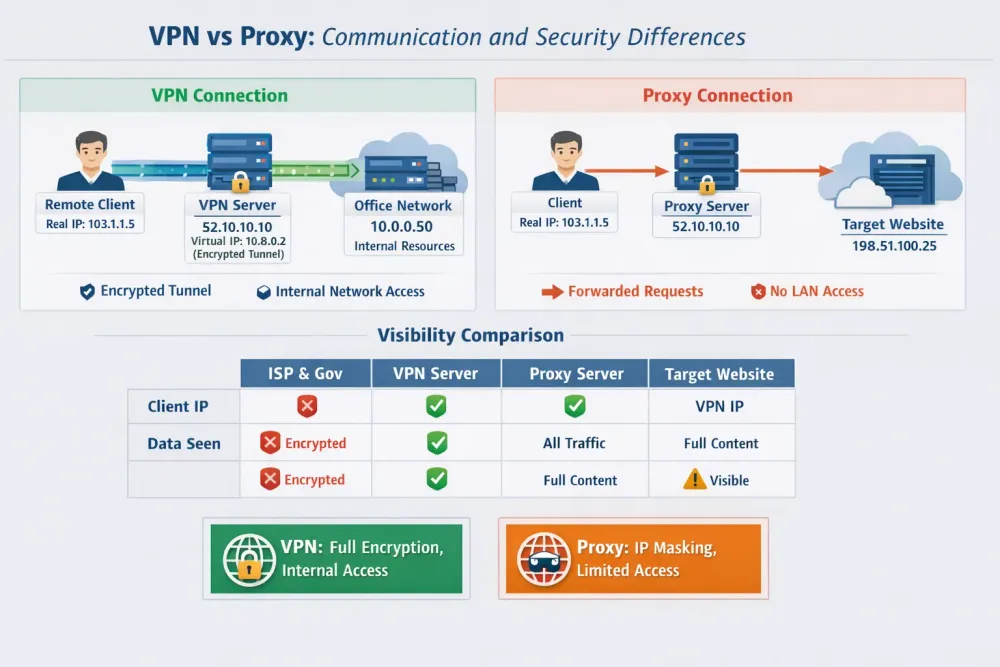
A VPN does not merely relay requests; it integrates the client into a virtualized network topology (meaning: logically constructed network structure). Consider a remote employee accessing internal office resources:
- The client device, with a real public IP (e.g.,
103.1.1.5), initiates a connection to a VPN gateway (52.10.10.10).
- Upon authentication, the VPN assigns the client a virtual IP from the internal subnet (e.g.,
10.8.0.2).
- All outgoing traffic is encapsulated and encrypted before traversing the public internet.
Packet structure:
Outer packet (internet-visible):
- Source:
103.1.1.5
- Destination:
52.10.10.10
- Payload: encrypted inner packet
Inner packet (virtual network):
- Source:
10.8.0.2
- Destination:
10.0.0.50(internal file server)
The VPN gateway decrypts the outer packet, inspects the inner packet, and routes it either to internal LAN resources or to the internet via NAT. Responses follow the same path in reverse, ensuring bidirectional confidentiality (meaning: protection in both directions).
From the client’s perspective, communication appears indistinguishable from being physically inside the office network.
Proxy Communication: Request Forwarding Without Network Integration
A proxy operates in a far more circumscribed (meaning: limited in scope) manner. It forwards application-level requests without extending network membership:
- The client (
103.1.1.5) sends an HTTP or HTTPS request to the proxy (52.10.10.10).
- The proxy forwards the request to the target server using its own IP address.
Flow overview:
- Client → Proxy (
103.1.1.5 → 52.10.10.10)
- Proxy → Website (
52.10.10.10 → 198.51.100.25)
- Response returns via the proxy to the client
No virtual IP is assigned, and no tunnel is created. As a result, the client remains logically external (meaning: not part of the internal network) and cannot directly access internal LAN services.
Visibility Matrix: Who Observes What?
ISP / Network Authorities
- Client real IP: Visible (outer packet source)
- Content or destination:
- VPN (encrypted)
- Proxy (visible for HTTP, hidden only with HTTPS)
VPN Gateway
- Client real IP: Visible
- Content and destinations: Fully visible
Proxy Server
- Client real IP: Visible
- Content and destinations: Visible
Target Website
- Client real IP:
- VPN (sees VPN IP)
- Proxy (sees proxy IP)
- Content:
- VPN (unless logged internally)
- Proxy
Crucial distinction:
A VPN encrypts traffic at the IP layer (meaning: network-layer encryption), obscuring payloads from intermediaries. A proxy typically rewrites requests and relies on application-layer security, which is inherently less comprehensive.
Why a VPN Exceeds a Proxy in Capability
Full Network Membership
A VPN assigns a virtual IP, enabling the client to function as a bona fide (meaning: genuine) node within the internal network.
End-to-End Encryption
VPN tunnels encrypt all traffic, safeguarding data against ISP monitoring and public Wi-Fi interception. Proxies generally protect only web traffic and only at the application layer.
Routing Control
VPNs support split-tunnel and full-tunnel policies, offering granular (meaning: finely controlled) traffic management. Proxies are confined to per-application forwarding.
Centralized Governance
Enterprise VPNs allow administrators to enforce access control, logging, and compliance at the device level. Proxies are largely limited to recording web requests and lack systemic control.
Conclusion: A Process-Oriented Comparison
VPN Workflow:
Encrypted tunnel established → Virtual IP assigned → Encrypted packets sent to VPN gateway → Gateway decrypts and routes → Response encrypted back → Client decrypts.
Visibility: ISP sees only encrypted traffic; VPN sees all; websites see VPN IP.
Proxy Workflow:
Client sends requests → Proxy forwards using its IP → Response relayed back.
Visibility: ISP may see content (HTTP); websites see proxy IP; no internal network access.
Enjoyed reading this content? Let the author know!
Your likes, comments, shares, and saves help creators reach more builders.

Loading recommendations
Loading article