
Decision Referee: Choosing Between AWS EC2 and AWS Lambda Using Trade-offs
A decision-support tool comparing AWS EC2 and Lambda through constraints and trade-offs to help users choose the right cloud compute option.


Introduction
When developers ask questions like “Which cloud service should I use?”, the most common responses give a single recommendation.
In reality, engineering decisions are context-dependent. Each option has strengths, weaknesses, and trade-offs that depend on user requirements.
This project, Decision Referee, was built to help users choose intelligently, not just consume information.
Problem Statement
AWS offers multiple compute services such as EC2 and AWS Lambda.
While both are powerful, choosing between them is not straightforward.
Common challenges include:
- Different traffic patterns (steady vs spiky)
- Cost sensitivity
- Operational effort
- Scalability needs
- Latency considerations
Most explanations fail to show what is gained and what is lost with each choice.
Solution Overview
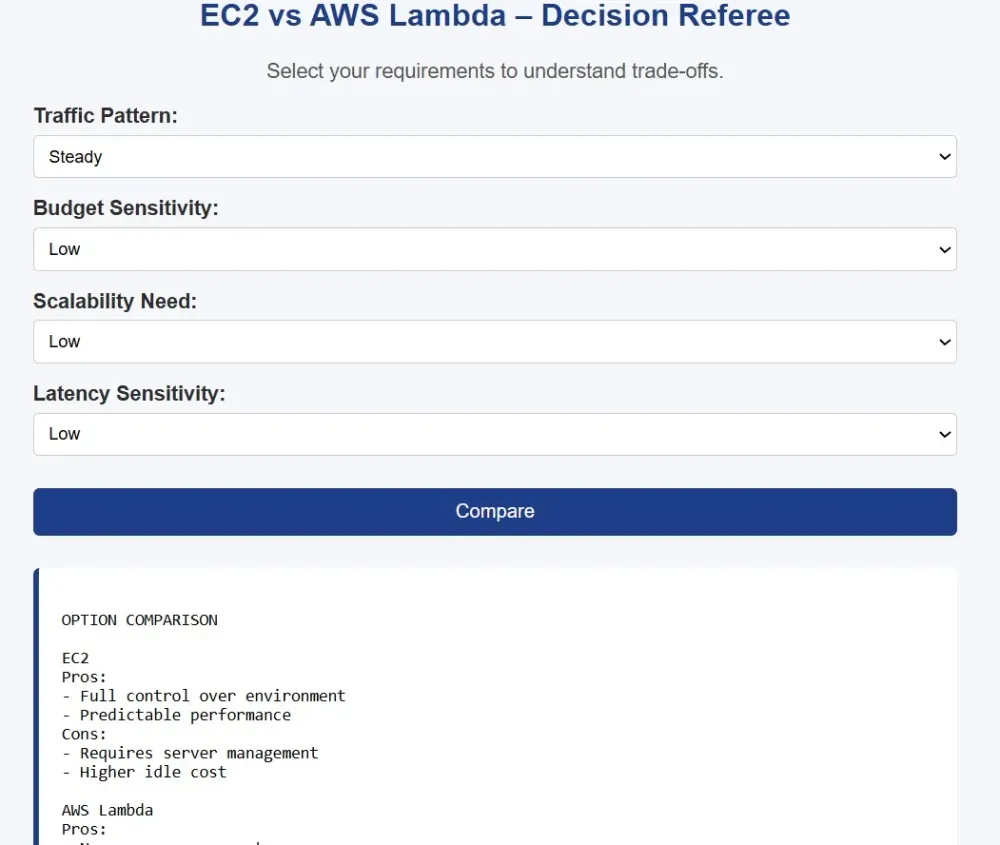
I built a decision-support web tool that compares AWS EC2 and AWS Lambda based on user-selected constraints.
Instead of giving a single answer, the tool:
- Collects user requirements
- Compares both options side-by-side
- Explains pros, cons, and trade-offs
- Provides decision guidance, not recommendations
This aligns with the principle of helping users choose, not forcing a decision.
How the Tool Works
- The user selects constraints such as:
- Traffic Pattern (steady / spiky)
- Budget Sensitivity (low / high)
- Scalability Need
- Latency Sensitivity
- A comparison function evaluates how EC2 and Lambda align with these constraints.
- The output displays:
- Pros and cons of EC2
- Pros and cons of AWS Lambda
- Explicit trade-offs
- Context-based decision guidance
The output changes dynamically based on the selected inputs.
Example Trade-offs Explained
- EC2
- Offers full control and predictable performance
- Requires server management and higher operational effort
- AWS Lambda
- Eliminates server management and scales automatically
- Introduces cold start latency and limits runtime control
There is no universally “better” option — only a better fit for specific requirements.
Role of Kiro in Development
Kiro played a critical role in accelerating and improving development.
How Kiro Helped:
- Identified key trade-offs between EC2 and Lambda
- Helped structure comparison logic around constraints
- Ensured the tool remained decision-oriented, not opinionated
- Improved clarity of pros, cons, and trade-off explanations
Kiro Artifacts
- Prompts and outputs used during development are included in the
.kirodirectory:
-
.kiro/prompts– comparison prompts
-
.kiro/decisions– distilled trade-offs


Architecture
The tool is implemented as a simple static web application:
- HTML for structure
- CSS for styling
- JavaScript for comparison logic
This keeps the architecture lightweight while focusing on decision logic, which is the core goal of the project.
Outcome
The Decision Referee demonstrates how comparative reasoning and trade-off analysis can be applied in real-world cloud decisions.
Key outcomes:
- Encourages thoughtful decision-making
- Avoids one-size-fits-all answers
- Helps users understand consequences of each choice
Conclusion
Choosing between AWS EC2 and AWS Lambda depends on requirements, not popularity.
By focusing on constraints and trade-offs, this tool helps users make informed and confident decisions.
This project fulfills the goal of Week 6: The Referee by prioritizing clarity, neutrality, and decision support.
Links
- GitHub Repository: https://github.com/srichaithanyaerukulla-ctrl/decision-referee
Enjoyed reading this content? Let the author know!
Your likes, comments, shares, and saves help creators reach more builders.

Loading recommendations
Loading article