
Unraveling Multi-tenancy Issues in Aurora MySQL
How to use AWS AI and machine learning tools to solve multi-tenancy challenges in Amazon Aurora MySQL. The core problem addressed is identifying which tenant is consuming excessive resources when multiple customers share a single Aurora cluster, as MySQL lacks native per-tenant resource capping capabilities.


This episode of "Let's Talk About Data" show is discussing how to use AWS AI and machine learning tools to solve multi-tenancy challenges in Amazon Aurora MySQL. The core problem addressed is identifying which tenant is consuming excessive resources when multiple customers share a single Aurora cluster, as MySQL lacks native per-tenant resource capping capabilities.
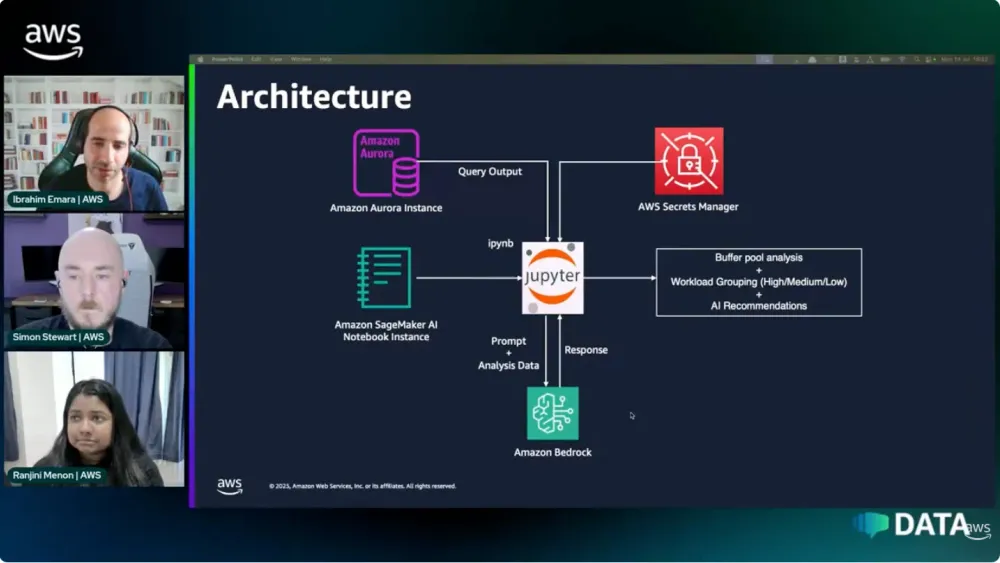
The solution combines two powerful approaches: buffer pool analysis using machine learning and AI-driven recommendations. The guests demonstrated a Python-based Jupyter notebook that queries Aurora's InnoDB buffer pool to identify per-schema memory usage, then applies statistical methods (z-scores, standard deviation, interquartile range) and k-means clustering to categorize tenants into high, medium, and low consumption groups. They then use AWS Bedrock with Claude 3 to generate specific troubleshooting steps and performance optimization recommendations tailored to each workload category.
The practical demonstration used a dental clinic SaaS example with 20 schemas, successfully identifying one high-consumption tenant (Dental Clinic 012) using 60MB of buffer pool versus the average of ~13MB. This enables informed decisions about resource allocation, customer separation, or differential billing.
Key Highlights:
- Aurora MySQL Benefits: Decoupled compute/storage layers, six data copies for high availability, self-healing storage nodes
- The Challenge: Identifying "noisy neighbors" in multi-tenant environments without native MySQL resource capping
- ML Analysis: Uses statistical methods and k-means clustering to categorize tenant resource consumption
- AI Recommendations: AWS Bedrock provides specific, actionable optimization steps based on analysis results
- Best Practices: Run in mirrored environments, use precise prompts, store historical data, consider Lambda automation
- Practical Actions: Separate high-resource tenants, implement differential billing, optimize slow queries, set appropriate resource limits
Hosts of the show 🎤
Ibrahim Emara - Database Specialist SA @AWS
Guests 🎤
Simon Stewart - Database Specialist SA @AWS
Ranjini Menon - Assc Database Specialist SA @AWS
Enjoyed reading this content? Let the author know!
Your likes, comments, shares, and saves help creators reach more builders.

Loading recommendations
Loading article