
Designing Real-time Data Architectures patterns for AI Agents
In this show we will dive deep how to augment existing real-time architectures using a practical blueprint that blends event streaming, lakehouse storage, traditional ML, and AI agents. Key takeaways include building a centralized decision engine, designing scalable agent orchestration, and integrating human oversight where required.


This episode featured real-time data architectures for AI agents, with a focus on geofence alert processing for connected vehicles. The team explained how streaming data architectures enable continuous data flow and processing, contrasting batch processing (data grouped by time intervals) with stream processing (data processed as it arrives). They emphasized that combining real-time data with agentic AI creates exponential business value by enabling autonomous decision-making on live data streams.
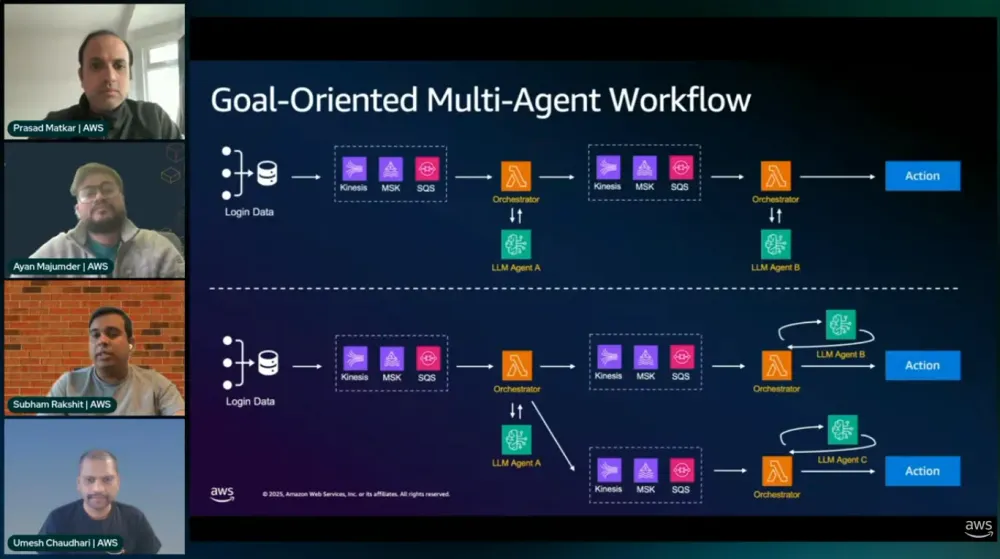
The session covered three key design patterns for integrating AI agents with streaming architectures. First, the "reactive agent on alert stream" pattern processes raw events through traditional stream processing (like Apache Flink) to generate alerts, then invokes AI agents only on those alerts rather than every raw event—maintaining pipeline performance while adding intelligent decision-making. Second, multi-agent workflows enable linear or parallel processing chains where specialized agents handle specific tasks asynchronously. Third, the "human in the loop" pattern demonstrated with ride-share surge pricing shows how agents can make recommendations that require human approval, with feedback loops that iteratively improve agent performance based on outcome measurements like customer complaints and ride completion rates.
The live demo showcased an end-to-end geofence monitoring solution using AWS services including IoT Core for vehicle telemetry ingestion, Amazon MSK (Managed Streaming for Apache Kafka) for stream storage, Managed Apache Flink for data validation and enrichment, Amazon Bedrock with Strand agents for alert analysis and notification generation, and Amazon SNS for delivery. The architecture achieved double-digit millisecond latency for the streaming pipeline, with overall end-to-end processing (including AI agent invocation) completing within seconds. The team emphasized that customers don't need to rebuild existing pipelines—agents can be added at the tail end of decision-making processes to enhance existing streaming architectures.
Key Highlights:
- Real-time vs. batch processing: Stream processing handles data continuously as it arrives (milliseconds to seconds), while batch processing groups data by time intervals
- Three design patterns: Reactive agents on alert streams, multi-agent workflows (linear/parallel), and human-in-the-loop with feedback loops
- Performance optimization: Invoke LLM models only on filtered alert events, not raw data streams, to maintain pipeline throughput
- Iterative improvement: Feedback loops measure agent decision outcomes and refine future performance without retraining
- AWS services demonstrated: IoT Core, Amazon MSK, Managed Apache Flink, Amazon Bedrock with Strand agents, DynamoDB, SQS, SNS
- Latency benchmarks: Double-digit milliseconds for streaming pipeline, few seconds end-to-end including AI agent processing
- Prompt engineering importance: Descriptive, well-crafted prompts with multiple iterations significantly improve agent output quality
- Guardrails and authority: Agents require defined boundaries, input/output validation, and permission-based actions to prevent hallucinations
- Minimal refactoring needed: Existing streaming pipelines can integrate agentic AI at decision points without major architectural changes
- Workshop coming soon: Team developing public workshop with GitHub repository for hands-on implementation
Hosts of the show
Prasad Matkar - Senior Database Specialist @AWS
Guests
Ayan Majumder
Subham Rakshit
Umesh Chaudhari
Links from today's episode
Enjoyed reading this content? Let the author know!
Your likes, comments, shares, and saves help creators reach more builders.

Loading recommendations
Loading article