
Infrastructure Design 📡 Amazon Leo & AWS Architectures for Software-Defined Private Satellite Networking ☁️
This one's for builders: how to use Amazon Leo as a first-class part of your architecture—treating satellite connectivity the same AWS builders think about Wavelength, Local Zones, or Outposts. My notes of network patterns like CVN and D2A, hybrid connectivity with PNI, and real-world solution architectures—from Space IoT and digital twins to video analytics and egress inspection. This session provided a field guide to plugging Leo into the systems you're already building on | re:AMZ302 at reInvent
Series: Amazon Leo Private Satellite Networking (3 articles)
- 3Infrastructure Design 📡 Amazon Leo & AWS Architectures for Software-Defined Private Satellite Networking ☁️ This article

A Builder's Lifecycle: From Design to Sustainment

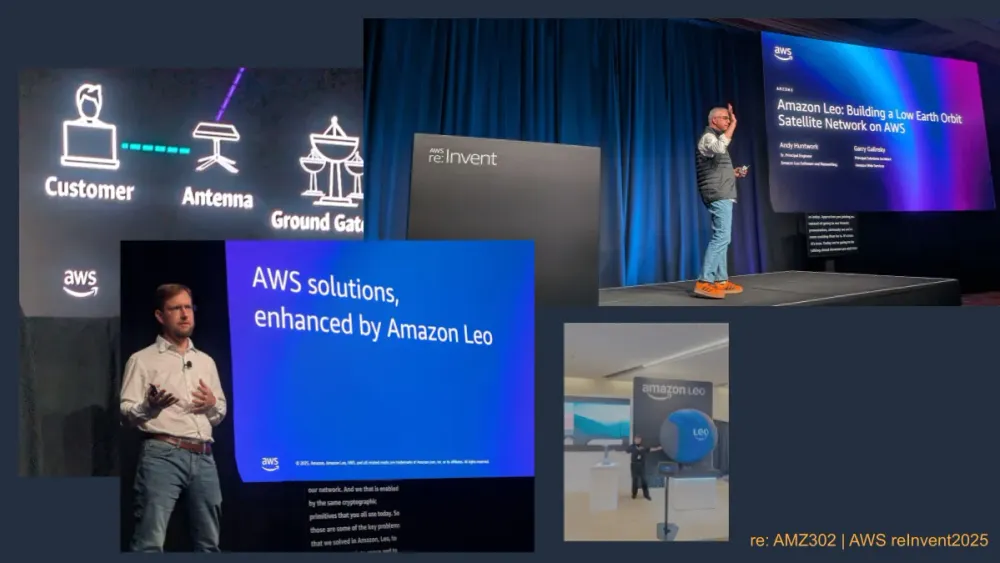
AWS Community Hero Bryan Chasko attends a long awaited architecture session on building with Amazon LEO and AWS
Let's dive deep into what the teams showed at a reInvent session I attended in terms of Low Earth Orbit satellite-specific patterns, let's take a glance at a well architected satellite network, with encrypted connection to AWS - then step back and think about the full lifecycle for autonomous or distributed systems.

Direct to AWS Amazon Leo Architecture
Amazon Leo fits into this lifecycle as:
- Another transport and edge platform alongside Outposts, Local Zones, and Wavelength—just one that happens to operate from orbit.
- A way to plug remote or space-based assets directly into your AWS-native architectures without rewriting everything for "satellite mode."
Amazon Leo fits into every stage—from predictive simulation to long-term sustainment
| Stage | Focus & Goal | AWS Capabilities / Enablers |
|---|---|---|
| Design & Development | Turbocharge autonomous system design with secure HPC, seamless collaboration, and AI-powered simulations. | Secure HPC, Seamless Collaboration, AI-Powered Simulations |
| Testing & Evaluation | Accelerate testing via high-fidelity simulations, edge computing, and robust analytics. | High-Fidelity Simulations, Edge Computing, Robust Analytics |
| Production & Integration | Fortify production with secure CI/CD, integration into new and existing systems, and factory-scale simulation. | Secure CI/CD Pipelines, Integration, Factory Simulation |
| Deployment & Operations | Dominate operations with global infrastructure, edge AI/ML, rapid capability deployment, and simulation for planning and ops. | Global Infrastructure, Edge AI/ML, Rapid Capability Deployment, Simulation |
| Maintenance & Upgrades | Optimize readiness with predictive maintenance, secure OTA updates, AI model retraining, and compatibility verification. | Predictive Maintenance, Secure OTA Updates, AI Model Retraining |
| Sustainment & Logistics | Fortify sustainment using cloud ERP, supply chain security, and lifecycle analytics across the ecosystem. | Cloud ERP, Supply Chain Security, Lifecycle Analytics |
Understanding the Leo Data Path
Most Leo-powered solutions will follow the same core data path. Here's the journey your packets take from a remote site to AWS (or the internet):
- Customer device → Customer terminal
A laptop, router, or industrial controller connects to a Leo Nano/Pro/Ultra terminal. - Terminal → LEO satellite
The terminal’s phased-array antenna talks to a passing satellite. - LEO satellite → OISL mesh
Data may hop across multiple satellites using optical inter-satellite links. - Satellite → Ground Gateway → POP
Once in view of a ground gateway, data is downlinked and handed to a POP. - POP → Amazon backbone
Traffic enters Amazon’s global fiber network. - Backbone → Internet or AWS
Traffic either:- Exits to the public internet, or
- Stays on the private backbone and is delivered Direct to AWS (D2A) into a VPC.
In shorthand:
Customer Device → Customer Terminal → LEO Satellite → OISL → Ground Gateway → POP → Amazon Backbone → Internet/AWS Cloud
Understanding where your application "attaches" along this path—terminal, CVN, VPC, or on-prem—is the key to choosing the right pattern. It's the same mental model as deciding between Direct Connect, VPN, or public internet routing, just with satellites in the mix.
Customer Virtual Network (CVN) and Virtual Network Interfaces (VNI)
At the boundary between space and cloud, Leo exposes a Customer Virtual Network (CVN) abstraction—think of it like a Virtual Private Cloud (VPC), but for your satellite traffic.
CVN basics:
- Customer-managed network segmentation:
Create private IP ranges, subnets, and DNS settings. - Use cases:
- Separate control-plane and data-plane traffic.
- Split employee internet from operations data.
- Insert custom routing (firewalls, inspection, NVA appliances).
Inside a CVN:
- A VNI (Virtual Network Interface) is the key attachment point:
- Represents the endpoint for a given antenna or terminal.
- Typically, one VNI per CVN per antenna (1:1 mapping).
- A CVN Gateway:
- One per CVN.
- Connects the CVN to external destinations:
- Internet
- Direct to AWS (D2A)
- Private Network Interconnect (PNI)
You can run multiple CVNs in parallel, each with:
- Its own gateway and antenna(s).
- Separate VNIs and segmentation policies.
- Distinct routing outcomes (e.g., one CVN for internet-only, one for private D2A).
Pattern 1: Space-to-Cloud with CVN + VNI
The simplest architecture—getting from a Leo terminal to the internet (or AWS):
- LEO terminal (at a remote site) connects to:
- LEO satellite, which relays to:
- Ground Gateway → POP, which feeds:
- Amazon Leo environment → CVN → VNI, then:
- Out to either Internet or AWS.
If your use case is "internet-only via Leo," this is your baseline. But here's where it gets interesting: the moment you attach workloads to a VNI inside a CVN, you can:
- Apply your own routing, firewalling, or NAT—just like you would in a VPC.
- Segment workloads into multiple subnets for traffic isolation.
- Attach multiple VNIs and treat each antenna as a separate network entry point.
In other words, you get the same network primitives you're used to from AWS networking, just delivered via satellite.

Amazon Leo allows you the same telemetry data your used to in the AWS tooling your used to for observability, making it compatible with observability partners like New Relic and Datadog
Pattern 2: Hybrid via Private Network Interconnect (PNI)
When you want Leo to be an extension of your corporate WAN—not just another internet pipe—you can use PNI (Private Network Interconnect).
When you want Leo to be an extension of your corporate WAN, you can use PNI.
Architecture:
- CVN / Amazon Leo side:
- CVN with subnets and VNIs.
- An antenna symbol at the boundary indicates the satellite link.
- A connection point on the CVN edge connects to PNI.
- PNI:
- A dedicated, private, secure circuit between Leo’s edge and your:
- Corporate Data Center:
- Servers, storage, and databases behind traditional firewalls.
Data path:
Use this when:
- You want Leo as another branch in your MPLS/SD-WAN fabric—treating satellite links like any other private circuit.
- You need tight control over routing, identity, and data residency (think: finance, healthcare, defense).
- You want to avoid the public internet entirely for certain applications—keeping traffic on your own wires (and lasers) end-to-end.
- You need tight control over routing, identity, and data residency.
- You want to avoid the public internet entirely for certain applications.
Pattern 3: Direct to AWS (D2A) – Leo ↔ VPC
The D2A (Direct to AWS) pattern brings Leo-connected devices and applications directly into your AWS VPC—bypassing the public internet entirely and keeping traffic on Amazon's private backbone from satellite to cloud.
The D2A pattern brings Leo-connected devices and applications directly into your AWS VPC.
Amazon Leo environment:
- Customer Virtual Network with:
- Subnet(s)
- VNI(s)
- Edge/input devices feeding data:
- Security cameras
- IoT/sensors
- Robotics/industrial devices
- Mobile or handheld units
AWS account side:
- VPC hosting:
- EC2 for compute
- RDS for relational data
- SageMaker for ML training/inference
The VNI in the CVN is directly linked (via D2A) to your VPC networking—no NAT, no internet gateway, no hops through the public web.
Use this pattern for:
- Edge analytics where preprocessing happens near the terminal (say, on a ship or oil rig), but core ML inference and storage live in AWS.
- Use cases that need private, predictable latency from remote sites into cloud services—think real-time dashboards or control loops.
- Scenarios where you want to apply your existing VPC security patterns (NACLs, Security Groups, IAM) directly to Leo traffic, treating it like any other VPC attachment.
- Use cases that need private, predictable latency from remote sites into cloud services.
- Scenarios where you want to apply your existing VPC security patterns (NACLs, SGs, IAM) to Leo traffic.
Space IoT and Predictive Workloads (Builder View)
From a builder’s standpoint, the “Space IoT / predicted state” architecture becomes a reusable pattern:
- Ingest:
Use Amazon Kinesis to ingest telemetry (orbital updates, device readings, health data). - Process:
Use AWS Lambda for transformations and quick checks.
Persist state in Amazon DynamoDB if needed. - Orchestrate:
Drive longer workflows with AWS Step Functions.
Spawn EC2 jobs when you need GPUs, custom libraries, or longer runtimes. - Store & Search:
Archive in Amazon S3.
You can apply this pattern to:
- Ships at sea with intermittent connectivity windows
- Aircraft that only downlink telemetry during certain flight phases
Digital Twins in Remote Locations (Wind Farm Example)
Let's make this concrete. Imagine a wind farm in a remote area—far from terrestrial fiber, but close enough to need real-time monitoring and control. You want to run a high-fidelity digital twin and a control loop that can issue "slow down" or "halt" commands to turbines based on predicted failures or grid conditions.
The key insight: Leo gives you the transport, but the architecture pattern (Kinesis → Lambda → Step Functions → S3 → OpenSearch) is the same one you'd use for any edge-to-cloud IoT system.
The key insight: Leo gives you the transport, but the architecture pattern (Kinesis → Lambda → Step Functions → S3 → OpenSearch) is the same one you'd use for any edge-to-cloud IoT system.
You can apply this pattern not just to satellites, but to any intermittent, constrained link using Leo—ships, aircraft, remote research stations, and more. You want to run a high-fidelity digital twin and control loop in real time.
Cloud side:
- Amazon ECS in a VPC runs the digital twin model.
- AWS IoT Core ingests turbine telemetry.
- Amazon Timestream stores time-series performance data.
- Amazon S3 holds general data, model artifacts, and historical logs.
Triggers & Actions:
- Anomaly trigger → AWS Lambda:
Detects anomalies in turbine behavior.
Sends metrics to Amazon Managed Grafana for visualization. - Action trigger → AWS Lambda:
Issues control signals (e.g., “slow down” or “halt” turbines) based on the twin’s outputs.
This pattern generalizes to any industrial asset in a hard-to-reach area: - Mines for predictive maintenance on excavation equipment
- Offshore oil rigs for real-time anomaly detection and safety shutdowns

Garry Galinsky, AWS on Amazon Leo at reInvent 2025
Egress Inspection for Sensitive Workloads
Here's a pattern I hear a lot of interest in at re:Invent and from the larger AWS developer community when talking about Amazon Leo: egress inspection for sensitive workloads. If your data is proprietary—think pharmaceutical research, defense systems, or financial models—you don't want it leaking to the outside world, even accidentally. If your data is proprietary and you need strict egress inspection, Leo can be paired with AWS Outposts and AWS Network Firewall to enforce strict egress controls.
The common thread: you need real-time data flow and low-latency control, but you're in a location where fiber is either unavailable or prohibitively expensive. Leo + digital twins + AWS IoT Core is the stack.
Connectivity via Amazon Leo:
The common thread: you need real-time data flow and low-latency control, but you're in a location where fiber is either unavailable or prohibitively expensive. Leo + digital twins + AWS IoT Core is the stack.
Connectivity via Amazon Leo:
- Amazon Leo CVN + VNI:
Provides secure, low-latency, private connectivity from the wind farm to the VPC. - Subnet VNI at the wind farm:
Handles local routing for turbines and edge gateways.
Forwards data across the Leo link without touching the public internet.
This pattern generalizes to any industrial asset in a hard-to-reach area: mines, offshore rigs, solar farms, or rail systems.

Inspecting Egress Traffic with Amazon Leo and AWS
Architecture:
- Remote site (AWS Outposts rack):
Hosts a VPC with a private subnet and EC2 instances.
Result: - All egress from on-prem EC2 (and potentially Leo-connected workloads) is forced through centralized cloud-based inspection before reaching the internet.
- You get full visibility and control over what leaves your network—even if the workload is running on an Outposts rack in a remote facility connected via Leo.
This is the kind of pattern that matters for compliance-heavy industries: you can run compute at the edge, but security policy is enforced centrally in the cloud.
Edge Video Analytics with Leo and AWS
Video analysis at the edge, backed by cloud-scale analytics. Think: security cameras on a construction site, wildlife monitoring in a national park, or quality inspection on a remote factory floor. Traffic path:
- EC2 on Outposts initiates outbound (egress) traffic.
- Traffic routes back to the AWS Region via Outposts.
- In-region, it enters a VPC and flows:
- From the antenna endpoint (representing the Outposts link),
- To Firewall Endpoints,
- Through Network Firewall for inspection.
- If allowed, traffic is forwarded to the Internet Gateway and out to the public internet.
Result:
- All egress from on-prem EC2 (and potentially Leo-connected workloads) is forced through centralized cloud-based inspection before reaching the internet.
Edge side:
- A security camera streams video to an antenna.
- Data flows into an Amazon Leo edge environment:
This pattern is applicable to: - Smart cities and public safety: Traffic monitoring, crowd detection, and emergency response coordination.
- Industrial inspection and quality assurance: Automated defect detection on assembly lines or construction sites.
- Retail analytics in locations with poor terrestrial connectivity: Store traffic analysis, shelf monitoring, and inventory management.
- Wildlife and environmental monitoring: Camera traps in remote areas feeding into ML models for species identification and conservation planning.
The key: edge preprocessing reduces bandwidth costs and latency, while cloud-scale analytics handles the heavy ML lifting and long-term storage.
Cloud side:
Security, Identity, and Observability for Builders
Here's what I really like about Leo as a builder: when you plug into it, you don't have to learn a "new cloud." You get to reuse AWS's existing security and observability primitives:
Analysis & delivery:
- AWS Step Functions orchestrate multi-step analysis workflows.
- AWS Lambda performs frame-by-frame or event-driven processing.
- Amazon OpenSearch Service indexes metadata and events (e.g., detected objects, anomalies).
- Amazon API Gateway exposes APIs to retrieve analysis results.
- AWS Amplify hosts front-end applications for Ops users to view live dashboards, alerts, and historical queries.

Film Production Security Pipeline i.e., Prime Video, Netflix Remote Filming
This pattern is applicable not learning a "new cloud" or adopting a proprietary satellite API. You're extending your existing AWS mental model—VPCs, IAM roles, CloudWatch metrics, S3 buckets—into orbit. It's the same tooling, just with a different last mile.
- Industrial inspection and quality assurance.
- Retail analytics in locations with poor terrestrial connectivity.
Conclusion: Amazon Leo is . . .
- Built on AWS: Using the same compute, networking, and security services you already deploy—Step Functions, Kinesis, SageMaker, IAM, the works.
- Integrated with your account: Connecting to edge locations, VPCs, and on-premises data centers via CVN, D2A, and PNI—treating satellite links like any other network attachment.
- Ready for builders: With proven patterns for Space IoT, digital twins, edge AI, egress inspection, video analytics, and more.
Related Reading:
- [0]: Intro to Amazon Leo
- [200]: How AWS Brought Project Kuiper to Market Check out the talk:
AWS empowers Amazon Leo to revolutionize global connectivity, bringing the world closer together
Always excited to talk about Amazon Leo and potential AWS integrations, comment below or find me on LinkedIn ☁️
Series: Amazon Leo Private Satellite Networking (3 articles)
- 3Infrastructure Design 📡 Amazon Leo & AWS Architectures for Software-Defined Private Satellite Networking ☁️ This article
Enjoyed reading this content? Let the author know!
Your likes, comments, shares, and saves help creators reach more builders.

Loading recommendations
Loading article