
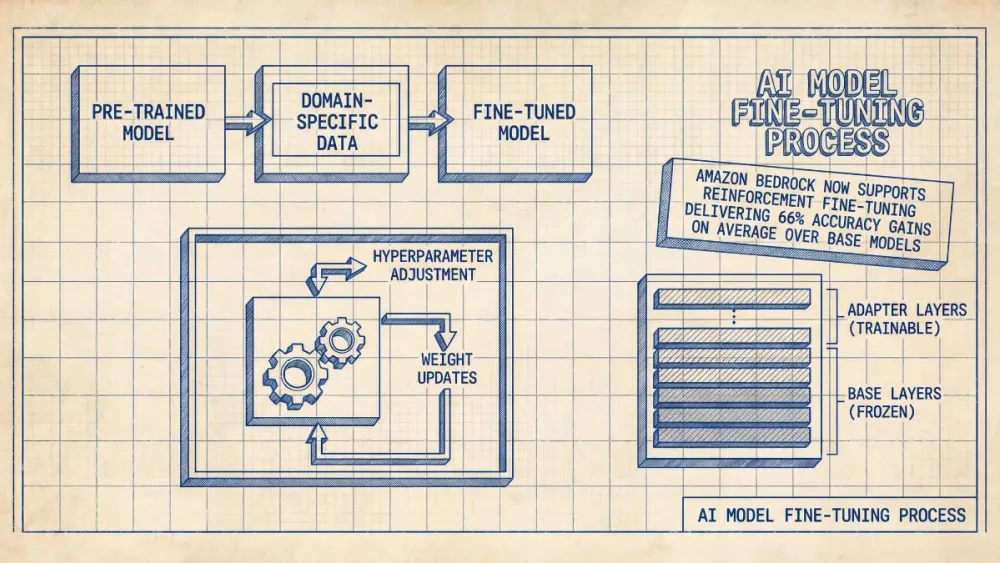
Reinforcement Fine-Tuning Nova 2 Lite with Amazon Bedrock
Demonstrating how domain adaptation for specialized terminology was achieved with minimal data, Model as a Judge, and on-demand inference.

This year, at re:Invent 2025, AWS announced a new feature: reinforcement fine-tuning for Amazon Bedrock. This capability allows developers to customize foundation models using reward functions rather than traditional supervised learning alone. I tested this feature by building a model that explains AWS services through military terminology. My target audience was veterans transitioning to cloud careers. The results demonstrate how minimal training data combined with AI-judged reinforcement can produce measurable behavioral changes in model output.
The Problem
Veterans often struggle to connect their operational experience with civilian life. This is also the case when trying to bring military experience into cloud computing. They understand logistics, security protocols, and mission-critical systems, but the technical language can be a barrier that can slow the learning curve. A QRF (Quick Reaction Force) and AWS Lambda share similar conceptual properties as they both spin up on demand, execute, and then stand down. That connection, however, isn't obvious when reading standard cloud documentation.
The goal was to fine-tune Amazon Nova 2 Lite to automatically contextualize AWS services using military analogies, without requiring explicit prompting.
The Training Data
In order to test this new feature, I created 100 JSON Lines in OpenAI Chat Completions format. Each contained a system prompt, user question, and an assistant response. The system prompt established the model's role as an assistant explaining AWS through military analogies. The user messages were simple service inquiries (for example "What is Amazon EC2?"), and assistant responses provided explanations using terminology like motor pools, FOBs, OPORDs, and TOCs. All of these have strong military nuance that any veteran would immediately understand but it would be incomprehensible to the large majority of people outside of that environment.
One hundred examples is minimal for fine-tuning. AWS allows up to 10,000 training records. This test pushed toward the lower boundary of that range.
JSON
{"messages": [{"role": "system", "content": "You are an assistant that explains AWS services using military analogies and veteran-friendly language."}, {"role": "user", "content": "What is Amazon VPC?"}, {"role": "assistant", "content": "A VPC is your FOB in the cloud. You define the perimeter, control the entry points, set up internal sectors, and decide what traffic flows where. Everything inside is your secured space, isolated from the outside until you deliberately open a gate."}]}
Reinforcement Fine-Tuning Configuration
Unlike traditional supervised fine-tuning, when you leverage the new reinforcement fine-tuning feature, you can use a reward function to evaluate model outputs during training. In this case, I configured the job using "Model as a Judge" with Amazon Nova Premier as the evaluator. This means Nova Premier scored each training response, providing feedback that guided weight updates.
I kept the training hyperparameters pretty conservative: 2 epochs (maximum allowed is 50), batch size of 64, and a learning rate multiplier of 0.00001. For advanced configuration, I set maximum prompt length to 4,096 tokens, training samples per prompt to 4, maximum response length to 8,192 tokens, reasoning effort to high, and evaluation interval to 10.
The job completed in approximately two hours.

Deployment
After training, I deployed the custom model using on-demand inference. This is also a new and cost-effective option since this pricing model allows you to pay per token rather than purchasing provisioned throughput which would require a minimum of 1 month commitment.

Comparative Results
To evaluate model performance, I ran the exact same prompt through both the base Nova 2 Lite model and the fine-tuned version using Bedrock's Compare mode. Both models used identical inference parameters: temperature set to 1 (encouraging creative responses), top_p at 0, and maximum output tokens at 7,500.
The prompt was simple: "I'm a veteran learning about the cloud. What is Cognito?"
The base Nova 2 Lite response opened with a generic cloud explanation: "AWS Cognito is a cloud-based service that helps you authenticate and authorize users for your applications." While technically accurate, nothing in the response leveraged the user's stated background.
The fine-tuned model responded differently from the the very first line: "AWS Cognito: A Guide for Veterans Learning the Cloud. If you're a veteran learning about cloud computing, especially AWS, you're probably already familiar with concepts like security, identity management, and access control—all of which are core strengths of AWS Cognito."
The fine-tuned version concluded with an analogy section: "Think of Cognito like a military base's ID card system. User Pools = the base ID card issuance office. Identity Pools = the gate guard who checks your ID and gives you a temporary pass to access certain buildings."
This behavioral shift occurred with only 100 training examples and 2 epochs (a fraction of what traditional fine-tuning typically requires).


Business Implications
The veteran use case is, I recognize, very specific, but the potential benefits apply broadly. Any organization with domain-specific terminology (be it legal, medical, financial, or manufacturing) faces the same translation problem. Moreover, foundation models trained on general web data don't naturally speak the language of specialized industries.
Reinforcement fine-tuning with Model as a Judge makes it possible to have domain adaptation without massive labeled datasets. The judge model evaluates outputs against implicit criteria, potentially capturing nuances that would be difficult to encode in explicit training examples.
Imagine a small clinic that wants to fine-tune a model to explain insurance terminology to patients, or a new law firm training a model to translate contract language for non-legal stakeholders. The ROI can be measured in hours and hundreds of examples rather than months and millions of records.
Limitations & Considerations
This experiment used minimal data intentionally, but production deployments would benefit from larger, and more diverse training sets. The 2-epoch configuration leaves room for additional training passes that could reinforce learned behaviors. Additionally, evaluation was qualitative. Measuring actual learning outcomes for veterans would require structured testing beyond prompt comparison.
The Model as a Judge approach introduces dependency on the evaluator model's judgment. If Nova Premier's assessment criteria don't align with your domain objectives, reward signals can push the model in unintended directions.
Conclusion
Amazon Bedrock's new reinforcement fine-tuning capability delivered measurable behavioral change with minimal training. For organizations serving specialized audiences like veterans, patients, clients, or internal stakeholders, this feature provides a more efficient and very effective path to domain-adapted language models without the overhead traditionally associated with custom model development.
Enjoyed reading this content? Let the author know!
Your likes, comments, shares, and saves help creators reach more builders.

Loading recommendations
Loading article