
5 qualities to become the Renaissance Developer in the AI era – AWS re:Invent CTO Keynote Summary
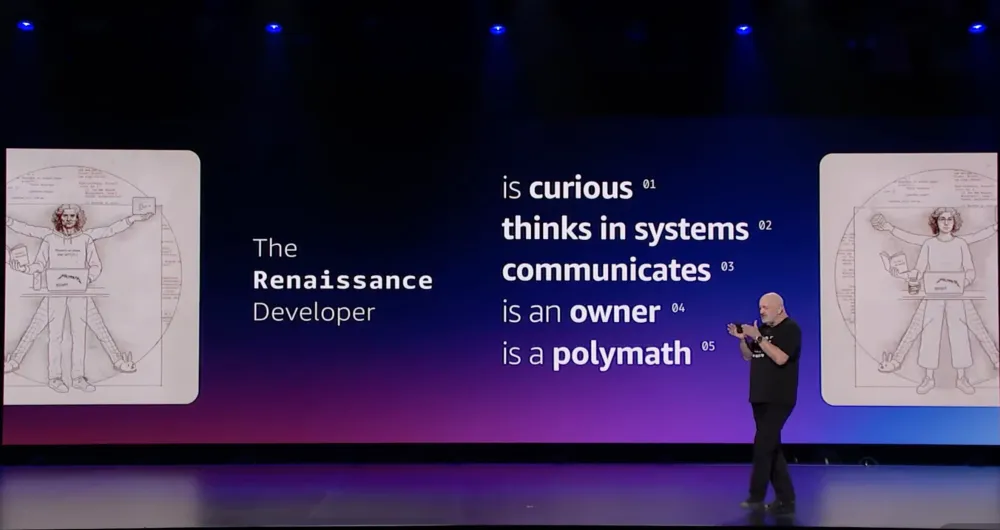
To succeed in new AI era, developers should have the mindset of the Renaissance developer, characterized by five key traits, who is curious, thinks in systems, communicates, is an owner, and a ploymath.

The highlight of AWS re:Invent, which I eagerly await every year,is the insightful keynote by Dr. Werner Vogles, CTO of Amazon.com. Sadly, this will likely be his last re:Invent keynote. (He's not leaving Amazon; he's making the decision to share diverse, young perspectives.) This year, with the ongoing debate about AI and the future of developers, it was a valuable opportunity to hear his perspectives based on his experiences.
With the help of AI, I've compiled a brief summary of his keynote.
“Will AI replace my job?”
This question is perhaps the most pressing topic among developers today. Just as with the emergence of COBOL in the 1960s or visual programming in the 1990s, we are once again faced with the fateful question of "the changing role of the developer" in the face of this massive wave of technology.
However, Dr. Werner Vogels defines this change not as an end, but as a new beginning— a new Renaissance . While the speed at which AI generates code is astonishing, understanding and taking responsibility for the value and system essence that code creates remains the responsibility of human developers. Now, with the powerful tool of AI in our hands, we must be reborn as creators of a new level, like the pioneers of the Renaissance.
To successfully adapt and thrive in this new era, CTO Vogels proposed five core qualities developers must possess, known as the Renaissance Developer Framework . These qualities go beyond simply acquiring new skills; they require a fundamental shift in mindset and attitude. We must now understand the entire system beyond individual components, clearly communicate intent in ambiguous natural language, and possess a sense of ownership, taking ultimate responsibility for the quality of AI-generated output. By internalizing these five qualities, we will be able to position ourselves as true builders, empowered by AI to solve complex problems previously unimaginable.
Renaissance developers, like the craftsmen of the past, push boundaries and pursue both depth and breadth. The five core competencies identified by Werner Vogels are as follows:
1. Don't lose your curiosity
Curiosity is the driving force behind learning and invention, and it's a natural instinct for developers.
- We must constantly protect our instinct to break things down and understand them.
- It is important to have an experimental spirit that is not afraid of failure, and this will lead to learning.
2. Thinking in systems
The ability to understand the feedback loops and interactions of the entire system, rather than its individual parts.
- As with the wolves in Yellowstone National Park, we need to understand how small changes (predator reintroduction) can alter entire systems (river flow, vegetation).
- It's important to recognize that every service, API, and queue is part of a larger system, so any isolated changes will impact the whole system.
3. Communication with precision
In the age of AI, the ability to communicate with machines through clear specifications rather than vague natural language becomes increasingly important.
- Natural language is inherently ambiguous, but to enable AI to generate accurate logic, we need to reduce ambiguity.
- Spec-driven developments a core methodology for increasing precision by clearly separating requirements, designs, and tasks in AI communication. Introducing Kiro, a specification-driven AI coding assistant!
4. Ownership of quality
Even if the code is generated by AI, the ultimate responsibility lies with the developer, which directly impacts regulatory compliance.
- AI coding should be an engineering endeavor, not a gamble, and careful review of generated code is essential.
- In the AI era, code review becomes more important than code generation, and it is a key mechanism for securing verification depth.
5. Polymath oriented, well-versed in various fields
You must have both depth of expertise and breadth of knowledge across multiple fields.
- You don't need to be a multi-disciplinary talent like Leonardo da Vinci, but you need to broaden your knowledge beyond being a T-shaped talent.
- Like Jim Gray, a former database expert, you can make better architectural decisions when you understand the business and technology beyond your own expertise.
Ultimately, developers in the AI era must evolve from those who "write" code to those who "understand, verify, and design systems." Customers won't praise the stability of the database we built overnight or the sophistication of our rollbacks. They simply see the results of their actions at the push of a button.
But it's precisely that unseen value—the professional pride in operational excellence—that defines the best developers. No matter how much code AI churns out, the ultimate responsibility and value of it all lies solely with you, the developer. Armed with your curiosity, now embark on a journey to lead this new renaissance.

Frankly, I'm very sad that this was his last keynote address. At the end, he said, “Dear Builders, I am immensely proud of you”. I'd like to say, “Dear Werner, you were a great thinker, visionary, and engineer.”
Keep going build!
P.S His t-shirt of this year says "Open mind for a different view, and nothing else matters…”. This is a lyrics of Metalica's "Noting Else Matters" song.
Enjoyed reading this content? Let the author know!
Your likes, comments, shares, and saves help creators reach more builders.

Loading recommendations
Loading article