
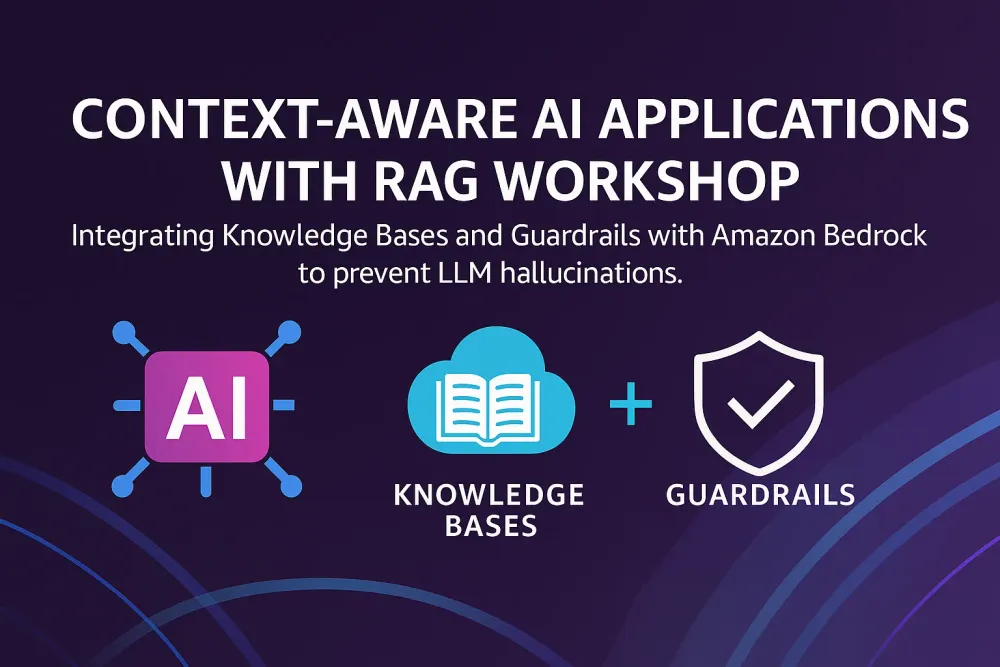
Context-Aware AI Applications with RAG Workshop
Building trustworthy AI systems requires more than just a powerful model. It requires a robust framework that can retrieve accurate information, restrict hallucinations, validate outputs, and ensure that responses align with enterprise standards. In this workshop, we explore how Amazon Bedrock enables this through a combination of Knowledge Bases (for Retrieval-Augmented Generation) and Guardrails (for safety and contextual grounding).


1. Introduction: Why LLM Hallucinations Are a Critical Problem
LLMs have become indispensable in a wide variety of applications: customer support agents, search engines, chatbots, documentation assistants, game knowledge engines, and enterprise automation workflows. Despite their power, all LLMs—including top-tier models—are prone to hallucinations.
What is a Hallucination?
A hallucination occurs when a model:
- Invents facts not present in any context
- Makes up numbers, rules, or events
- Confidently states incorrect or fabricated information
- Fills gaps with imaginative guesses rather than real data
This is dangerous for production environments.
Why Hallucinations Happen
- LLMs are predictive text machines: they generate likely continuations, not guaranteed truths.
- Without grounding, they have no way to verify information.
- When asked about specific domains (finance, healthcare, gaming rules, law), they might guess if not guided by trusted data.
Why This Matters for Enterprises
Hallucinations can lead to:
- Incorrect advice for customers
- Compliance violations
- Financial risk
- Legal exposure
- Broken user trust
Therefore, modern enterprises cannot rely solely on raw LLM output. They need systems that enforce correctness, verify factual grounding, and tightly control model behavior.
2. Step 1: Building the Knowledge Base with RAG
Amazon Bedrock Knowledge Bases implement RAG without requiring developers to build their own vector databases, pipeline components, or chunking strategies manually. The system ingests documents, converts them into embeddings, stores them in a vector database, and retrieves context efficiently.
In this example, we use the Dungeons & Dragons (D&D) System Reference Document (SRD)—a structured set of rules ideal for evaluating factual grounding.
How the Knowledge Base Works (Deep Explanation)
2.1 Data Source
The raw dataset (SRD PDF) is uploaded to Amazon S3, ensuring:
- Durability
- Versioning support
- Easy pipeline integration
- IAM-based access control
2.2 Vector Database Layer
Amazon OpenSearch Serverless stores the embeddings.
This ensures:
This ensures:
- Ultra-fast semantic search
- Low-latency retrieval
- Automatic scaling
- Zero database maintenance
2.3 Embedding Model
The Titan Embeddings Text V2 model converts passages into dense vectors.
These vectors encode meaning, not keywords.
These vectors encode meaning, not keywords.
Semantic retrieval helps answer questions like:
“What abilities do High Elves have?”
…even if the wording in the document is different.
2.4 Chunking Strategy
The PDF is chunked into sections:
- 300 tokens per chunk
- 20% overlap between chunks
- Fixed size ensures consistency
This provides:
- Enough context in each chunk
- No loss of important details
- Better grounding during answer generation
Knowledge Base Ingestion Summary
Once indexing is complete, you get a status confirmation:
1
2
3
4
5
6
7
{
  "status": "COMPLETE",
  "statistics": {
    "numberOfDocumentsScanned": 1,
    "numberOfNewDocumentsIndexed": 1
  }
}
The system is now ready to support RAG queries.
3. Step 2: Creating the Guardrail for Contextual Grounding
RAG alone solves half the problem. It retrieves data but does not prevent the model from:
- Adding extra facts
- Guessing
- Misinterpreting context
This is where Amazon Bedrock Guardrails come in.
Guardrails evaluate each response using numeric filters and block any output that fails validation.
The Two Core Filters: How They Work
1. Grounding Filter
Checks:
Is the model’s answer factually tied to the retrieved documents?
Is the model’s answer factually tied to the retrieved documents?
A grounding score of 0.5 means at least 50% confidence that the response is supported by the supplied context.
2. Relevance Filter
Checks:
Is the response actually related to what the user asked?
Is the response actually related to what the user asked?
A relevance threshold of 0.8 requires the model to be highly focused on the user’s query.
Together, these filters prevent:
- Hallucinated reasoning
- Irrelevant responses
- Creative fabrications
- “Educated guesses”
Why Threshold Tuning Is Important
Different industries have different risk tolerance levels:
| Industry | Recommended Grounding | Recommended Relevance | Reason |
|---|---|---|---|
| Healthcare | 0.9 | 0.9 | Zero tolerance for mistakes |
| Finance | 0.8+ | 0.8+ | Must be fully compliant |
| Gaming / SRD | 0.5 | 0.8 | Flexible but must be factual |
| Creative | 0.3 | 0.5 | Allows imagination |
This allows developers to customize AI behavior to business needs.
Guardrail Code Example
1
2
3
4
5
6
7
8
9
10
11
12
response = bedrock.create_guardrail(
    name="contextual-grounding-guardrail-{}",
    description="D&D Guardrail",
    contextualGroundingPolicyConfig={
        'filtersConfig': [
            {'type': 'GROUNDING', 'threshold': 0.5},
            {'type': 'RELEVANCE', 'threshold': 0.8},
        ]
    },
    blockedInputMessaging="Sorry, I can not respond to this.",
    blockedOutputsMessaging="Sorry, I can not respond to this.",
)
Guardrails now act as a real-time safety net over the LLM.
4. Step 3: Contextual Grounding in Real Action
Two APIs work together:
1. Retrieval
bedrock-agent-runtime.retrieve pulls relevant chunks from the Knowledge Base.2. Generation
bedrock-runtime.converse uses Claude 3 Sonnet, enriched with retrieved chunks, then validates results via Guardrails.Workflow
- User asks question
- RAG retrieves context
- LLM generates answer
- Guardrails evaluate grounding + relevance
- If approved → delivered
- If rejected → safe fallback response
This ensures high reliability.
Example 1: Grounded Query
User: “What are High Elves?”
Response Characteristics:
- Accurate summary
- Pulled directly from SRD
- No invention or creative additions
Scores:
- Grounding: 0.79
- Relevance: 1.0
Outcome:
Response is allowed.
This proves RAG + Guardrails work correctly for valid questions.
Example 2: Irrelevant Question (Testing Hallucination Prevention)
User: “Where should the elves go if they arrive in Paris?”
SRD has no mention of Paris.
Expected Behavior:
The model must:
- Not imagine answers
- Not create new lore
- Not mix real world with fantasy unless allowed
Actual Response:
“The passage does not provide any specific information about where elves should go if they arrive in Paris…”
Scores:
- Grounding: 0.93
- Relevance: 1.0
Outcome:
Response is allowed because it is fully grounded (the content says nothing about Paris).
This demonstrates that Guardrails prevent hallucinations without unnecessarily rejecting harmless queries.
5. Expanded Conclusion: Why This Architecture Is Transformative
Combining RAG + Guardrails creates a highly reliable, enterprise-ready AI stack. This solution goes far beyond retrieval and generation — it creates a controlled intelligence system with predictable and explainable behavior.
Key Benefits (Expanded)
✔ 1. Maximum Accuracy Through Verified Context
Guardrails force the LLM to stick to the source material, dramatically reducing hallucinations.
✔ 2. Consistent and Reproducible Results
Because every output is validated, results remain consistent across:
- Different users
- Different queries
- Different environments
✔ 3. Enterprise-Grade Trust and Compliance
Confidence scores act as:
- Audit logs
- Explainability metadata
- Compliance evidence
This is important for industries governed by regulations.
✔ 4. Operational Efficiency
Companies avoid the need to:
- Build custom hallucination filters
- Fine-tune large models constantly
- Manually validate responses
The platform does it automatically.
✔ 5. Scalable Knowledge Management
Knowledge Bases allow:
- Continuous ingestion
- Automatic re-indexing
- Support for millions of documents
No infrastructure management is required.
✔ 6. Strong User Experience
When context doesn’t exist, the response is neutral and factual:
“The document does not contain that information.”
This clarity builds trust and avoids confusion.
Real-World Use Cases (New Section)
1. Customer Support Automation
Providing answers strictly from product manuals or official policies.
2. Legal Assistants
Summarizing sections only from provided legal documents.
3. Healthcare Knowledge Systems
Offering medical guidance only from approved medical literature.
4. Financial Bots
Explaining investment products based solely on official documentation.
5. Game Databases
Responding to player queries based on official rulebooks.
Architectural Perspective
A modern AI application using this stack includes:
- LLM (Claude 3 Sonnet)
- Knowledge Base for Retrieval
- Vector Database (OpenSearch Serverless)
- Guardrails for Output Validation
- API Gateway or Bedrock Runtime Layer
This helps deliver:
- Reliability
- Explainability
- Full governance control


Enjoyed reading this content? Let the author know!
Your likes, comments, shares, and saves help creators reach more builders.

Loading recommendations
Loading article