
Building a Serverless Mobile Backend: Example Architecture and Key Concepts
In this article, we walk through a demo serverless mobile backend architecture designed to deliver reliability, scalability, and low-latency performance without the overhead of managing servers.

Introduction
Modern mobile applications demand real-time data, seamless synchronization, and a rich user experience across devices. Users expect apps to load instantly, update without delay, and scale effortlessly — regardless of traffic spikes. Meeting these expectations traditionally required complex backend infrastructure, but serverless architectures have transformed how mobile backends are built.
In this article, we walk through a demo serverless mobile backend architecture designed to deliver reliability, scalability, and low-latency performance without the overhead of managing servers.
Why Serverless for Mobile Applications?
Serverless technologies, such as AWS Lambda and Amazon API Gateway, enable application developers to focus on building features — not managing infrastructure. For mobile apps, this translates directly into:
✅ Real-time data delivery:
Mobile users expect information to refresh instantly. Serverless patterns allow backend functions to react to events as they happen, pushing updates to clients via APIs, WebSockets, or event streams.
✅ Automatic scaling:
Whether your app has 100 users or 1 million, serverless services automatically scale up and down without manual configuration.
✅ Lower operational overhead:
There are no servers to patch, scale, or maintain. You pay only for actual usage.
✅ Faster development cycles:
Teams can deploy new features quickly using event-driven components and managed services.
Demo Architecture Overview
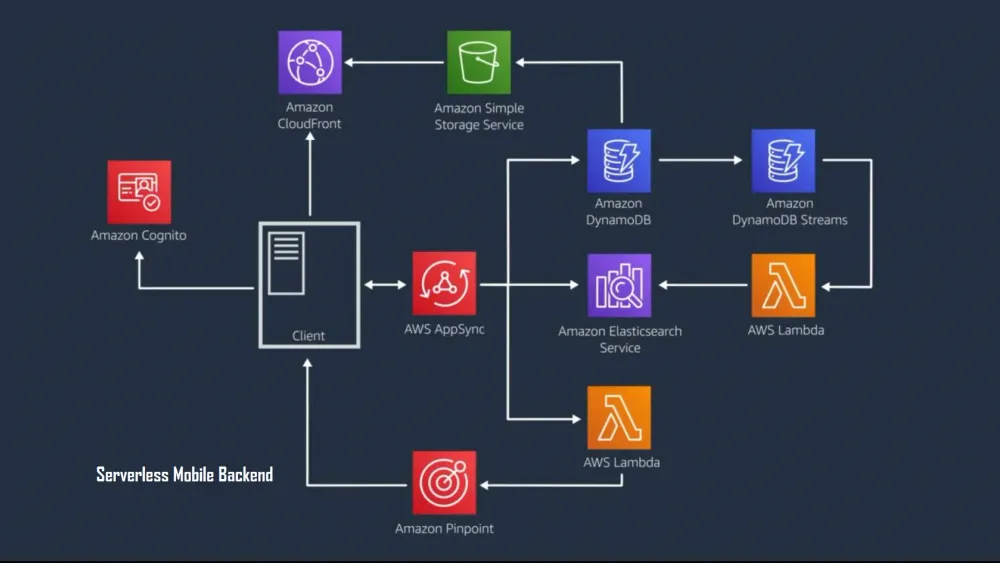
Below is a typical serverless mobile backend pattern using AWS components:
1. Mobile App (Frontend)
iOS, Android, or cross-platform frameworks like React Native and Flutter communicate with the backend using secure APIs.
2. Amazon API Gateway
Handles REST APIs and WebSocket connections.
- Provides authentication/authorization
- Manages routing
- Supports real-time communication patterns
3. AWS Lambda (Business Logic)
Stateless compute functions triggered by API calls or events.
Example tasks:
Example tasks:
- User profile management
- Data validation
- Processing mobile app requests
4. Amazon DynamoDB (NoSQL Database)
Stores user profiles, app state, preferences, and real-time operational data.
- Millisecond latency
- Scales automatically
- Ideal for mobile session data
5. Amazon Cognito (Authentication)
Provides secure:
- User sign-up/sign-in
- Token-based authentication
- Social login integration (Google, Apple, Facebook, etc.)
6. Real-time Updates (API Gateway WebSockets / AppSync / DynamoDB Streams)
For live notifications or instant UI updates, the architecture supports:
- DynamoDB Streams → Lambda → WebSocket push
- Or GraphQL subscriptions via AppSync
7. CloudFront + S3 (Static Assets)
If the app uses web-based components or stores images/videos, CloudFront accelerates delivery globally.
How the Data Flows
- The mobile user logs in via Amazon Cognito.
- The app sends an authenticated API request to API Gateway.
- API Gateway triggers a Lambda function.
- Lambda performs business logic and stores/retrieves data in DynamoDB.
- If real-time updates are required, DynamoDB Streams trigger another Lambda to push updates to connected WebSocket clients.
- The mobile UI updates instantly with fresh data.
Benefits of This Architecture
🔹 High performance
DynamoDB delivers predictable low-latency responses needed for smooth user experiences.
🔹 Real-time user interactions
WebSockets or AppSync enable instant messaging, live dashboards, and notifications.
🔹 Enterprise-grade security
Cognito ensures users and tokens are managed securely.
🔹 Fully managed
No infrastructure provisioning, no servers, and no scaling concerns.
Enjoyed reading this content? Let the author know!
Your likes, comments, shares, and saves help creators reach more builders.

Loading recommendations
Loading article