

5 Data Annotation Myths: Avoid AI Project Failure
Learn the 5 biggest data annotation myths that cause AI projects to fail. Discover how prioritizing data quality and a strategic approach can lead to long-term success.

The AI revolution is here. From autonomous vehicles to personalized medicine, intelligent systems are transforming every industry. But behind every breakthrough AI model is a secret weapon. It’s not the algorithm. It’s the data.
Specifically, it’s the quality of your training data. This data is painstakingly prepared through a process called data annotation. This is the crucial step that teaches your AI models to see, hear, and understand the world.
Yet, many AI/ML companies harbor damaging misconceptions about this process. These myths lead to critical errors, wasted resources, and model underperformance. According to some industry reports, up to 85% of AI projects fail due to poor data quality and inadequate volume.
These failures are often predictable. They stem directly from flawed assumptions about data annotation. This article is your guide to avoiding these pitfalls. We will debunk the five most prevalent data annotation myths that are hurting your AI model's performance.
Let's dive in.
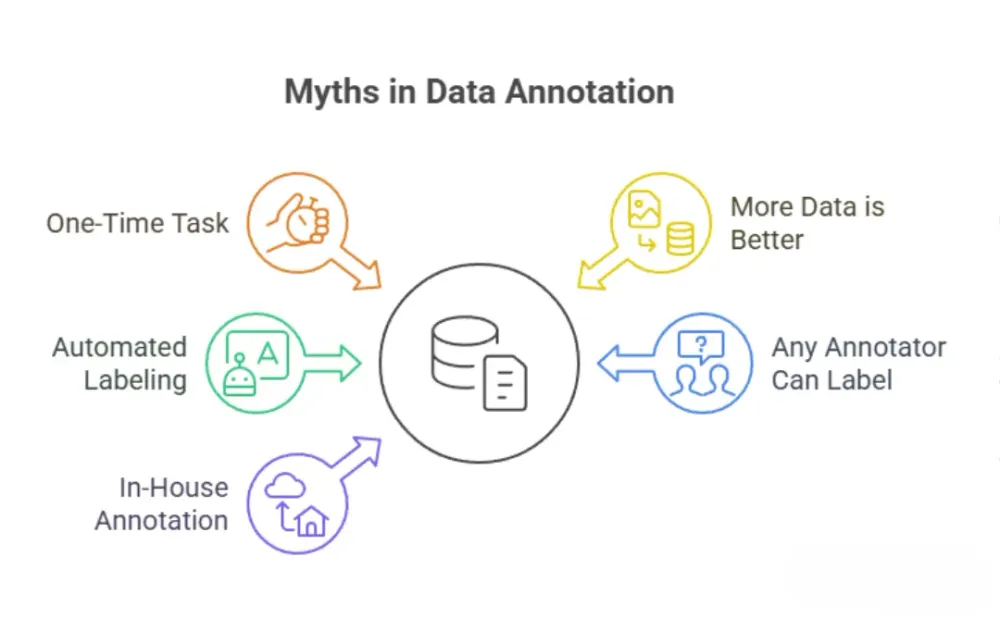
Myth #1: Data Annotation is a One-Time Task
The most common mistake companies make is viewing data annotation as a single, upfront task. They believe you label your dataset once. Then, you train your model. After that, you're done.
This "one-and-done" mentality is fundamentally flawed. It ignores the dynamic nature of both data and AI models. Data changes. Markets evolve. User behavior shifts. All of this can render your initial dataset obsolete.
This phenomenon is known as "data drift." It occurs when the statistical properties of your target variable change over time. It can severely degrade your model's predictive accuracy. Without a continuous feedback loop, your AI will lose its effectiveness.
The reality is that data annotation is an iterative and ongoing process. It must be integrated into the entire machine learning lifecycle. It is a core part of model maintenance and improvement.
To counteract this myth, you must embrace continuous data annotation. This approach treats data labeling services as a constant activity. It ensures your model remains relevant and robust. This method involves consistently monitoring your model's performance and retraining it with fresh, new data.
Here are the key elements of a continuous annotation strategy:
- Feedback Loops: Set up automated systems to flag data points where your model's predictions are uncertain. This helps you identify and prioritize data that needs human review and annotation.
- Active Learning: This technique intelligently selects the most valuable data points for annotation. Instead of randomly labeling new data, the model actively requests labels for instances it finds difficult or confusing. This dramatically improves efficiency and accuracy.
- Re-annotation: Regularly revisit existing datasets. As your model and its understanding evolve, you may need to re-annotate older data. This ensures consistency and prevents a "stale" training set from compromising performance.
- Data Drift Monitoring: Implement tools to track changes in your live data. When a significant drift is detected, you can initiate a targeted re-annotation effort. This keeps your model from becoming irrelevant.
The global data annotation tools market is projected to reach $12.45 billion by 2033. This growth is a clear indicator. It shows that companies are moving away from the one-time approach. They are investing in solutions that support continuous, iterative annotation workflows.
This strategic shift is non-negotiable for any AI/ML company aiming for long-term success. It ensures your model is not just accurate at launch but remains a valuable asset for years to come.
Myth #2: More Data is Always Better
The idea that "more data equals better AI" is a seductive but dangerous myth. It’s an easy trap for companies to fall into. They pour money into collecting and labeling massive datasets. They mistakenly believe that sheer quantity will compensate for any lack of quality.
This mindset overlooks a fundamental truth of machine learning. Your model's performance is directly tied to the quality of its training data. A model trained on a large, but flawed, dataset will learn the flaws. It will not become more intelligent.
Instead, it will become an expert at replicating errors. It will internalize biases. It will make inaccurate predictions. This is the "garbage in, garbage out" principle. It is a painful and costly lesson to learn.
So, what constitutes "garbage" data? It's more than just missing values or duplicates. It includes:
- Inaccuracies: Incorrect or sloppy labels that confuse the model.
- Inconsistencies: Different annotators applying different rules to the same data.
- Bias: Data that over-represents one group or scenario. It under-represents another. This leads to unfair and unreliable predictions.
- Noise: Irrelevant or corrupted data points that distract the model from learning the true patterns.
The solution is to prioritize quality over quantity. A smaller, meticulously annotated dataset is always superior. It is better than a massive, messy one. Focus on building a training set that is:
- Accurate: Labels must be correct and precise. This requires clear guidelines and rigorous quality control.
- Representative: The data must accurately reflect the real-world conditions the model will encounter. It needs to include a diverse range of examples.
- Consistent: All data points must be labeled according to the same rules. This prevents confusion for the model.
- Clean: The data should be free of noise, duplicates, and irrelevant information.
A recent study found that companies using high-quality data can achieve 35% higher AI model accuracy. They can also reduce time-to-market by up to 20%. These statistics highlight the critical importance of a quality-first approach.
A large dataset can even be detrimental. It can lead to "overfitting." This is when a model learns the noise and mistakes of the training data. It performs well in a controlled environment. But it fails spectacularly in the real world. A focus on quality helps prevent this.
Myth #3: Automated Labeling Replaces Human Annotators
With the rise of sophisticated AI, it’s easy to believe that machines can now label data for other machines. This myth claims that automated labeling tools will make human annotators obsolete.
It is true that these tools are becoming more powerful. They can handle simple, repetitive tasks. They can pre-label a large volume of data. This gives human annotators a head start. It can dramatically speed up the process.
However, they cannot replace human judgment. AI models are excellent at pattern recognition. But they lack the ability to understand context, nuance, and ambiguity. These are the very qualities that make human intelligence unique.
Consider a simple image. An AI can easily identify a car or a tree. But what if the car is partially hidden behind the tree? Or if the lighting is poor? These are the "edge cases" where automated tools struggle and where professional image annotation services become essential for ensuring precision and accuracy.
The solution is not a battle of "human vs. machine." It is a collaboration. The most effective strategy is the Human-in-the-Loop (HITL) approach. Here, humans and AI work together in a synergistic loop.
The AI performs the initial, high-volume labeling. Then, a human expert reviews, corrects, and refines the work. This ensures maximum accuracy and reliability.
Here's why human expertise remains indispensable:
- Handling Ambiguity: Humans can interpret data that is vague or open to multiple interpretations. They can apply contextual knowledge that a machine lacks.
- Edge Case Detection: Humans are essential for identifying and correctly labeling rare or unusual instances. These are the examples that most automated systems will fail to handle.
- Subjectivity: In tasks like sentiment analysis, emotion classification, or content moderation, human judgment is the only reliable way to get an accurate label. Specialized text annotation for NLP ensures that linguistic context, sarcasm, and intent are correctly captured—something even the most advanced automated systems often miss.
- Quality Assurance: A human-in-the-loop workflow provides the ultimate quality control. It is the final check before the data is used to train a critical model.
Despite the hype around automation, manual annotation still leads the market. It holds a 63.8% market share in 2024. This is particularly true for high-stakes applications like medical imaging, autonomous vehicles, and legal text analysis. In these fields, the cost of an error is simply too high.
Myth #4: Any Annotator Can Label Any Data
This myth assumes that data annotation is a generic, low-skill task. It suggests that any trained person can accurately label any type of data, from a picture of a cat to a medical CT scan.
This is a grave error. While basic tasks can be handled by a general workforce, complex data requires a deep understanding of the domain. This is where subject matter experts (SMEs) become essential.
An SME has specialized knowledge. They can correctly identify and label objects and concepts that a general annotator would misinterpret. They are the difference between a good model and a great one.
Think about the consequences of using a non-expert. In a healthcare project, a general annotator might misclassify a subtle tumor. In a legal project, they might miss a key clause. These seemingly small mistakes can have massive, real-world repercussions.
For AI projects in these sectors, an SME is not a luxury. They are a necessity. They provide critical context that is impossible to convey in a simple set of guidelines.
For example, in a project for a financial services AI, an SME can accurately classify fraudulent transactions based on their specialized knowledge of financial systems. A general annotator would not have this expertise.
Here's how to integrate subject matter experts into your workflow:
- For High-Stakes Data: Identify data types where errors could have serious consequences. This is a clear signal that you need an SME.
- Specialized Teams: Build or partner with teams that have domain-specific knowledge. These teams can provide accurate and consistent labels that are essential for high-performance models.
- Knowledge Transfer: Use SMEs to create and refine your annotation guidelines. Their expertise can ensure that your rules are comprehensive and accurate.
- Quality Control: Have SMEs perform the final quality checks on a subset of the data. This provides a crucial layer of validation.
The impact of this approach is tangible. Projects that leverage SMEs for annotation see a 40% reduction in re-work. They also achieve significantly higher model performance metrics. This is a direct result of the enhanced accuracy and consistency provided by expert-led annotation.
Investing in domain-specific expertise upfront saves a tremendous amount of time, money, and headaches down the road. It is a strategic move that pays for itself.
Myth #5: In-House Annotation is Always Better
Many companies believe that controlling their data annotation process internally is the best option. They assume it's more secure, efficient, and cost-effective.
This myth ignores the operational complexities and hidden costs of building and managing an in-house team. The reality is that for most companies, strategic outsourcing is the smarter, more scalable choice.
Consider the challenges of an in-house operation:
- High Costs: You must pay salaries, benefits, and overhead. You also have the cost of training, tool licensing, and managing a workforce. These costs can quickly balloon.
- Scalability Issues: AI projects have unpredictable needs. They may require a small team one month and hundreds of annotators the next. An in-house team is not flexible enough to handle this.
- Talent Acquisition: It is difficult and expensive to find, hire, and retain skilled annotators. The work can be tedious, leading to high employee churn.
- Lack of Specialization: An in-house team may be great at one type of annotation, but not another. Outsourcing gives you immediate access to diverse and specialized talent.
- Management Burden: Your core team must spend valuable time managing annotators and their workflow. This is time that could be spent on core AI development.
Strategic outsourcing, on the other hand, allows you to leverage a partner's expertise and infrastructure. This frees up your internal resources to focus on what they do best.
Here are the benefits of outsourcing to a specialized data annotation company:
- Scalability: Instantly scale your team up or down based on project needs. This provides a flexible workforce and prevents costly underutilization of resources.
- Cost-Effectiveness: Pay only for the annotation you need. This eliminates the fixed costs of salaries, benefits, and office space. It can lead to significant savings.
- Specialized Expertise: Gain immediate access to a global pool of skilled annotators, including domain experts. This is crucial for niche or complex projects.
- Proven Workflows: Leverage a partner’s established quality control processes and secure data handling procedures. This ensures your data is accurate and protected.
- Faster Turnaround: Specialized providers can complete large volumes of work in a fraction of the time. This accelerates your time-to-market.
The global data annotation services market is valued at $2.5 billion. It is growing rapidly. This trend is a clear sign that companies are recognizing the value of outsourcing. They are choosing to focus on their core competencies.
Before you build your own team, conduct a thorough cost-benefit analysis. For most organizations, especially those in a growth phase, outsourcing is the more strategic and financially sound choice.
Conclusion: The Path to AI Success
Data is the lifeblood of AI. But for too long, the critical task of data annotation has been misunderstood and undervalued. The myths we’ve explored today are not harmless. They can lead to project failure, financial loss, and ethical risks.
By debunking these five myths, you can build a more robust and resilient AI strategy. Remember, the key to success lies in:
- Treating annotation as a continuous process, not a one-time task.
- Prioritizing quality over quantity in your datasets.
- Embracing a human-in-the-loop approach.
- Leveraging domain expertise for complex data.
- Strategically outsourcing for scalability and efficiency.
Your AI model is only as good as the data you feed it. By adopting a more informed, strategic approach to data annotation, you can give your models the best chance to succeed. This is how you move from AI project failure to true innovation.
What myths have you encountered in your own projects? Share your experiences in the comments below!
Enjoyed reading this content? Let the author know!
Your likes, comments, shares, and saves help creators reach more builders.

Loading recommendations
Loading article