
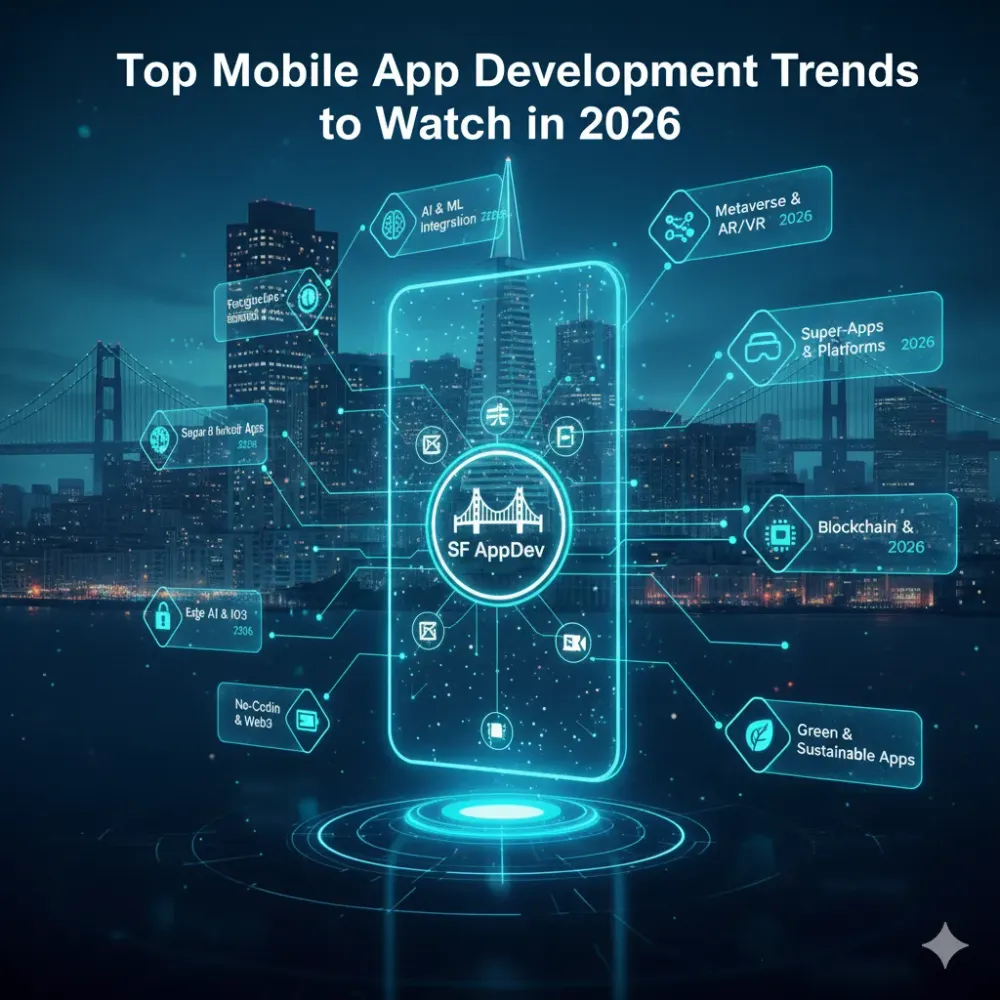
Top Mobile App Development Trends to Watch in 2026
Discover the top mobile app development trends to watch in 2026—from AI and 5G to cross-platform frameworks and AR/VR. Stay ahead with insights for businesses, developers, and every software development company.


Mobile app development is evolving rapidly, driven by technological advancements, user expectations, and industry disruptions. As we approach 2026, businesses, developers, and tech enthusiasts are keen to understand what lies ahead. From AI integration to cross-platform frameworks, the future of app development is shaping up to be more intelligent, responsive, and immersive.
In this blog, we explore the top mobile app development trends that are set to dominate 2026—and how companies can stay ahead of the curve.
1. AI-Driven Personalization Will Become Standard
Artificial Intelligence is no longer a buzzword—it's becoming an essential part of the mobile app experience. In 2026, expect AI-powered personalization to become the norm across all types of apps, from e-commerce and fintech to fitness and education.
Apps will increasingly use machine learning algorithms to tailor content, recommendations, and notifications based on user behavior and preferences. From voice recognition to predictive analytics, AI will not only enhance user engagement but also streamline operations for businesses.
For any software development company, integrating AI modules will be a must-have, not a nice-to-have.
2. 5G Will Unlock New App Possibilities
With global 5G adoption nearing its peak by 2026, mobile apps will be able to support faster data transfer, low latency, and real-time processing. This opens doors to feature-rich experiences like:
- Cloud gaming on mobile
- Augmented reality (AR) and virtual reality (VR)
- Real-time video streaming
- Connected IoT applications
App developers must begin designing experiences that take advantage of 5G’s speed and reliability. Whether you're a web development company or focused solely on mobile, optimizing for 5G will be critical to delivering next-gen user experiences.
3. Cross-Platform Development Will Dominate
Frameworks like Flutter, React Native, and Kotlin Multiplatform have made it easier than ever to build cross-platform apps with native performance. By 2026, cross-platform mobile app development will likely be the default for most startups and enterprises due to:
- Lower development costs
- Faster time-to-market
- Easier maintenance
A modern app development strategy will no longer mean building separate iOS and Android apps from scratch. Instead, companies will adopt unified codebases that can deploy to multiple platforms without compromising user experience.
4. Super Apps Will Gain Popularity in the West
Popularized in Asia (e.g., WeChat, Gojek), super apps combine multiple services under one umbrella—messaging, shopping, payments, bookings, and more. By 2026, Western markets will see a rise in super apps as large brands seek to consolidate services into one app to increase user retention and engagement.
To compete, smaller companies and startups must focus on seamless integration and interoperability. This will be a challenge—and an opportunity—for every software development company aiming to build scalable, modular solutions.
5. Voice-Enabled Interfaces Will Enhance Accessibility
Voice user interfaces (VUIs) are set to expand in 2026. With AI-powered voice assistants like Siri, Google Assistant, and Alexa becoming more intelligent, users will expect more voice-enabled controls in apps.
From booking a cab to setting reminders and performing searches, VUIs improve both accessibility and convenience. Apps that ignore voice integration risk falling behind.
A forward-thinking mobile app development approach will prioritize multimodal interfaces—touch, voice, and even gesture-based inputs—to enhance the overall UX.
6. AR and VR Will Go Mainstream
Augmented Reality (AR) and Virtual Reality (VR) are transitioning from niche applications to mainstream use cases. Thanks to advancements in mobile GPUs and 5G, AR/VR-enabled apps will flourish in:
- Retail (virtual try-ons)
- Healthcare (remote surgeries, 3D imaging)
- Education (immersive learning)
- Gaming and entertainment
App developers will increasingly rely on platforms like ARKit, ARCore, and Unity to create immersive experiences. Businesses looking to capitalize on AR/VR must partner with a skilled web development company that understands spatial computing and immersive design.
7. IoT-Integrated Apps Will Reshape Industries
The Internet of Things (IoT) continues to expand, with billions of connected devices forecasted by 2026. Mobile apps are the natural interface for controlling and monitoring these devices.
IoT integration is transforming industries like:
- Smart homes
- Healthcare (remote monitoring)
- Logistics (real-time tracking)
- Agriculture (automated irrigation systems)
For any software development company, developing IoT-compatible apps will require knowledge of edge computing, real-time data sync, and secure APIs.
8. Focus on Privacy and Data Protection
With increasing data breaches and stricter regulations like GDPR, HIPAA, and CCPA, data privacy will be at the forefront of mobile app development in 2026.
Developers will need to:
- Implement end-to-end encryption
- Provide transparent data usage policies
- Ensure compliance with regional laws
Failure to do so could lead to penalties and a loss of user trust. Privacy-focused design will be a competitive advantage.
9. Low-Code and No-Code Platforms Will Expand Access
The rise of low-code and no-code platforms is democratizing app development. By 2026, more non-developers will be able to create functional apps with drag-and-drop interfaces.
While these platforms won't replace professional developers entirely, they’ll be powerful tools for:
- Prototyping
- MVP development
- Internal tools
A forward-looking web development company or software development company will offer hybrid services—combining custom development with low-code tools to speed up delivery.
10. Edge Computing Will Reduce Latency
As apps become more complex and real-time dependent (e.g., autonomous vehicles, smart cities), edge computing will play a bigger role. Instead of sending data to centralized cloud servers, edge computing processes it closer to the source.
The benefits?
- Reduced latency
- Lower bandwidth usage
- Enhanced reliability for critical apps
This trend will be especially important for apps in logistics, healthcare, and industrial automation.
'Final Thoughts
2026 promises to be a transformative year in the world of mobile app development. With emerging technologies like AI, 5G, AR/VR, and IoT shaping the digital landscape, businesses must adapt quickly or risk falling behind.
Whether you're a startup looking to launch your first app or an enterprise seeking to modernize your systems, staying updated with these trends is essential. Partnering with an experienced software development company or web development company can ensure that your app is not just functional—but future-ready.
Enjoyed reading this content? Let the author know!
Your likes, comments, shares, and saves help creators reach more builders.

Loading recommendations
Loading article