
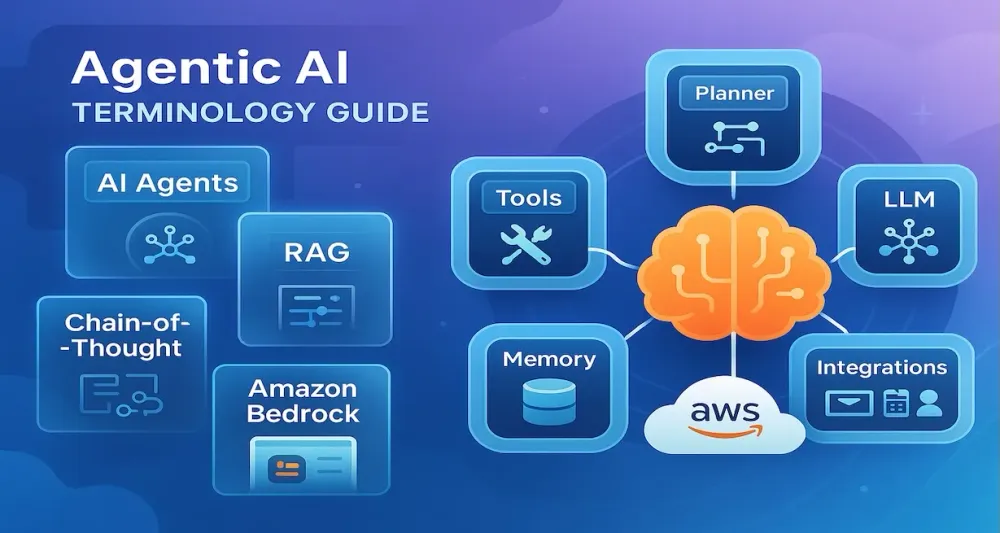
Agentic AI Terminology Guide: Essential Concepts and Terms
A concise, practical glossary of Agentic AI terms - from core agent concepts to AWS Bedrock, multi‑agent patterns, RAG, and operational best practices. Designed as a living reference for developers, product leaders, and researchers.

Are you feeling overwhelmed by the rapidly evolving vocabulary of the AI world? You’re not alone. The field of Agentic AI is advancing at breakneck speed, introducing new concepts, frameworks, and terminology almost daily. No matter where you are on your AI journey, this comprehensive guide will serve as your compass through the complex landscape of AI language.
This reference covers everything from foundational concepts—such as agents and large language models—to cutting-edge patterns like multi-agent orchestration and retrieval‑augmented generation. You’ll find clear, practical definitions that go beyond buzzwords, explaining what these technologies actually do and why they matter.
A comprehensive reference guide for understanding the language of AI agents, from basic concepts to advanced enterprise implementations.
Access the latest interactive version online: https://zechariahkasina.github.io/agentic-ai-terminology/

Check out the interactive version of this guide here . To view the source code or contribute, visit the GitHub repository .
Select a category from the below dropdown to learn about the AI terms in that category.
Agent
An autonomous AI system that can perceive its environment, make decisions, and take actions to achieve specific goals. Unlike traditional software that follows predetermined paths, agents can adapt and reason through complex scenarios.
Agentic AI
AI systems designed to act autonomously on behalf of users, making decisions and taking actions without constant human intervention. These systems can plan, execute tasks, and adapt to changing conditions.
Multi-Agent System (MAS)
A collection of multiple AI agents that work together, communicate, and coordinate to solve complex problems that would be difficult for a single agent to handle alone.
Agent Orchestration
The coordination and management of multiple agents working together, including task distribution, communication protocols, and result aggregation.
Tool Calling
The ability of an AI agent to invoke external functions, APIs, or services to gather information or perform actions beyond its base capabilities.
Function Calling
A specific implementation of tool calling where the AI model can call predefined functions with structured parameters to perform specific tasks.
Reasoning
The agent's ability to process information, draw conclusions, and make logical decisions based on available data and context.
Planning
The process by which an agent breaks down complex goals into smaller, actionable steps and determines the sequence of actions needed to achieve objectives.
Context Window
The amount of text (measured in tokens) that an AI model can process and remember in a single conversation or interaction.
Session Management
The handling of persistent conversations and context across multiple interactions with an agent, maintaining state and memory between requests.
Agent Workflow
A structured sequence of tasks and decision points that an agent follows to accomplish complex objectives, often involving multiple tools and reasoning steps.
Autonomous Decision Making
The agent's capability to make choices and take actions without human intervention, based on its training, context, and defined objectives.
Agent Collaboration
The ability of multiple agents to work together, share information, and coordinate actions to solve problems that require diverse skills or perspectives.
Feedback Loop
A mechanism where an agent learns from the results of its actions and adjusts future behavior accordingly, enabling continuous improvement.
Agent State
The current condition and context of an agent, including its memory, active tasks, and environmental awareness at any given moment.
Quick Reference
| Term | Category | Complexity | Key Use Case |
|---|---|---|---|
| Agent | Core | Beginner | Autonomous AI system |
| LLM | Model | Beginner | Text generation and understanding |
| RAG | Framework | Intermediate | Knowledge-enhanced responses |
| ReAct | Framework | Intermediate | Reasoning and acting combined |
| Bedrock | AWS Service | Beginner | Foundation model access |
| MCP | Protocol | Advanced | Agent-tool integration |
| IAM | Security | Intermediate | Access control |
| Observability | Monitoring | Advanced | System health tracking |
| AI Governance | Business | Intermediate | Responsible AI implementation |
| Constitutional AI | Advanced | Advanced | Principle-guided AI behavior |
| Human-in-the-Loop | Operational | Intermediate | Human oversight integration |
| Mixture of Experts | Architecture | Advanced | Specialized model routing |
Conclusion
This terminology guide serves as your compass through the rapidly evolving landscape of Agentic AI. As the field continues to advance at breakneck speed, new concepts, frameworks, and technologies will emerge. We recommend bookmarking this guide and returning to it regularly as you encounter new terms in your AI journey.
Remember, understanding these concepts is just the beginning. The real value comes from applying them to solve real-world problems and create meaningful AI solutions. Whether you're building your first chatbot, implementing enterprise-scale agent orchestration, or researching the next breakthrough in AI reasoning, having a solid grasp of this terminology will accelerate your progress and improve your communication with others in the field.
Feel free to contribute or provide feedback in the comments below or on the Github page .
Enjoyed reading this content? Let the author know!
Your likes, comments, shares, and saves help creators reach more builders.

Loading recommendations
Loading article