
Supply Chain Attacks in Agentic AI: Emerging Threats and Defensive Strategies
Explains about how agentic AI expands the supply chain attack surface across data, models, plugins, and orchestration, and details a defense-in-depth playbook with ABOM provenance, rigorous validation, zero-trust execution, human review, and AWS-native controls to secure end-to-end deployments.


As agentic AI systems evolve from narrow, task-specific tools to autonomous digital agents capable of complex reasoning, planning, and execution, their integration into organizational ecosystems introduces novel cybersecurity attack vectors. AI supply chain attacks against agentic systems are rising because adversaries increasingly abuse dependencies such as datasets, models, plugins, and APIs to subvert agent behavior and exfiltrate data, often starting with compromised integrations and weak access controls in AI platforms. As per IBM’s 2025 report finds one in six breaches involved AI driven attacker use (e.g., phishing, deepfakes), while 13% of organizations suffered breaches involving their own AI models or applications, often lacking basic access controls in 97% of cases; these AI platform breaches frequently began as supply chain intrusions through compromised apps, APIs or plugins.
Defining the AI Supply Chain Threat Model
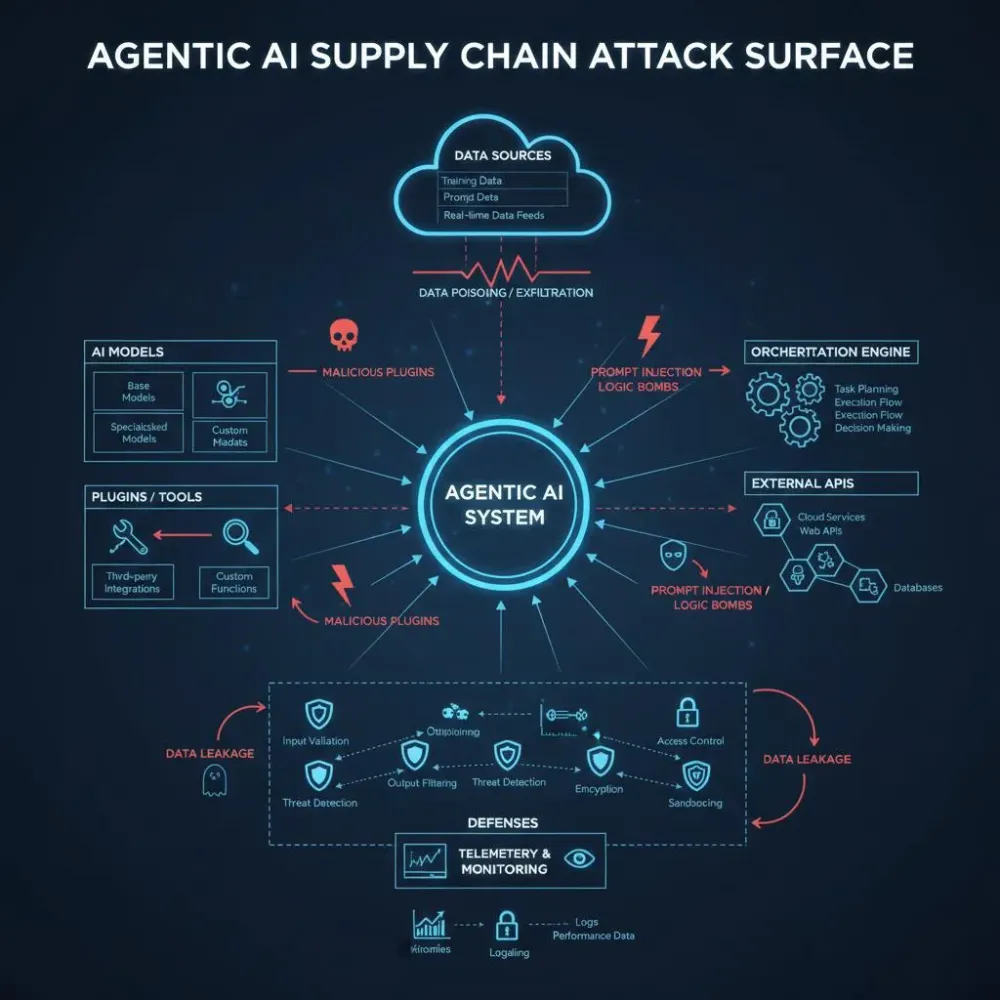
Supply chain attacks in traditional software environments exploit trust relationships between vendors, libraries, and end-users. In agentic AI, the supply chain expands to include datasets, pre-trained models, fine-tuning pipelines, plugins, APIs, and orchestration frameworks. Each component represents a potential insertion point for adversaries aiming to subvert AI behavior or exfiltrate sensitive data. Unlike static binaries, AI agents operate on probabilistic reasoning with dynamic execution paths, amplifying the impact of subtle corruptions.
Attack Surfaces Unique to Agentic AI
- Data Supply Integrity: Fine-tuning datasets sourced externally risk poisoning attacks that induce failures or bias AI behavior toward attacker objectives. This data dependency chain often lacks sufficient provenance tracking or validation mechanisms.
- Model and Plugin Tampering: Third-party modules or plugins integrated into agentic AI can be weaponized. Malicious models or compromised modules may perform unauthorized actions, execute code injections, or facilitate lateral movement within enterprise environments.
- Prompt Injection via Content Channels: Agentic AI’s reliance on natural language prompts as inputs exposes it to injection attacks via corrupted content streams—emails, web pages, or documents embedded with adversarial instructions.
- Component Interoperability and Escalation Risk: The complexity of orchestrated workflows allows attackers who compromise even one node in the supply chain to escalate privileges or pivot through AI-driven automation to deeper network layers.
Defensive Frameworks for AI Supply Chain Security
- Provenance and Metadata Management: Implementing AI Bills of Materials (ABOMs) that catalog dataset sources, model lineage, and plugin authenticity provides traceability and facilitates auditing.
- Robust Validation Pipelines: Automated and manual controls to vet incoming data and models via anomaly detection, adversarial testing, and cryptographic verification strengthen component integrity.
- Zero-Trust Execution Environment: Agentic AI actions must be sandboxed with least-privilege access, strict API rate-limiting, and continuous monitoring to intercept aberrant behaviors.
- Comprehensive Telemetry and Anomaly Detection: Leveraging explainability frameworks alongside real-time telemetry allows security teams to identify deviations from expected AI decision-making processes.
- Human-in-the-Loop Safeguards: Critical decision points in AI workflows should require human validation, especially those involving sensitive data access or external communications.
AWS Security Best Practices for Agentic AI Supply Chain Defense
Organizations leveraging AWS for deploying agentic AI systems can apply the following best practices to mitigate supply chain risks:
- Use AWS Identity and Access Management (IAM) with Least Privilege: Enforce granular permissions for AI components ; for example, limit access to datasets, models, and APIs strictly to only what the agent needs to perform its tasks. Utilize IAM Roles for service-level access control.
- Enable AWS CloudTrail and AWS Config: Implement comprehensive logging and configuration tracking to detect unauthorized changes in model environments, plugin deployments, or dataset accesses, facilitating fast incident response.
- Adopt Amazon Macie and GuardDuty: Use data privacy and threat detection services to monitor sensitive data repositories and detect anomalous or suspicious activity that may indicate supply chain compromises.
- Leverage Amazon SageMaker Model Monitoring: Continuously track model quality, drift, and data integrity to identify adversarial inputs or poisoned datasets in production AI models.
- Implement AWS Service Control Policies (SCPs) via AWS Organizations: Apply organization-wide guardrails that restrict potentially dangerous API calls or risky configurations that attackers might exploit through compromised AI components.
- Use AWS Secrets Manager and AWS Key Management Service (KMS): Protect credentials, API keys, and encryption keys used by agentic AI workflows to prevent unauthorized access or data leaks.
- Network Security with VPC and Security Groups: Isolate AI workloads within Virtual Private Clouds (VPCs) with strict inbound/outbound rules to contain potential lateral movement from compromised components.
- Enable AWS Systems Manager for Patch Management: Maintain up-to-date security patches on AI-related infrastructure to mitigate exploitation of known vulnerabilities in plugins or dependencies.
Future Directions in AI Supply Chain Security
- Developing formal threat models specific to autonomous AI agents and their supply chains will guide targeted vulnerability assessments.
- Advancing adversarial attack simulations tailored for chained AI components is essential to preempt novel exploit patterns.
- Encouraging the design of open standards for ABOMs and trusted AI registries will facilitate sharing of security intelligence across the community.
Final thoughts
The fusion of agentic AI capabilities with complex supply chains presents a paradigm shift in cybersecurity. The multi-faceted attack surfaces arising from data, models, plugins, and autonomous orchestration necessitate holistic security practices extending beyond conventional perimeter defenses. By treating every artifact as traceable, gating deployments with adversarial testing, and aligning autonomous actions to intent-aware policies, teams can safely harness autonomy without sacrificing integrity. Leveraging cloud-native security services like those provided by AWS can significantly enhance visibility, control, and resilience of agentic AI deployments at scale.
Enjoyed reading this content? Let the author know!
Your likes, comments, shares, and saves help creators reach more builders.

Loading recommendations
Loading article