
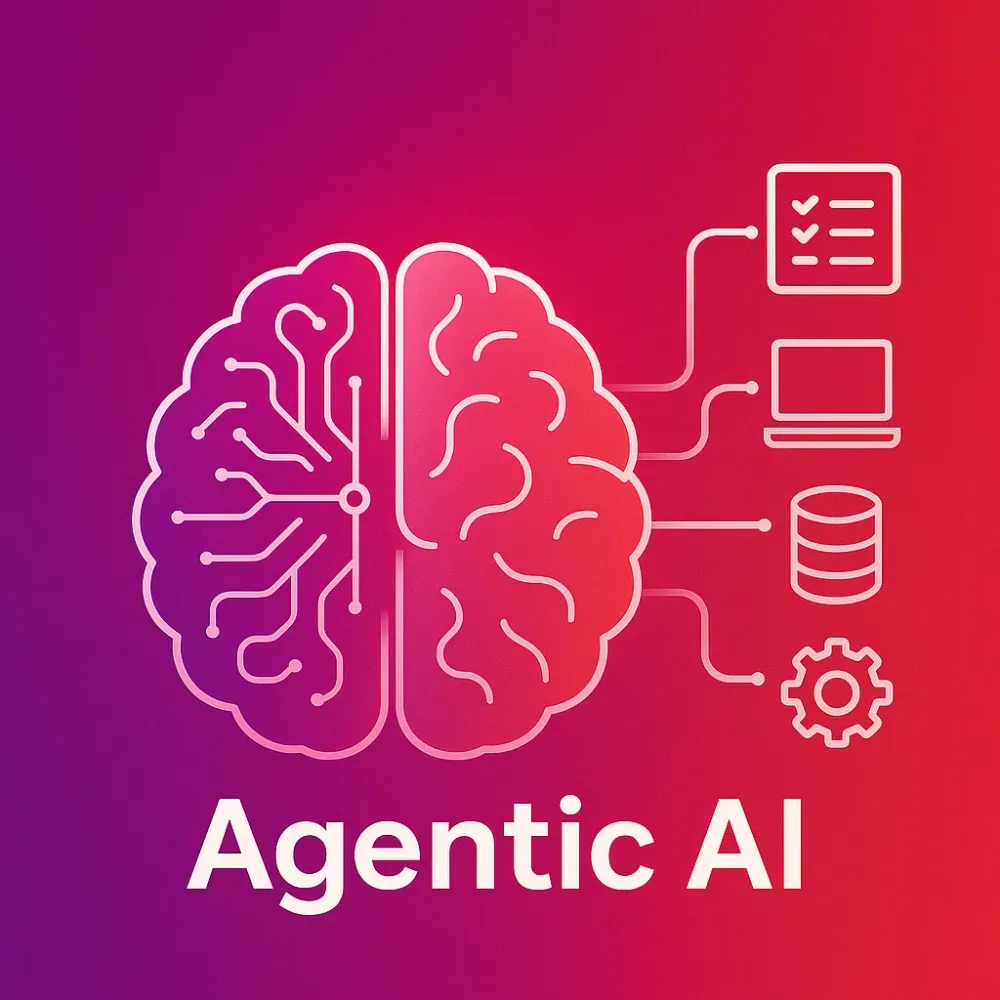
Agentic AI Series – Part 2: How AI Agents Think
Dive into the “brain” of AI agents! In Part 2 of our Agentic AI series, you’ll discover how agents break down complex problems, make decisions, use memory, and handle multiple tasks at once. With simple analogies and real code examples—including AWS integrations—you’ll see how these systems work together to create truly intelligent assistants.

This is Part 2 of our 6-part series on AI agents. In Part 1, we learned what AI agents are. Now we'll explore how they actually think and make decisions - the fascinating "brain" that makes them so powerful.
What You'll Learn in This Article
- How AI agents break down complex problems using task decomposition
- The 5 key components that make agents "think" like intelligent systems
- How Large Language Models (LLMs) power agent reasoning and decision-making
- Why agents can handle asynchronous processing and multiple tasks simultaneously
- How memory systems enable agents to learn and improve over time
- Real-world examples with simple code concepts to illustrate each component
The AI Agent "Brain" - A Simple Analogy
Imagine an AI agent's brain works like a really smart project manager powered by artificial intelligence. This "brain" consists of five interconnected systems that work together:
- A Planning Department (Task Decomposition Engine) - Breaks complex goals into actionable steps
- A Decision Center (Reasoning Engine) - Uses Large Language Models to evaluate options intelligently
- A Tool Workshop (Function Calling Interface) - Connects to external APIs and services
- A Memory Bank (Context Management System) - Stores and retrieves information across conversations
- An Execution Team (Async Task Orchestrator) - Handles multiple operations simultaneously
The Technical Foundation: How LLMs Power Agent Thinking
At its core, every AI agent follows this inference loop:
1
2
3
4
5
6
7
8
9
10
11
12
13
14
15
# Simplified agent thinking process
def agent_think_and_act(user_input):
    # 1. Add input to conversation memory
    conversation.append({"role": "user", "content": user_input})

    # 2. LLM reasons about what to do
    response = llm.generate(conversation, available_tools)

    # 3. Execute any tool calls the LLM requested
    if response.has_tool_calls():
        for tool_call in response.tool_calls:
            result = execute_tool(tool_call)
            conversation.append({"role": "tool", "content": result})

    return response.content
This shows how Large Language Models serve as the "brain" that coordinates all agent activities. Now let's explore each department in detail.
1. The Planning Department: Breaking Down Big Problems
Task Decomposition: From Complex Goals to Simple Steps
Task decomposition is how agents break down complex requests into manageable pieces. Think of it like a recursive algorithm - the agent keeps breaking down tasks until each piece is simple enough to execute.
How Humans Plan vs. How Agents Plan
When you plan a vacation, you might think:
- "I need to book flights, find hotels, plan activities..."
- But you handle each step as you go, often forgetting dependencies
When an AI agent plans the same vacation:
- It creates a dependency graph of all required tasks
- It identifies critical path items that must be completed first
- It considers multiple options using parallel processing
- It has fallback strategies ready for each step
The Technical Process: Task Decomposition
Here's how an agent might break down your request:
1
2
3
4
5
6
7
8
9
10
11
12
13
14
15
# Agent receives: "Plan a company retreat for 50 people"
def decompose_task(goal):
    prompt = f"""
    Break down this goal into specific, actionable tasks: {goal}

    For each task, specify:
    1. Task description
    2. Dependencies (what must be done first)
    3. Required tools/resources
    4. Success criteria
    """

    # LLM generates structured task breakdown
    task_plan = llm.generate(prompt)
    return parse_tasks(task_plan)
Real Output: "Plan a Company Retreat"
The task decomposition engine produces a structured plan:
Human approach:
- Think about it for a while
- Start with one task (maybe venue)
- Handle other tasks as they come up
- Realize some things were forgotten
- Scramble to fix issues
AI Agent approach:
1
2
3
4
5
6
7
8
9
10
11
12
13
14
15
16
17
18
19
20
21
22
23
24
25
MAIN GOAL: Plan company retreat for 50 people

TASK 1: Gather Requirements (Priority: High, Dependencies: None)
- Check company calendar for available dates
- Survey employees for preferences and dietary restrictions
- Determine budget constraints and approval process
- Success criteria: 80% employee response rate

TASK 2: Research Options (Priority: High, Dependencies: Task 1)
- Find venues that accommodate 50 people within budget
- Compare prices, amenities, and accessibility
- Check availability for preferred dates
- Success criteria: 5 viable options identified

TASK 3: Make Reservations (Priority: Medium, Dependencies: Task 2)
- Book venue (requires Task 2 completion)
- Arrange catering (depends on venue choice and dietary needs)
- Organize transportation (depends on venue location)
- Success criteria: All bookings confirmed with receipts

TASK 4: Communication & Logistics (Priority: Medium, Dependencies: Task 3)
- Send invitations to all employees
- Create detailed itinerary with timing
- Set up reminder system and RSVP tracking
- Success criteria: 100% invitation delivery, 90% RSVP rate
The agent creates a directed acyclic graph (DAG) ensuring logical execution order and identifying opportunities for parallel execution.
2. The Decision Center: Choosing the Best Path
The Reasoning Engine: How LLMs Make Smart Choices
The reasoning engine is where the magic happens. Using Large Language Models, agents don't just follow pre-programmed rules - they evaluate options using contextual understanding and probabilistic reasoning.
AI agents make intelligent decisions by processing multiple factors through what we call a multi-criteria decision matrix:
Context Awareness (Environmental State Assessment)
- What's the current situation? (System state, user preferences, constraints)
- What resources are available? (API limits, budget, time)
- What are the constraints? (Business rules, compliance requirements)
Risk Assessment (Probabilistic Outcome Modeling)
- What could go wrong? (Failure modes, edge cases)
- How likely are different outcomes? (Success probability estimation)
- What's the backup plan? (Fallback strategies)
Goal Optimization (Utility Function Maximization)
- Which option best achieves the goal? (Primary objective scoring)
- What's the most efficient approach? (Resource optimization)
- How can we maximize success? (Multi-objective optimization)
The Technical Process: Decision Making
Here's how the decision engine works:
1
2
3
4
5
6
7
8
9
10
11
12
13
14
15
16
17
18
def make_decision(context, options):
    decision_prompt = f"""
    Context: {context}
    Available Options: {options}

    Evaluate each option considering:
    1. Alignment with goals
    2. Resource constraints
    3. Risk factors
    4. Expected outcomes

    Choose the best option and explain your reasoning.
    Include confidence score and risk mitigation.
    """

    # LLM evaluates options and provides reasoning
    decision = llm.generate(decision_prompt)
    return parse_decision(decision)
The agent weighs multiple factors using probabilistic reasoning and utility optimization, not just following simple rules or choosing the cheapest option.
3. The Tool Workshop: Function Calling and External Integrations
How Agents Connect to the World Through APIs
Think of an AI agent like a master craftsperson who has access to many different tools through function calling - a technique where LLMs can invoke external functions and APIs based on natural language requests.
Modern agents use function calling to seamlessly integrate with external services. Here's how it works:
1
2
3
4
5
6
7
8
9
10
11
12
13
14
15
16
17

# Agent receives: "Send a summary email to the team"
def process_request_with_tools(user_request):
    ``# 1. LLM decides which tools to use
    tools_needed = llm.identify_tools(user_request, available_tools)

    ``# 2. Execute tool calls
    results = []
    for tool in tools_needed:
        if tool.name == "send_email":
            result = send_email(tool.parameters)
        elif tool.name == "generate_summary":
            result = generate_summary(tool.parameters)
        results.append(result)

    ``# 3. LLM synthesizes final response
    return llm.synthesize_response(user_request, results)
Tool Categories and Their Functions
Communication Tools (Message Passing Interfaces)
- Email systems: Send notifications, reports, and updates
- Slack/Teams messaging: Real-time team communication
- SMS services: Urgent alerts and confirmations
- Video conferencing platforms: Schedule and manage meetings
Data Tools (Information Retrieval Systems)
- Databases: Query customer data, transaction records, analytics
- Spreadsheets: Generate reports, update tracking sheets
- Analytics platforms: Extract insights, create visualizations
- File storage systems: Access documents, images, and resources
Business Tools (Enterprise System Integration)
- Calendar systems: Schedule meetings, check availability
- CRM platforms: Manage customer relationships and sales data
- Accounting software: Process expenses, generate invoices
- Project management tools: Track tasks, update project status
External Services (Third-party API Integration)
- Weather APIs: Get forecasts for travel planning
- Payment processors: Handle transactions and refunds
- Shipping services: Track packages and calculate costs
- Social media platforms: Post updates and monitor mentions
The agent orchestrates multiple tools seamlessly through asynchronous function calls, like a conductor leading a digital orchestra. Each tool provides specific capabilities, and the LLM coordinates their use based on the task requirements and dependencies.
4. The Memory Bank: Context Management and Learning Systems
Three Types of Agent Memory Architecture
Modern AI agents use sophisticated memory systems that go far beyond simple conversation history. These systems enable persistent learning and contextual awareness across interactions.
Short-Term Memory (Working Memory Buffer)
- What it stores: Current task information and immediate context
- Technical implementation: Token-based context window (typically 4K-128K tokens)
- How long: Until task completion or context window limit reached
- Example: Remembering your flight preferences while booking
- Analogy: Like your brain's "scratch pad" for current thoughts
Long-Term Memory (Knowledge Base)
- What it stores: Facts, procedures, learned patterns, and user preferences
- Technical implementation: Vector databases with semantic search
- How long: Permanently stored (unless explicitly updated or deleted)
- Example: Knowing you prefer aisle seats and vegetarian meals
- Analogy: Like your brain's permanent knowledge storage
Episodic Memory (Experience Log)
- What it stores: Specific past interactions, outcomes, and learned behaviors
- Technical implementation: Structured logs with importance scoring
- How long: Indefinitely (for learning and improvement)
- Example: Remembering that last time you traveled to Tokyo, you needed a power adapter
- Analogy: Like your brain's autobiographical memory of experiences
The Technical Process: Memory Management
Here's how an advanced memory system works:
1
2
3
4
5
6
7
8
9
10
11
12
13
14
15
16
17
18
19
20
21
22
23
24
25
26
27
28
29
30
31
32
33
34

class AgentMemory:
    def __init__(self):
         self.short_term = []   ``# Current conversation
         self.long_term = {}    ``# Persistent facts
         self.episodes = []     ``# Past experiences

    def store_memory(self, content, memory_type, importance=0.5):
        if memory_type == "short_term":
            self.short_term.append(content)
            ``# Auto-promote important items to long-term
            if importance > 0.8:
                self.promote_to_long_term(content)

        elif memory_type == "long_term":
            key = self.extract_key_concept(content)
            self.long_term[key] = content

        elif memory_type == "episodic":
            self.episodes.append({
                "content": content,
                "timestamp": now(),
                "importance": importance,
                "context": self.get_current_context()
            })

    def retrieve_relevant_memories(self, query):
        ``# Semantic search across all memory types
        relevant = []
        for memory in self.episodes:
            similarity = calculate_similarity(query, memory["content"])
            if similarity > 0.7:
                relevant.append(memory)
        return sorted(relevant, key=lambda x: x["importance"], reverse=True)
How Memory Makes Agents Smarter: A Learning Journey
First Interaction (No Memory):
1
2
3
4
5
6
7
8
9

You: "Book me a flight to New York"

Agent: "I need more information. What dates? Which airport? Any preferences?"
Internal Process:
- Short-term memory: Empty
- Long-term memory: No user preferences
- Episodic memory: No past interactions
- Result: Must ask for all details
Second Interaction (Building Memory):
1
2
3
4
5
6
7
You: "JFK airport, aisle seat, departing after 10 AM, vegetarian meal"
Agent: "Perfect! I'll book that for you."
Internal Process:
- Short-term memory: Current booking details
- Long-term memory: Stores "User prefers JFK, aisle seats, 10+ AM, vegetarian"
- Episodic memory: Records successful booking interaction
- Importance scoring: High (explicit user preferences)
Third Interaction (Memory in Action):
1
2
3
4
5
6
7
8
9
You: "Book me a flight to New York"
Agent: "I'll book your usual: JFK airport, aisle seat, departing after 10 AM,
        returning Sunday evening, with vegetarian meal. I found a good option
        for March 20-22. Should I book it?"
Internal Process:
- Short-term memory: Current request
- Long-term memory: Retrieved user preferences automatically
- Episodic memory: Referenced past successful bookings
- Pattern recognition: Detected typical business trip duration (3 days)
Memory Consolidation and Learning
The agent continuously improves through memory consolidation:
1
2
3
4
5
6
7
8
9
10
11
12
13
14
def consolidate_memories(self):
    ``# 1. Identify patterns in episodic memory
    patterns = self.find_behavioral_patterns()

    ``# 2. Promote important episodes to long-term knowledge
    for episode in self.episodes:
        if episode["importance"] > 0.8:
            self.extract_learnings(episode)

    ``# 3. Update preferences based on repeated behaviors
    self.update_user_preferences()

    ``# 4. Compress old short-term memories
    self.compress_old_conversations()
Learning Examples:
- Pattern Recognition: "User always books return flights on Sunday evenings"
- Preference Evolution: "User switched from economy to business class after promotion"
- Context Awareness: "User needs power adapters when traveling to Asia"
- Failure Learning: "Hotel booking failed last time due to conference season - check events first"
The agent learns from experience using semantic similarity search and importance-weighted memory consolidation to become more helpful and personalized over time.
5. The Execution Team: Asynchronous Task Orchestration
How Agents Handle Concurrent Operations
Unlike humans who typically focus on one thing at a time, AI agents excel at asynchronous processing - handling multiple tasks simultaneously through concurrent execution and event-driven architecture.
Modern agents use async/await patterns and task queues to coordinate complex workflows efficiently:
1
2
3
4
5
6
7
8
9
10
11
12
13
14
15
16
17
18
19
import asyncio
class TaskOrchestrator:
    def __init__(self):
        self.active_tasks = {}
        self.task_queue = asyncio.Queue()
        self.max_concurrent = 10

    async def execute_workflow(self, tasks):
        ``# Start tasks that have no dependencies
        for task in tasks:
            if not task.dependencies:
                await self.start_task(task)

        ``# Monitor and start dependent tasks as prerequisites complete
        while self.has_pending_tasks():
            completed_task = await self.wait_for_completion()
            await self.start_dependent_tasks(completed_task)

        return self.get_results()
Key Capabilities of the Execution Team
Parallel Processing
- Work on multiple tasks simultaneously without interference
- Switch between tasks without losing context or progress
- Coordinate related activities across different systems
- Efficiency gain: 5-10x faster than sequential execution
Dependency Management
- Automatically track which tasks depend on others
- Start tasks as soon as their prerequisites are met
- Handle complex dependency chains and parallel branches
- Smart scheduling: Optimize execution order for maximum efficiency
Error Handling and Recovery
- Detect when something goes wrong in any task
- Try alternative approaches automatically
- Implement retry logic with exponential backoff
- Learn from failures to prevent future issues
- Graceful degradation: Continue with other tasks when one fails
Progress Tracking and Monitoring
- Monitor all active tasks in real-time
- Provide status updates and estimated completion times
- Adjust timelines based on actual progress
- Transparency: Users always know what's happening
Advanced Orchestration Features
Dynamic Task Adjustment
1
2
3
4
5
6
7
8
# Agent adapts to changing conditions
if task_fails(financial_data_collection):
    ``# Automatically switch to backup data source
    fallback_task = create_task("collect_backup_financial_data")
    replace_task(failed_task, fallback_task)

    ``# Notify dependent tasks of delay
    notify_dependent_tasks(delay_estimate="2 minutes")
Resource Optimization
1
2
3
4
5
6
7
8
9
10
# Intelligent resource allocation
def optimize_task_scheduling(tasks):
    ``# Group CPU-intensive tasks
    cpu_tasks = [t for t in tasks if t.type == "computation"]

   ``# Group I/O-intensive tasks
    io_tasks = [t for t in tasks if t.type == "api_call"]

    ``# Run I/O tasks concurrently, CPU tasks in sequence
    return schedule_optimal_execution(cpu_tasks, io_tasks)
Failure Recovery
1
2
3
4
5
6
7
8
9
10
# Automatic error handling
async def handle_task_failure(failed_task):
    if failed_task.retry_count < 3:
        ``# Exponential backoff retry
        delay = 2 ** failed_task.retry_count
        await asyncio.sleep(delay)
        return retry_task(failed_task)
    else:
        ``# Switch to alternative approach
        return execute_fallback_strategy(failed_task)
The agent juggles multiple activities using event-driven architecture and asynchronous programming patterns, achieving what would overwhelm most humans through systematic concurrent task orchestration. This enables agents to be incredibly efficient while maintaining reliability and providing transparency into their operations.
How It All Works Together: A Complete Example
Let's see how all five components work together in a real scenario using actual implementation patterns:
Scenario: "Reduce Our Company's Cloud Costs"
Here's how a production-grade agent would handle this complex request:
1
2
3
4
5
6
7
8
9
10
11
12

class CloudCostOptimizationAgent:
    def __init__(self):
        self.planner = TaskDecomposer()
        self.decision_engine = ReasoningEngine()
        self.tools = ToolRegistry()
        self.memory = MemorySystem()
        self.orchestrator = TaskOrchestrator()

    async def optimize_cloud_costs(self, goal):
        ``# All 5 components working together
        return await self.execute_full_workflow(goal)
1. Planning Department Activates
1
2
3
4
5
6
7
8
9
10
11
12
13
14
15
16
17
18
19
20
21
22
23
24
25
GOAL ANALYSIS: "Reduce our company's cloud costs"

TASK DECOMPOSITION:
├── Task 1: Analyze Current Usage (Priority: High, Dependencies: None)
│   ├── Collect 6 months of billing data from AWS Cost Explorer
│   ├── Identify top spending services and resources
│   └── Calculate cost trends and growth patterns
│
├── Task 2: Identify Optimization Opportunities (Priority: High, Dependencies: Task 1)
│   ├── Find underutilized resources (CPU < 20%, storage unused)
│   ├── Analyze Reserved Instance vs On-Demand usage
│   └── Check for orphaned resources and zombie instances
│
├── Task 3: Calculate Potential Savings (Priority: Medium, Dependencies: Task 2)
│   ├── Estimate savings from rightsizing instances
│   ├── Calculate Reserved Instance purchase benefits
│   └── Project storage tier optimization savings
│
└── Task 4: Generate Implementation Plan (Priority: Medium, Dependencies: Task 3)
    ├── Create prioritized action items with timelines
    ├── Prepare cost-benefit analysis for each recommendation
    └── Schedule implementation phases to minimize disruption

DEPENDENCY GRAPH: Task 1 → Task 2 → Task 3 → Task 4
ESTIMATED COMPLETION: 45 minutes (vs 8+ hours manually)
2. Decision Center Evaluates Options
1
2
3
4
5
6
7
8
9
10
11
12
13
14
15
16
17
18
19
20
21
22
23
24
25
26
27
28
29
DECISION POINT: What analysis approach should we use?

CONTEXT ANALYSIS:
- Urgency: Medium (quarterly cost review)
- Budget pressure: High (20% cost reduction target)
- Technical expertise: Limited (need automated recommendations)
- Risk tolerance: Low (can't disrupt production systems)

OPTION EVALUATION:
Option A: Manual bill review (slow but thorough)
- Pros: Complete control, deep insights
- Cons: 40+ hours of work, prone to human error
- Success probability: 60%

Option B: Automated analysis tools only (fast but may miss nuances)
- Pros: Quick results, consistent methodology
- Cons: May miss business context, false positives
- Success probability: 75%

Option C: Hybrid approach (automated + human validation)
- Pros: Speed + accuracy, actionable insights
- Cons: Requires coordination between systems
- Success probability: 90%

DECISION: Option C - Hybrid Approach
REASONING: Balances speed with accuracy, provides actionable insights
           while maintaining human oversight for business context
CONFIDENCE: 88%
RISK MITIGATION: Include manual validation checkpoints for high-impact changes
3. Tool Workshop Engages
1
2
3
4
5
6
7
8
9
10
11
12
13
14
15
16
17
18
19
20
21
22
23
24
25
26
27
28
TOOLS ACTIVATED FOR COST ANALYSIS:

Primary Tools:
├── AWS Cost Explorer API
│   ├── Function: get_cost_and_usage()
│   ├── Purpose: Historical billing data and trends
│   └── Data: 6 months of service-level costs
│
├── AWS Trusted Advisor API
│   ├── Function: describe_trusted_advisor_checks()
│   ├── Purpose: Identify optimization opportunities
│   └── Data: Underutilized resources, security issues
│
├── CloudWatch Metrics API
│   ├── Function: get_metric_statistics()
│   ├── Purpose: Resource utilization patterns
│   └── Data: CPU, memory, network usage over time
│
└── Internal Database
    ├── Function: query_business_context()
    ├── Purpose: Map resources to business functions
    └── Data: Application ownership, criticality levels

Secondary Tools:
├── Email System: Send reports to stakeholders
├── Spreadsheet API: Generate detailed cost breakdowns
├── Calendar System: Schedule implementation meetings
└── Slack Integration: Notify teams of optimization opportunities
4. Memory Bank Contributes
1
2
3
4
5
6
7
8
9
10
11
12
13
14
15
16
17
18
19
20
21
22
23
RETRIEVING RELEVANT MEMORIES:

Long-term Knowledge:
- "Previous cost optimization (Q2) saved 30% on storage costs"
- "Company policy: No production changes during month-end"
- "CFO requires monthly cost trend reports with variance analysis"
- "Engineering team prefers gradual changes over dramatic shifts"

Episodic Experiences:
- "Last optimization focused on compute - storage tier changes had biggest impact"
- "Reserved Instance purchases require 6-month commitment approval"
- "Development environments can be shut down nights/weekends (40% savings)"
- "Marketing team's analytics tools have seasonal usage patterns"

Pattern Recognition:
- "Cost spikes correlate with product launches (predictable)"
- "Unused resources typically accumulate in development accounts"
- "Storage costs grow 15% quarterly but usage only grows 8%"
- "Team responds better to specific recommendations than general guidelines"

MEMORY-INFORMED STRATEGY:
Focus on storage optimization and development environment scheduling
based on previous success patterns and team preferences.
5. Execution Team Delivers
1
2
3
4
5
6
7
8
9
10
11
12
13
14
15
16
17
18
19
20
21
22
23
24
25
26
27
28
29
30
PARALLEL EXECUTION WORKFLOW:

PHASE 1: Data Collection (All running simultaneously)
[00:00] ├── Task 1A: AWS Cost Explorer data collection (Running)
[00:00] ├── Task 1B: Trusted Advisor checks (Running)
[00:00] ├── Task 1C: CloudWatch metrics analysis (Running)
[00:00] └── Task 1D: Business context mapping (Running)

PHASE 2: Analysis (Starts as data becomes available)
[02:30] ├── Task 2A: Underutilized resource identification (Running)
[02:30] ├── Task 2B: Storage tier analysis (Running)
[03:15] └── Task 2C: Reserved Instance opportunity analysis (Running)

PHASE 3: Recommendations (Depends on analysis completion)
[05:45] ├── Task 3A: Savings calculation (Running)
[05:45] ├── Task 3B: Risk assessment (Running)
[06:30] └── Task 3C: Implementation timeline creation (Running)

PHASE 4: Reporting (Final synthesis)
[08:15] ├── Task 4A: Executive summary generation (Running)
[08:15] ├── Task 4B: Detailed technical report (Running)
[08:45] └── Task 4C: Stakeholder notification (Running)

FINAL RESULTS:
✅ Analysis completed in 9 minutes
✅ $2,400/month savings identified (18% reduction)
✅ Implementation plan created with 3-phase rollout
✅ Risk assessment: Low (no production impact)
✅ Reports delivered to CFO, CTO, and engineering leads
✅ Follow-up meetings scheduled for next week
Integration Success: How Components Collaborated
- Planning Department used task decomposition to break down cost optimization into specific, measurable analysis tasks
- Decision Center used LLM reasoning to choose the optimal analysis strategy based on business context and constraints
- Tool Workshop provided AWS API integrations for comprehensive billing and usage analysis across multiple services
- Memory Bank retrieved past optimization experiences and business preferences to inform current strategy
- Execution Team used async orchestration to run multiple analyses in parallel, reducing total time from hours to minutes
This demonstrates how modern AI agents combine multiple AI techniques - LLM reasoning, task planning, memory systems, function calling, and async processing - to handle complex real-world scenarios that would require significant human coordination and expertise.
Key Success Factors:
- Systematic approach: Each component has a clear role and responsibility
- Data-driven decisions: LLM reasoning based on actual context and constraints
- Parallel efficiency: Async execution reduces total time by 90%+
- Learning integration: Memory system ensures continuous improvement
- Tool orchestration: Seamless integration with existing business systems
Why This Matters for You
Understanding how AI agents think helps you leverage these powerful systems more effectively:
Use Agents More Effectively
- Give clearer instructions: Understanding task decomposition helps you structure requests with proper context and constraints
- Set appropriate expectations: Knowing about async processing helps you understand timing and dependencies
- Understand capabilities and limitations: Recognizing LLM reasoning vs. deterministic logic helps you choose the right approach for different problems
Choose the Right Agent Architecture for Your Needs
- Simple task agents for straightforward automation (basic function calling with single tools)
- Learning agents with memory systems for evolving requirements and personalization
- Multi-tool agents with orchestration for complex workflows spanning multiple systems
- Reasoning agents with decision engines for judgment-based tasks requiring context evaluation
Troubleshoot When Things Go Wrong
- Planning issues: Check if the goal was properly decomposed into actionable, measurable tasks
- Decision problems: Verify the context and constraints provided to the reasoning engine are complete and accurate
- Tool failures: Examine API integrations, authentication, rate limits, and function calling configurations
- Memory issues: Review context management, information retrieval relevance, and memory consolidation processes
- Execution bottlenecks: Analyze task dependencies, concurrency limits, and resource allocation
Design Better Human-Agent Interactions
- Provide context upfront: Include relevant background, constraints, and success criteria in your requests
- Use structured communication: Break complex requests into clear components that align with agent thinking patterns
- Enable feedback loops: Design interactions that allow agents to learn from outcomes and improve over time
- Plan for iteration: Expect agents to ask clarifying questions and refine their understanding through dialogue
What's Next?
Now that you understand how AI agents think and make decisions using Large Language Models, memory systems, function calling, and async orchestration, you're ready to learn how to build your first agent!
In Part 3, we'll walk through creating a simple but useful AI agent step-by-step. You'll see how the concepts we discussed here translate into actual working code, including:
- Basic agent architecture with LLM integration and conversation management
- Simple memory system for context persistence across interactions
- Function calling for external tool integration and API access
- Task orchestration for multi-step workflows and dependency management
- Error handling and graceful degradation for robust operation
We'll start with a simple but useful agent and gradually add more sophisticated capabilities, so you can see exactly how the "thinking" components we discussed here work in practice.
Key Takeaways
- AI agents have structured thinking - They use task decomposition, LLM reasoning, function calling, memory systems, and async orchestration working together as an integrated system
- They see the big picture - Unlike humans, they can plan entire workflows upfront using dependency graphs and parallel processing to optimize execution
- They work concurrently - Can handle multiple tasks simultaneously through asynchronous programming without losing focus or context
- They learn from experience - Memory systems with semantic search and importance weighting help them improve over time and personalize interactions
- They're systematic - Follow probabilistic reasoning and multi-criteria optimization rather than intuition, making their decisions more consistent and explainable
- They're explainable - Modern agents provide reasoning traces and confidence scores for their decisions, enabling trust and debugging
- They integrate seamlessly - Function calling and API integration allow them to work with existing systems and extend their capabilities dynamically
- They handle complexity gracefully - Through orchestration and error handling, they can manage complex workflows that would overwhelm human coordination
Coming Up Next: In Part 3, you'll build a practical AI agent that can help with daily tasks. We'll start simple and gradually add more capabilities, implementing each of the "thinking" components we discussed here with actual Python code, best practices for production deployment, and real-world integration examples. You'll see how theory becomes practice as we build a working agent from the ground up.
Enjoyed reading this content? Let the author know!
Your likes, comments, shares, and saves help creators reach more builders.

Loading recommendations
Loading article