
The Agentic AI Revolution: Transforming Enterprise Business Processes with AWS and Global Strategic Partners
Explore how AWS and its partners are revolutionizing enterprise operations through agentic AI, transforming traditional business processes into intelligent, automated workflows that work alongside human teams.

By
Prasanta Roy, Principal Solutions Architect, WW Consulting Sales, AWS
Ninad Joshi, EMEA Data & AI Solutions Architect, AWS
Something remarkable is happening in the world of business. Picture this: instead of rooms filled with people manually processing invoices, responding to customer queries, and handling HR paperwork, intelligent AI agents are quietly transforming how work gets done. This isn't science fiction – it's the reality of the agentic AI revolution, led by AWS and its Global Strategic Partners.
The Dawn of a New Era
Let me share a story that brings this to life. A major financial services company recently transformed their invoice processing system. Instead of a team of 20 people manually reviewing thousands of invoices daily, they deployed AI agents that could handle the same workload in a fraction of the time. But here's the interesting part – they didn't have to overhaul their entire system. The AI agents simply plugged into their existing workflow, learning and adapting as they went along. Recent IDC study reveals that over 45% of organizations prioritizing AI agent development for work automation.
Agentic AI systems are helping automation of complex workflows, where agents need to plan, decide, interconnect with other agents, connect to enterprise systems or carry out self-realisation checks. All these actions are often guided through agentic framework, which are either systems or libraries running on top of runtime that orchestrates the work of several agents. Most of the organisations facing challenge whether to use off-the-shelf specialised agentic AI solutions or build with open-source frameworks. In addition, low revenue attribution coming out of AI and generative AI projects is resulting them to be cautious in the experiment with frameworks, platforms.
Whilst organisations are experimenting with agentic AI systems, often those proof-of-concept exercises are not making to the production. So, how can organisations run agents on production systems? This is where AWS and their partners building agentic AI offerings on AWS can help. This paper provides architectural patterns to identify business processes, build & scale agentic AI across your organization delivering BPO services while maintaining security, compliance and governance.
Remember when implementing AI meant months of data preparation and complex infrastructure setup? Those days are rapidly fading. Today's AI agents don't wait for data to come to them – they go where the work is happening. They're like highly skilled digital colleagues who can plug directly into existing systems and get to work immediately.
Business Process agentic Automation
The transformation from people intensive to process automated approach requires three main steps -
1/ Process discovery to unlock priority business processes
2/ Process reimagination
3/ Agent orchestration
The first step of the journey i.e. process discovery involves with the implementation of continuous observation systems. Unlike traditional monitoring methods, modern AI-powered solutions operate in real-time, capturing on-screen activities while maintaining strict privacy protocols. This allows organizations to understand work patterns as they naturally occur, providing invaluable insights into how work gets done.
At the heart of this transformation is the creation of virtual replicas of operational processes that provide a comprehensive view of workplace activities. These replicas capture the complexity of modern work environments, where employees frequently collaborate across multiple applications and engage in parallel workflows. By mapping these intricate processes, organizations can identify bottlenecks and opportunities for improvement that might otherwise go unnoticed. There are several AWS partners in this segment helping customers with AI-powered solutions.
Technology optimization plays a crucial role in this transformation. Through detailed analysis of application usage patterns and switch frequencies, organizations can streamline their technology landscape and identify automation opportunities. This often leads to significant efficiency gains.
Once optimisation opportunities are identified in the technology landscape and processes involved, the next step is to reimagine the process and automating complex workflows with agentic powered workflow.
The enterprise AI landscape is undergoing a fundamental shift. While traditional AI implementations required extensive data preparation, complex infrastructure, and significant upfront investment, agentic AI is flipping this paradigm on its head. Instead of bringing data to AI, we're now bringing AI to data—directly where business processes live and breathe.
This transformation is particularly profound in Business Process Outsourcing (BPO), where repetitive, rule-based tasks have long been prime candidates for automation.
Think of traditional AI implementation as moving into a new house - you had to pack everything up (extract data), transport it to a special facility (centralized processing), then carefully arrange it all in the new location (complex integration), all while needing expensive moving equipment and specialists (high barriers). It was time-consuming, costly, and often frustrating.
But agentic AI flips this script entirely. Instead of moving your entire house, imagine having smart assistants who simply show up at your doorstep, learn your space, and get to work immediately. These AI agents seamlessly integrate into your existing systems, like helpful digital colleagues who adapt to your workplace rather than forcing you to adapt to them. They process information in real-time where it lives, eliminating the need for massive data transfers or complex system overhauls. Best of all, getting started is as simple as opening the door and letting them in - no heavy lifting required.
This fundamental shift from "moving mountains of data to AI" to "bringing AI to the data" represents one of the most significant advances in enterprise technology, making sophisticated AI capabilities accessible to organizations of all sizes.
But how can organisations determine the true return of investment of using agentic AI system?
Working backwards from the opportunity organisations need to determine which business process needs to be prioritised and for what business value. Once this is done the rest is just 4 steps.
- Define Persona and the goal of persona
- Allow the persona to work on system processes as required by the business use case. Example a supply chain agent accessing SAP Ariba for supplier management
- Decompose the process flow into sequence of tasks to be replaced by agents
- Determine the ROI using agentic approach
Understanding agent types
Different tasks need different types of AI agents. Choose the right one by starting with what your workflow needs. Let’s explore using candidate recruiting workflows as our example and review different agent types that are required.
a/Reactive agents
When to use: Event-driven processes, immediate response requirements
Recruiting Example: Candidate CV processing
Trigger: New CV received from applicant
Actions:
- Parse CV and extract key information
- Score against job requirements
- Send personalized acknowledgment
- Update ATS with initial assessment
b/Proactive agents
When to use: Continuous monitoring, predictive actions
Recruiting Example: Talent pipeline management
Actions:
- Monitor job market trends
- Identify potential candidates before positions open
- Maintain engagement with passive candidates
- Predict hiring needs based on business metrics
c/Collaborative / Augmented agents
When to use: multi-stakeholder processes, complex decision-making
Recruiting Example: Interview panel coordination
Collaboration Points:
- Coordinate schedules across multiple interviewers
- Collect and synthesize feedback from all interviewers
- Facilitate consensus-building on hiring decisions
- Manage communication between all parties
d/ Autonomous agents
When to use: well-defined processes, high-volume operations etc
Recruiting Example: Reference checking automation
Actions:
- Automatically request references from candidates
- Conduct structured reference interviews via phone/video
- Analyse responses for consistency and red flags
- Generate comprehensive reference reports
Decision Framework: Selecting the Right Pattern
Process Characteristic | Recommended Pattern | Recruiting Example |
|---|---|---|
High volume, routine | Autonomous | Resume screening |
Event-triggered | Reactive | Application acknowledgment |
Requires monitoring | Proactive | Talent pipeline management |
Multi-stakeholder | Collaborative / Augmented | Interview coordination |
Complex decision-making | Collaborative / Augmented | Final hiring decisions |
Predictable workflow | Autonomous | Onboarding preparation |
Security Principles : The Foundation of Enterprise agentic AI
Any production enterprise agentic AI implementation must prioritize security controls at all levels.
Data Protection
The production agents have to work with sensitive data right at the source, maintaining security and privacy compliance without moving information outside protected boundaries.
Identity and Access Management
AI agents are required to operate under a rigorous security framework, with precise access controls and comprehensive activity logging for every interaction.
Encryption and Compliance
AI agents must utilize state-of-the-art encryption and security measures at every level, ensuring data protection and compliance with key industry standards.
Governance, Observability, and Operational Excellence
Any production agentic AI systems should have comprehensive monitoring systems to track and record every aspect of AI agent performance, from processing metrics to decision rationale, ensuring complete transparency and accountability.
AI agents need to follow a rigorous lifecycle management process, from initial development with synthetic data through validation against human performance to carefully monitored deployment. Each agent continuously evolves through regular updates and improvements, guided by ongoing performance tracking.
AI systems is recommended to comply with robust compliance and risk management mechanisms through automated checks and regular security audits. Each agent deployment therefore should undergo thorough risk assessment, with established procedures for rapid response to any incidents.
AI operations must be optimized for cost efficiency through smart strategies like capacity right-sizing, off-peak scheduling, and reduced redundancy in processing. Every business outcome is tracked against its cost, ensuring maximum value from AI investments.
AWS Marketplace: Democratizing AI Access for Enterprises
Imagine walking into a digital marketplace where AI capabilities are as easy to acquire as downloading an app from your phone's store. This is exactly what AWS has created with its ground-breaking new AI marketplace. Gone are the days of complex AI implementations and difficult choices about technology – AWS has reimagined how businesses can access and deploy AI solutions.
Think of it as a bridge between two worlds. On one side, you have businesses looking to harness AI's power without the traditional headaches of implementation. On the other, you have innovative partners and developers creating cutting-edge AI solutions. AWS's new marketplace brings these worlds together seamlessly.
For businesses, the experience is refreshingly simple. Need an AI assistant for customer service? Or perhaps some specialized AI tools for data analysis? Just browse, subscribe, and you're ready to go – complete with API keys that plug right into your existing systems. It's like having a universal adapter for AI capabilities.
The marketplace isn't just about buying and selling; it's about transformation. AWS partners are crafting solutions that can work with your current systems while opening doors to more advanced AI-powered services. Whether you're taking your first steps into AI or looking to expand your capabilities, there's a path forward.
This new AI marketplace represents a significant step forward in making advanced AI capabilities more accessible and easier to integrate for businesses of all sizes. It showcases AWS's commitment to fostering innovation in the AI space and providing a platform for both AI developers and users to connect and create value.
But how can you build and deploy agents beyond just for experimentation/ proof-of-concept to production scale ?
There are several ways for organisations to use agentic workflow orchestration using off-the-shelf specialised agentic solutions or do-it-yourself using agentic framework (e.g. Strands agents ).
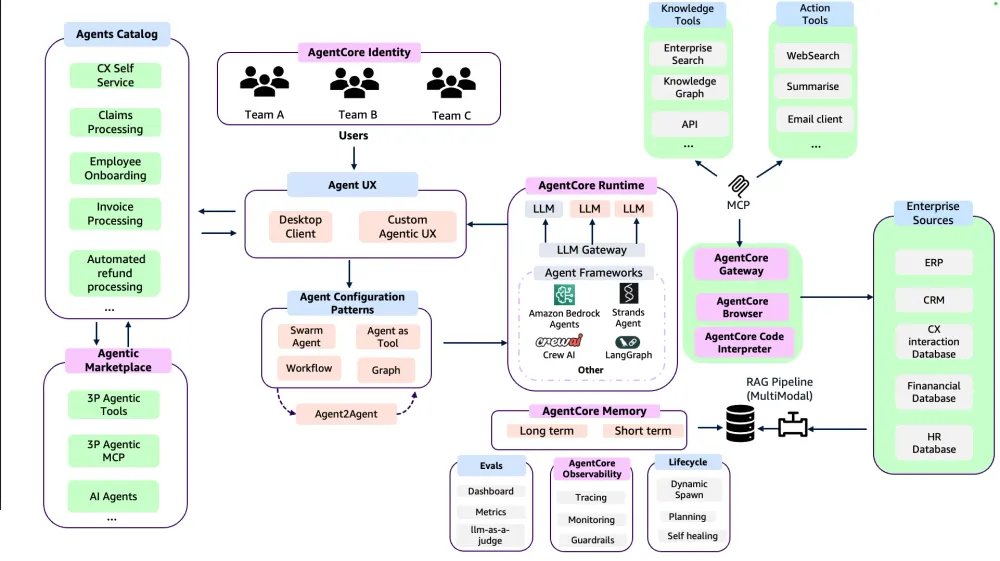
The design is an illustrative architecture utilising AWS Strands agents, where developers use model agnostic, open framework approach to build an agentic architecture on AWS. Amazon Bedrock AgentCore identity enables secure access to AWS services and 3rd party services on behalf of humans, AgentCore memory for building context-aware agents, AgentCore gateway to convert resources to MCP compatible tools, making them available to agents, AgentCore Observability to trace, debug and monitor agentic AI performance on production systems.

This architecture enables an AI and agentic ecosystem, a combination of agentic and procedural solutions that interface with open standards and preserve institutional AI intellectual property and organization-wide capabilities.
Once the process is decomposed into tasks, the tasks are executed over multiple iterations and through interactions between agents ( agent2agent ), often involving numerous tool calls. The framework (e.g. LangGraph or Strands agents ) coordinates this work, tracks outputs, and can terminate processes if a desired outcome isn’t reached after a set number of iterations.
Once the agentic workflow is built, AWS Partners could publish those systems in the agent catalog so that agents can assume the role to perform specific actions. With Amazon Bedrock AgentCore, agents can be deployed into production with the scale, reliability, and security, critical to real-world deployment.
Interoperability plays an important role in the agentic AI workflows. This is where Amazon Bedrock AgentCore embracing open-source protocols such as MCP and A2A for agent communication with external systems or another agent.
In addition to the above architecture design, AWS Partners add humans / people to augment to the service as humans remains essential in the workflow alongside AI agents and deterministic software procedures. Agentic AI it's not about replacing humans; it's about creating a powerful partnership between human expertise and AI capabilities. Think of it as having a highly capable assistant who can handle routine tasks while you focus on more strategic work.
One HR director put it perfectly: "Our AI agents handle the paperwork and routine tasks, which gives our human team more time to focus on what they do best – building relationships and solving complex problems that require emotional intelligence and creative thinking."
Conclusion: The Future is agentic
The future of enterprise technology lies in the seamless integration of human and AI capabilities. As AWS and its partners continue to pioneer agentic AI solutions, we're seeing the emergence of a new paradigm where organizations can achieve unprecedented levels of efficiency, innovation, and value creation. The key to success will be maintaining the balance between rapid innovation and responsible deployment, ensuring that these powerful new capabilities are harnessed in ways that benefit both businesses and their customers. This transformation represents more than just technological advancement - it's a fundamental reimagining of how enterprises operate, innovate, and deliver value in the AI era. As we move forward, the partnership between AWS and its partners will continue to be crucial in shaping this new landscape and helping organizations navigate their journey toward an agentic future.
The question is no longer whether agentic AI will transform your business processes—it's how quickly you can harness its power to gain competitive advantage. The organizations that act now will set the standard for their industries, while those that wait will find themselves playing catch-up in an increasingly automated world. The winners will be those who adapt quickly leveraging AI for efficiency while maintaining strong governance and a focus on high-value human work.
Ready to start your agentic AI journey? Begin with a single, high-impact process, prove the value, and then scale across your entire organization. AI agents represent a significant expansion of automation capabilities; they will complement rather than replace existing business automation technologies. Success will depend on effectively combining AI agents with established tools while maintaining focus on concrete business outcomes. The future of enterprise automation is here, and it's more accessible than ever before.
Enjoyed reading this content? Let the author know!
Your likes, comments, shares, and saves help creators reach more builders.

Loading recommendations
Loading article