
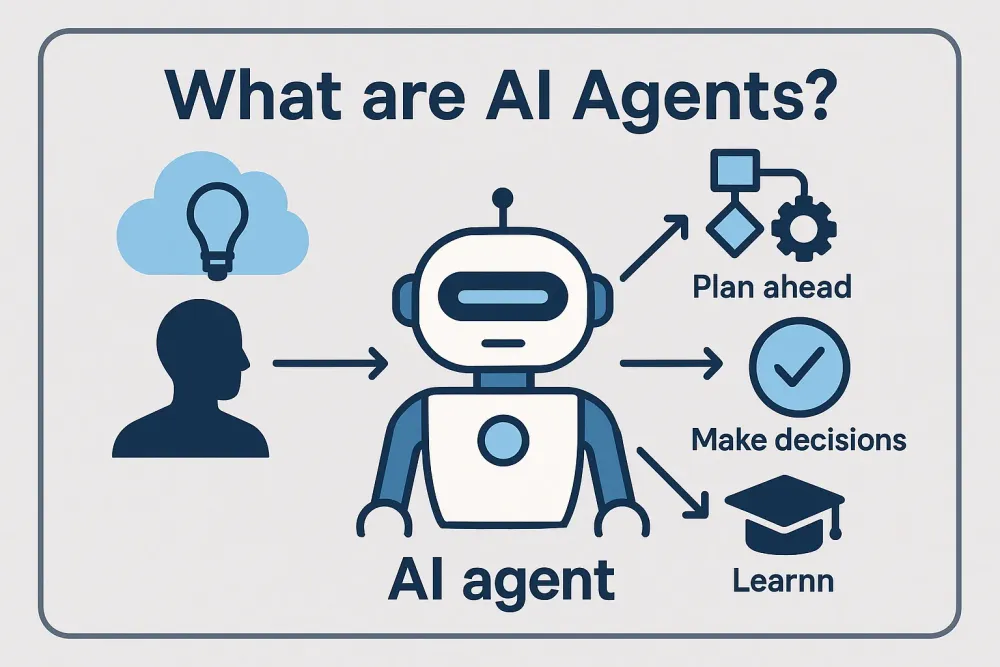
Agentic AI Series – Part 1: What Are AI Agents and Why Do They Matter?
This is the first article in our 6-part Agentic AI Beginner’s Guide. Start your journey by learning what AI agents are, how they go beyond chatbots, and why they’re transforming work and business. Real-world examples and simple explanations set the foundation for the hands-on learning ahead in the series.

This is Part 1 of our 6-part series on building intelligent AI agents. Perfect for beginners who want to understand what AI agents are and how they differ from regular chatbots.
What You'll Learn in This Article
- What AI agents are and why they matter
- How AI agents differ from chatbots like ChatGPT
- Real-world examples of AI agents in action
- Why businesses are excited about AI agents
What is an AI Agent? (Simple Explanation)
Imagine you have a really smart assistant who can:
- Think ahead and plan multiple steps to solve a problem
- Take action by using different tools and services
- Make decisions on their own without asking you every step
- Learn from what they do and get better over time
That's essentially what an AI Agent is - a smart computer program that can work independently to achieve goals you give it.
A Simple Example: Meeting Coordination
Let's say you tell a regular chatbot: "Schedule a team meeting for next week to discuss the project."
Regular Chatbot Response:
To schedule an effective team meeting, consider: - Finding a time that works for everyone - Booking an appropriate room - Sending calendar invites - Preparing an agendaWould you like help creating a meeting agenda template?"AI Agent Response:
1. ✅ Checked calendars for all 6 team members2. ✅ Found optimal time: Tuesday 2-3 PM (everyone available)3. ✅ Booked Conference Room B with projector4. ✅ Sent calendar invites with project discussion agenda5. ✅ Added Zoom link for remote participants6. ✅ Set reminder for you to prepare presentation7. ✅ Ordered catering for 6 people
Meeting confirmed: Tuesday Dec 10, 2-3 PM, Conference Room B"
See the difference? The AI agent actually did things instead of just talking about them.
AI Agents vs. Regular Chatbots: The Key Differences
Aspect | Regular Chatbots | AI Agents |
|---|---|---|
What they do | Answer questions and chat | Complete tasks and solve problems |
How they work | Respond to what you say | Plan ahead and take action |
Tools they use | Usually none | Can use many different tools and services |
Memory | Remember only the current conversation | Remember past interactions and learn |
Independence | Need you to guide every step | Work independently once given a goal |
Real-World Examples of AI Agents
1. Personal Assistant Agent
What you say: "I need to prepare for my business trip to London next week."
What the agent does:
- Checks weather forecast for London
- Books hotel recommendations
- Creates packing list based on weather
- Adds travel reminders to your calendar
- Sends you a complete travel itinerary
2. Customer Service Agent
What happens: A customer emails about a billing issue
What the agent does:
- Reads and understands the email
- Looks up customer account information
- Identifies the billing problem
- Processes a refund if needed
- Sends personalized response to customer
- Updates customer record
3. IT Support Agent
What happens: Server performance is slow
What the agent does:
- Monitors system performance automatically
- Identifies the root cause (high memory usage)
- Restarts problematic services
- Scales up resources if needed
- Sends report to IT team
- Prevents future issues
Why Are AI Agents Important?
For Individuals:
- Save Time: Agents handle routine tasks while you focus on important work
- Reduce Stress: No more juggling multiple apps and services
- Better Decisions: Agents can analyze more information than humans quickly
- 24/7 Availability: Your agent works even when you're sleeping
For Businesses:
- Increased Efficiency: Automate repetitive processes
- Cost Savings: Reduce need for manual work
- Better Customer Service: Instant, personalized responses
- Scalability: Handle more work without hiring more people
Types of AI Agents (Simple Categories)
1. Task Agents
- What they do: Complete specific tasks like booking appointments or sending emails
- Example: "Schedule a meeting with John for next Tuesday"
2. Information Agents
- What they do: Gather and analyze information from multiple sources
- Example: "Give me a market analysis for our new product launch"
3. Monitoring Agents
- What they do: Watch systems and alert you when something needs attention
- Example: Monitoring website uptime and fixing issues automatically
4. Learning Agents
- What they do: Get better at their job over time by learning from experience
- Example: A sales agent that learns which email templates work best
How Do AI Agents Actually Work? (Simplified)
Think of an AI agent like a very organized person with superpowers:
Step 1: Understanding the Goal
- You tell the agent what you want: "Help me reduce my AWS cloud costs"
- The agent understands this means it needs to analyze spending and find savings
Step 2: Making a Plan
- Agent thinks: "I need to check current costs, identify expensive services, and suggest optimizations"
- Creates a step-by-step plan to achieve the goal
Step 3: Taking Action
- Connects to your AWS account (with permission)
- Analyzes your spending patterns
- Identifies unused resources
- Calculates potential savings
Step 4: Reporting Back
- Creates a detailed report with recommendations
- Sends it to your email- Optionally implements approved changes
Step 5: Learning for Next Time
- Remembers what worked well
- Notes your preferences for future tasks
- Gets better at helping you over time
Common Misconceptions About AI Agents
❌ Myth: "AI agents will replace all human workers"
✅ Reality: AI agents handle routine tasks so humans can focus on creative and strategic work
❌ Myth: "AI agents are too complicated for small businesses"
✅ Reality: Many AI agents are designed to be simple and user-friendly
❌ Myth: "AI agents make too many mistakes"
✅ Reality: Well-designed agents are very reliable and can be more accurate than humans for routine tasks
❌ Myth: "AI agents are expensive to implement"
✅ Reality: Many AI agent solutions are cost-effective and pay for themselves quickly
Getting Started: What You Need to Know
For Non-Technical People:
- You don't need to be a programmer to use AI agents
- Many AI agents have simple, user-friendly interfaces
- Start with pre-built agents for common tasks
- Focus on identifying repetitive tasks in your work
For Technical People:
- Basic programming knowledge helps but isn't always required
- Cloud platforms like AWS offer managed AI agent services
- Open-source tools are available for custom solutions
- Understanding APIs and integrations is valuable
What's Coming Next in This Series
Now that you understand what AI agents are, here's what we'll cover in the remaining parts:
- Part 2: How AI Agents Think and Make Decisions (The Brain Behind the Magic)
- Part 3: Building Your First AI Agent (Step-by-Step Guide)
- Part 4: Connecting AI Agents to Real-World Tools and Services
- Part 5: Keeping AI Agents Safe and Secure
- Part 6: Advanced AI Agents and Future Possibilities
Key Takeaways
- AI agents are action-oriented - They don't just talk, they do things
- They work independently - Give them a goal and they figure out how to achieve it
- They use multiple tools - Can connect to various services and systems
- They learn and improve - Get better at helping you over time.
- They're practical today - Not science fiction, but real tools you can use now
Ready to Learn More?
In Part 2, we'll dive deeper into how AI agents actually think and make decisions. You'll learn about the "brain" that powers these intelligent systems and how they break down complex problems into manageable steps.
Questions to Think About:
- What repetitive tasks in your daily work could an AI agent handle?
- How much time could you save if routine tasks were automated?
- What would you do with the extra time an AI agent could give you?
Enjoyed reading this content? Let the author know!
Your likes, comments, shares, and saves help creators reach more builders.

Loading recommendations
Loading article