
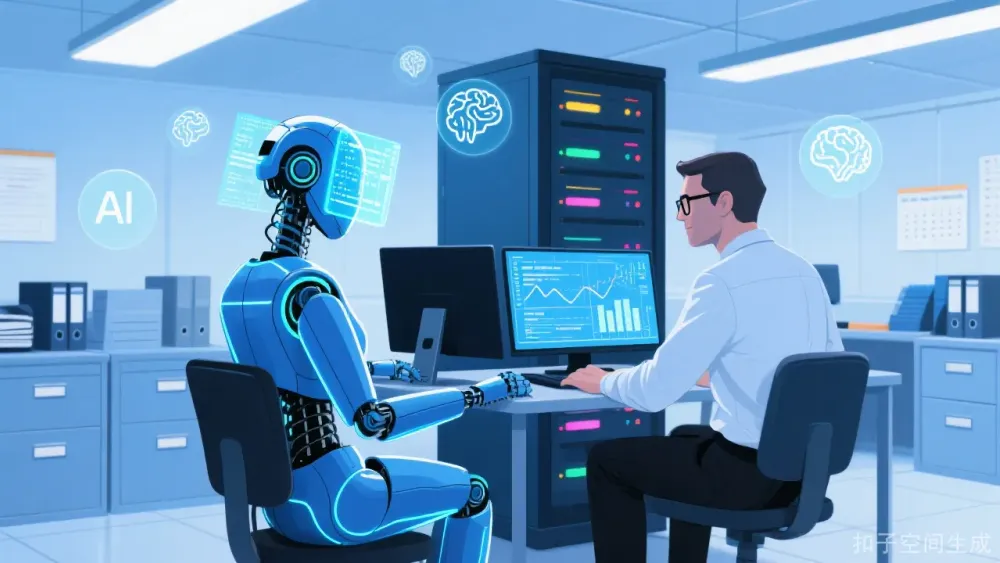
Context Engineering: The Dynamic Context Construction Technique for AI Agents
Context Engineering (CE) has emerged as the critical successor to Prompt Engineering (PE) for building advanced AI agents. While PE optimizes static, single-interaction instructions for LLMs, CE focuses on dynamically constructing and managing context within the model’s limited window during complex, autonomous tasks. It addresses core limitations of PE—evolving task states, information overload, real-time needs, and adaptability—by intelligently assembling the most relevant context at each step.

When you input instructions into ChatGPT, you've already come into contact with the most basic Prompt Engineering. However, as AI applications move towards complexity, long-term use, and autonomy, a new concept - Context Engineering - is quickly becoming the focus.
Concept Origin: A Collective Awakening of Silicon Valley Leaders
In June 2025, Shopify CEO Tobias Lütke first proposed on Twitter: "I really like using 'context engineering' instead of 'prompt engineering'. It more appropriately describes the core skill - the art of providing complete background information for tasks so that large models can reasonably solve problems."

This view quickly resonated with technical leaders in the AI industry. Andrej Karpathy, a former OpenAI researcher and head of Tesla AI, retweeted it with a "+1" in support and further explained: "In industrial-grade LLM applications, context engineering is the key - a technical job that combines science and intuition. It is necessary to accurately fill the context window with the information needed for the next step."
Technical Tipping Point: IBM's Groundbreaking Experiment
Experiments by IBM's Zurich Research Institute have provided academic legitimacy to the concept. After researchers injected structured cognitive tools into GPT-4.1, the accuracy rate on the AIME2024 mathematics competition dataset jumped from 26.7% to 43.3%, a performance improvement of 61.4%, almost catching up with OpenAI's o1-preview model (44.6%). This breakthrough result completely countered the doubt of "coining new terms".
What is its relationship with Prompt Engineering? Why is it so important? This article will clearly break down its core concepts, technical implementation, and value.
Distinction between Prompt Engineering, In-context Learning and Context Engineering
To understand Context Engineering, it is necessary to first clarify its differences and connections with two closely related concepts:
Prompt Engineering (PE)
Definition: The process of designing and optimizing the instructions/prompts input to AI models in a single time.
Goal: To enable the model to accurately understand the user's current intention and generate the expected output.
Core: It is static and one-time. It's like carefully designing a question or command.
Techniques: Clear instructions, providing examples, structured input, style control, etc.
Goal: To enable the model to accurately understand the user's current intention and generate the expected output.
Core: It is static and one-time. It's like carefully designing a question or command.
Techniques: Clear instructions, providing examples, structured input, style control, etc.
In-Context Learning (ICL)
Definition: A core capability of large language models (LLMs), which refers to the ability of models to complete tasks using information (context) provided in the current prompt without updating their internal weights (i.e., without fine-tuning).
Main Forms:
Main Forms:
- Zero-shot Learning: Do not provide task examples, and only rely on instructions and model pre-trained knowledge for reasoning. (e.g., "Translate ' 你好 ' into English" -> "Hello").
- Few-shot Learning: Provide a small number (usually 2-5) of task examples in the prompt to guide the model to imitate and perform new tasks. (e.g., let the model translate new sentences after giving several Chinese-English translation pairs).
Core: PE is the main means of utilizing ICL capabilities. The effect of ICL is highly dependent on the quality of the context provided by PE. ICL itself is also static and relies on the content of a single input.
Context Engineering (CE):
Inclusion and Transcendence: CE includes excellent PE practices (designing clear instructions, providing effective examples), but its scope is far more than that.
Solving Static Limitations: PE and ICL based on PE are inherently static. They cannot adapt to the constantly changing environment and state in long-running autonomous tasks. CE is precisely born to solve this core limitation.
Dynamic Construction: The core value of CE lies in "dynamically constructing" context.
Definition: The scientific and engineering practice of dynamically constructing, managing, and optimizing the complete context information required for AI models (especially running agents) to perform tasks.
Core: It goes beyond single and static prompt optimization. It focuses on how to dynamically determine which information needs to be put into the model's limited context window according to the current state and changes during the task/conversation.
The Core of the Rise of Context Engineering: Dynamic Context Construction
Why is Context Engineering needed? The core is to solve the shortcomings of traditional PE/ICL in complex, continuous, and autonomous tasks:
- Task State Changes: In long conversations or multi-step tasks, goals and environments will continue to evolve.
- Information Overload: Long-term operation will generate massive historical information, which cannot all be put into the limited context window.
- Real-time Requirements: Need to access the latest data or external tool results.
- Self-adaptability: Agents need to adjust their behaviors or strategies according to feedback.
The core task of Context Engineering is to dynamically build the most relevant and effective current context window according to the current state and changes of the conversation/task. This is mainly achieved through the following key technologies:
Retrieval-Augmented Generation (RAG)
Principle: When a user raises a query or task, the agent retrieves information fragments most relevant to the current problem from external knowledge bases (vector databases, document libraries, knowledge graphs, etc.) in real-time.
Role: Dynamically inject the retrieved information into the context to provide the model with the latest, accurate, and specific background knowledge, and solve the problems of outdated model knowledge and "hallucinations".
Example: When answering questions about the company's latest quarterly financial report, automatically retrieve and inject the newly released financial report summary or key data points.
Tool Calling / Function Calling
Principle: The agent identifies the part of the user's request that requires external capabilities (calculation, query, operation, etc.) and dynamically calls predefined APIs/functions (such as search engines, calculators, calendar APIs, database queries, etc.).
Role: Dynamically integrate the input requests and return results of tool calls into the context, which greatly expands the model's capability boundary and enables it to process real-time data and perform specific operations.
Example: When a user asks "Is my boss available for a meeting at 3 pm tomorrow?", the agent calls the calendar API to query the boss's schedule and injects the query result (available/unavailable/alternative time) into the context to reply to the user accordingly.
Agent Memory
Short-term Memory: Manages the state, intermediate results, user intentions, etc., in the current conversation/task chain. It is usually easy to lose.
Long-term Memory: Persistently stores key information across conversations, user preferences, task knowledge, etc. It requires efficient storage, indexing, and retrieval mechanisms (often combined with RAG).
Principle: Design short-term and long-term memory mechanisms to intelligently store, organize, and recall historical information related to tasks.
Role: Dynamically retrieve and inject the most relevant historical fragments from the memory bank according to current task requirements, maintaining the coherence and personalization of the agent.
Challenges and Frontiers: Handling ultra-long contexts (such as models supporting millions of tokens), memory summarization technology, and filtering memory based on importance/relevance are key research directions.
"The Art of Asking Questions" vs. "The Science of Environment Construction"

Next Level: Dynamic Prompts and Self-Evolution
The ultimate goal of Context Engineering is not only to build a data context but also to realize the dynamic optimization of the instruction context, promoting agents to evolve towards self-adaptation and self-improvement:
Dynamic Prompt/Instruction Adjustment
Intelligently adjust prompts or strategies for subsequent steps based on task progress, user feedback, or observed model behaviors. For example:
- When it is found that the model output is lengthy, automatically add the requirement of "please answer concisely" in subsequent prompts.
- When solving complex reasoning problems, dynamically switch different prompt strategies (such as switching from Chain of Thought (CoT) to Tree of Thought (ToT)) according to the success or failure of intermediate steps.
Realization of Self-Improvement
- Combine the above technologies with mechanisms such as Reinforcement Learning (RL):
- Frameworks such as PromptWizard: Let LLM conduct "self-criticism" based on its own output results, generate improvement suggestions, and iteratively optimize prompts. Realize automated prompt engineering.
- Technologies such as Promptbreeder: Adopt evolutionary algorithms to allow prompts to be continuously optimized in generational replacement ("self-reference"), which significantly surpass static prompt methods in tasks such as mathematical reasoning.
Memory-Driven Optimization
Analyze successful/failed cases in long-term memory and automatically summarize more effective prompt templates or action strategies.
Why is Context Engineering Crucial?
In short: Prompt Engineering teaches AI "how to answer a question", while Context Engineering builds a dynamic environment for AI agents that work continuously to "understand the current situation and act autonomously". It is an indispensable core engineering capability for building truly practical, powerful, and autonomous AI Agents. With the explosion of agent applications, mastering Context Engineering will become a key competitiveness for AI professionals.
Enjoyed reading this content? Let the author know!
Your likes, comments, shares, and saves help creators reach more builders.

Loading recommendations
Loading article