
Optimizing Karpenter on EKS: A Guide to Efficient NodePool Configuration Strategies
Optimize EKS costs with Karpenter NodePool strategies for Graviton and x86. Learn best practices for managing Spot and On-Demand instances across architectures

When running containerized workloads on Amazon Elastic Kubernetes Service (EKS), optimizing compute resources directly impacts both cost efficiency and performance. Recently, we worked with customers to implement AWS Karpenter configurations that balance architecture preferences with practical operational requirements. This post explores effective strategies for configuring NodePools when managing mixed architecture environments.
The Configuration Challenge
A common pattern we encounter is the need to implement a specific instance type hierarchy, typically prioritizing Spot Graviton instances, followed by Spot x86 instances, then On-Demand Graviton instances, and finally On-Demand x86 instances. This approach emerges from careful consideration of several key factors.
Performance analysis consistently shows superior price-performance ratios on ARM architecture for many workloads. Organizations that have invested in application optimization for both architectures can effectively leverage this advantage. Additionally, cost optimization through Spot Instance usage has become a standard practice, with potential savings of up to 90% compared to On-Demand pricing. When combined with Graviton instances' typically better baseline pricing, the cost reduction potential becomes substantial.
Risk management requires maintaining reliable fallback options. While Spot Instances offer significant savings, having a clear progression to On-Demand instances ensures workload stability when needed. This balance between cost optimization and reliability forms the foundation of a robust compute strategy.
Understanding Architecture and Purchasing Options
The choice between Graviton and x86 architectures represents a significant decision point in compute strategy. Graviton processors, AWS's ARM-based solution, offer improved price-performance ratios for optimized workloads and access to the latest generation instance types like c7g and c8g. The ecosystem of compatible applications continues to grow, making Graviton an increasingly viable option for many workloads.
Traditional x86-based instances maintain their relevance through broad application compatibility and multiple vendor options from Intel and AMD. Their extensive performance history across generations provides a well-understood baseline for workload behavior and capacity planning.
The decision between Spot and On-Demand instances introduces another layer of consideration. Spot Instances provide substantial cost savings but come with variable availability and potential interruptions with 2-minute notifications. Pricing fluctuates based on market demand, requiring workloads to be interruption-tolerant. On-Demand Instances, while more expensive, offer consistent availability, predictable pricing, and no interruption risk, making them suitable for critical workloads that require stability.
Karpenter's Instance Selection Process
Karpenter employs a sophisticated evaluation system that considers multiple factors simultaneously. The process begins with requirements matching, where Karpenter verifies architecture compatibility, aligns resource requirements, and validates node requirements. This initial phase ensures that only suitable instances are considered for deployment.
Cost optimization forms the second phase of evaluation. Karpenter analyzes current On-Demand pricing, examines 30-day Spot pricing trends, and calculates instance size efficiency. This comprehensive cost analysis helps identify the most economical options that meet workload requirements.
The final phase focuses on availability assessment. Karpenter verifies real-time capacity, analyzes historical interruption patterns, and examines zonal capacity distribution. This thorough evaluation ensures that selected instances not only meet technical and cost requirements but also provide reliable capacity for workload deployment.
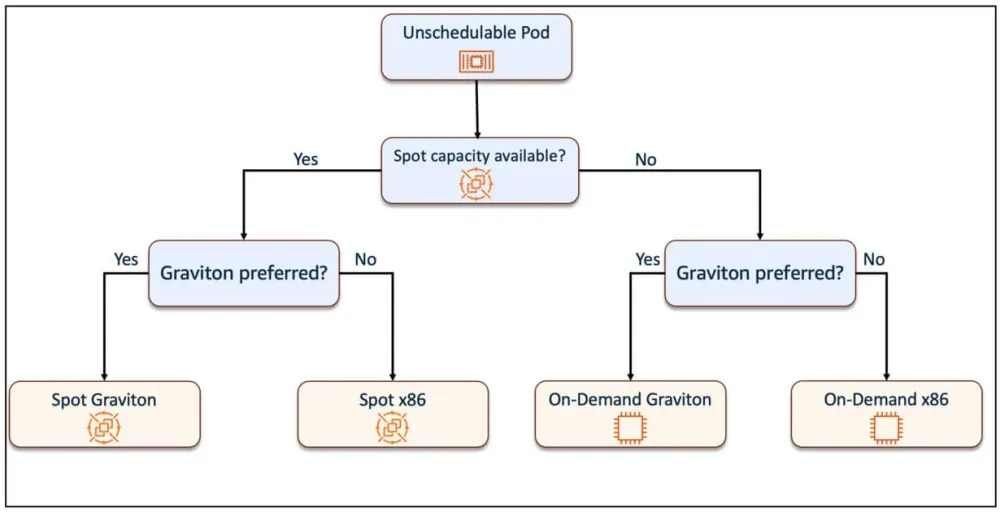
NodePool Configuration Strategies
When implementing Karpenter, organizations typically choose between two main approaches: the single NodePool approach and the multiple NodePool approach. Each strategy offers distinct advantages and considerations that must be weighed against operational requirements.
The single NodePool approach allows Karpenter to optimize instance selection based on real-time availability and cost. This method reduces operational overhead and speeds up instance provisioning by allowing Karpenter to adapt quickly to Spot market changes. However, it provides limited control over specific instance selection and may not maintain strict architecture preferences.
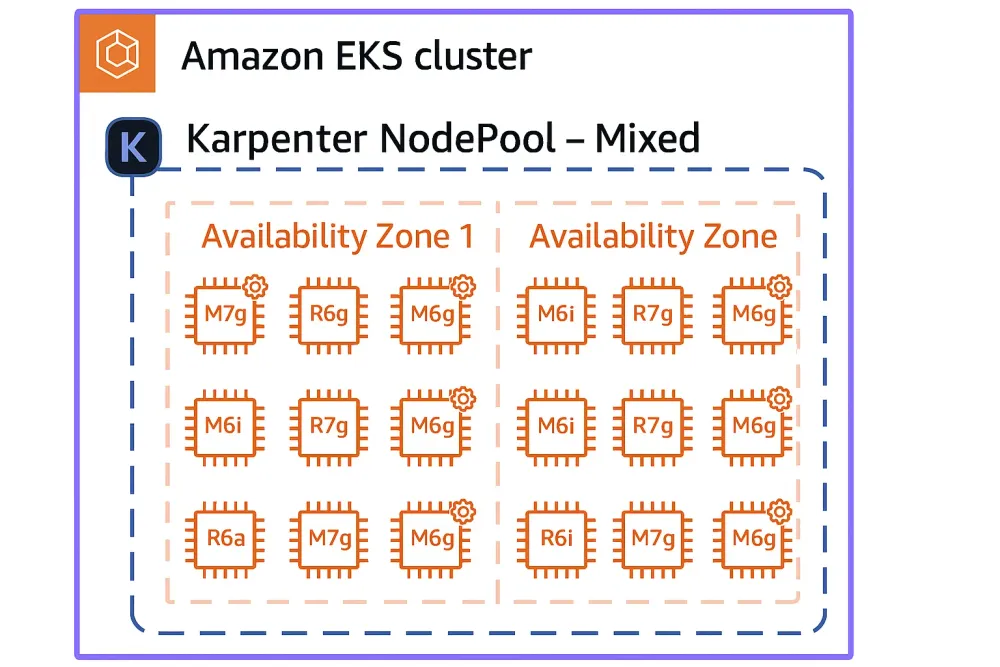
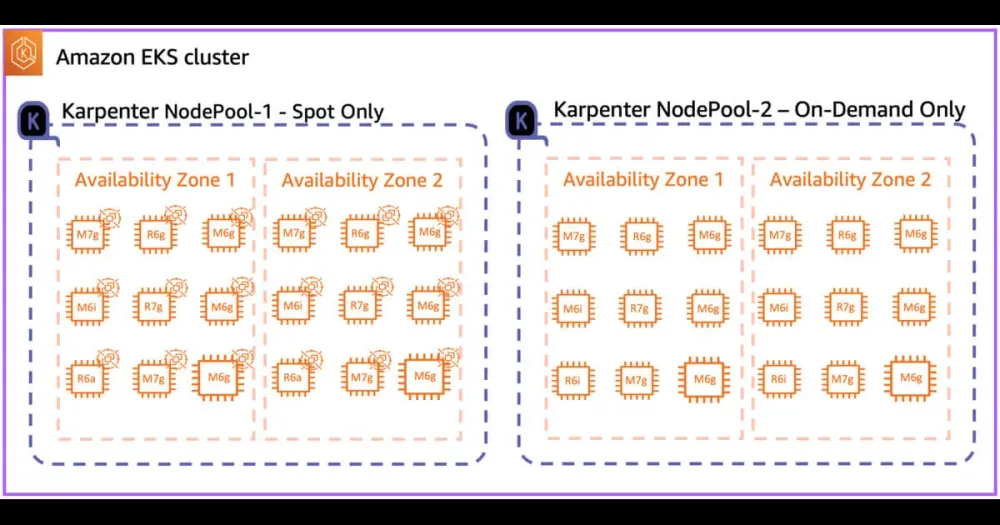
In contrast, the multiple NodePool approach provides explicit control over instance type selection and ordering. While this offers clearer capacity boundaries and controlled architecture selection, it comes with increased management overhead and potentially slower provisioning times. Each pool attempt adds latency, typically 10-30 seconds, which can impact rapid scaling scenarios.
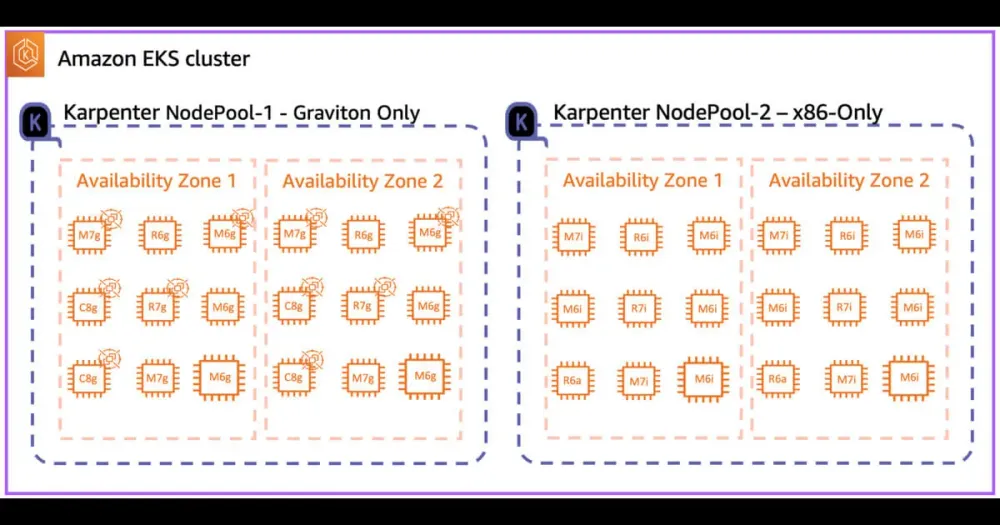
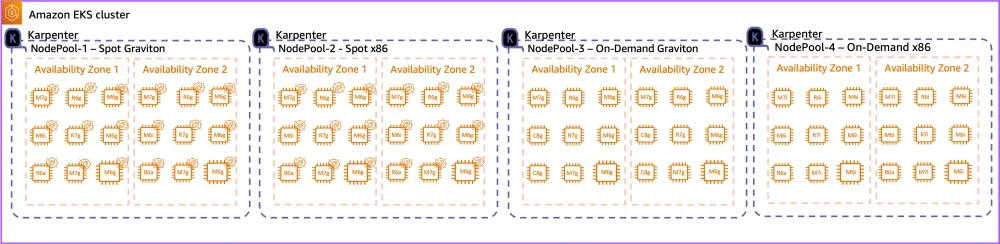
Real-World Scenarios
Let's explore five common scenarios we've encountered in production environments and examine how different NodePool configurations perform in each case
Scenario 1: High Spot Availability
This scenario has two key aspects:
Market Conditions
- Abundant Spot capacity across instance types
- Stable Spot pricing near market baseline
- Multiple instance families available
Workload Flexibility
- Applications can run on any supported architecture
- No strict instance type requirements
- Tolerant of instance type switching
| Architecture | Rating | Comments |
|---|---|---|
| Single Pool | ★★★★★ | Optimal - selects cheapest option |
| Two Pools (Spot/OD) | ★★★★ | Adds complexity |
| Two Pools (Graviton/x86) | ★★★ | Splits capacity unnecessarily |
| Four Pools | ★★ | Overcomplicates setup |
Scenario 2: Limited Graviton Spot
A more challenging scenario emerges when Graviton Spot capacity becomes scarce while x86 Spot capacity remains abundant. Organizations with strict Graviton preferences often struggle with this situation. Multiple NodePools configured to enforce Graviton preference can result in significant provisioning delays during capacity shortages.
A single NodePool with weighted preferences often provides better results, maintaining a Graviton-first approach while allowing rapid fallback to x86 instances when necessary. This improves application availability without significantly impacting cost optimization goals.
| Architecture | Rating | Comments |
|---|---|---|
| Single Pool | ★★★★★ | Quick fallback to x86 Spot |
| Two Pools (Spot/OD) | ★★★ | May delay Intel Spot selection |
| Two Pools (Graviton/x86) | ★★★★ | Clear fallback path but more complex |
| Four Pools | ★★★ | Clear priority but slower response |
Scenario 3: High Spot Interruption Risk
This scenario presents complex challenges when available Spot capacity shows high interruption rates. The challenge here isn't just capacity availability – it's capacity stability. Organizations typically need to balance between maintaining cost savings and ensuring workload stability.
A hybrid approach often works best:
- Critical workloads should have rapid access to On-Demand instances
- Background processing workloads can maintain Spot usage with appropriate resilience mechanisms
- Real-time monitoring of interruption metrics should guide NodePool behavior
| Architecture | Rating | Comments |
|---|---|---|
| Single Pool | ★★★★★ | Dynamically adjusts based on risk |
| Two Pools (Spot/OD) | ★★★ | Less flexible with varying risk levels |
| Two Pools (Graviton/x86) | ★★ | May stick to risky instances |
| Four Pools | ★★ | Too rigid for dynamic spot market |
Scenario 4: No Spot Availability
When no Spot capacity is available in either architecture:
- All Spot capacity exhausted in desired instance types
- Both Graviton and x86 On-Demand available
- Focus on maintaining workload availability
| Architecture | Rating | Comments |
|---|---|---|
| Single Pool | ★★★★★ | Smooth fallback to OD |
| Two Pools (Spot/OD) | ★★★★ | Clear fallback path |
| Two Pools (Graviton/x86) | ★★ | Complicates OD fallback |
| Four Pools | ★★★ | Clear priority but slower transition |
Scenario 5: Mixed Instance Types
The final scenario involves environments with access to multiple instance generations (c6g, c7g, c6i, c7i, c6a, c7a). This presents unique challenges in optimizing for both cost and performance across different instance families, especially when workloads show varying performance characteristics.
A single NodePool configuration with careful instance type selection and capacity distribution often provides the best balance between operational simplicity and performance optimization.
| Architecture | Rating | Comments |
|---|---|---|
| Single Pool | ★★★★★ | Best flexibility across generations |
| Two Pools (Spot/OD) | ★★★ | Limits cross-generation optimization |
| Two Pools (Graviton/x86) | ★★ | Artificially segments available types |
| Four Pools | ★ | Too rigid for mixed fleet optimization |
Making Your Choice
Consider these factors when selecting your approach:
Workload Requirements
Workload Requirements
- Do your applications need specific architectures?
- How important is rapid scaling?
Operational Priorities
- Is simplified management crucial?
- Do you need guaranteed instance type ordering?
Cost vs. Control
- Can you trade some control for better cost optimization?
- How important is predictable instance selection?
Conclusion
Optimizing compute resources with Karpenter requires careful consideration of architecture choices, purchasing options, and operational requirements. While the temptation to implement strict control through multiple NodePools exists, our experience shows that a more flexible, single NodePool approach often provides better results in terms of cost optimization and operational efficiency.
Remember that compute optimization is an iterative process. Regular review of performance metrics, cost data, and operational patterns will help refine your configuration over time, ensuring optimal results for your specific use case.
Additional Resources
Note: This guide reflects current Karpenter capabilities. Features and recommendations may evolve with new releases.
Enjoyed reading this content? Let the author know!
Your likes, comments, shares, and saves help creators reach more builders.

Loading recommendations
Loading article