
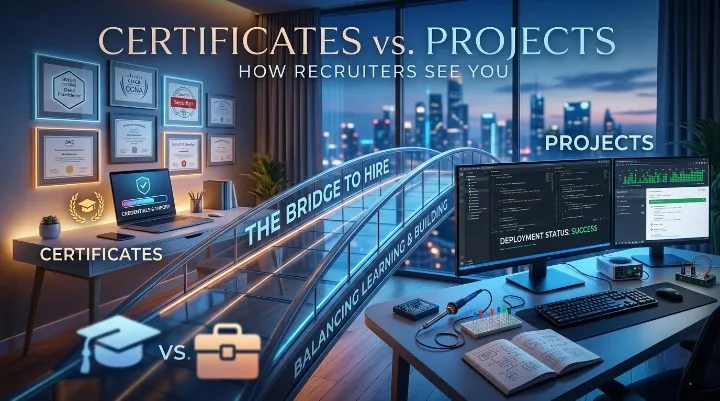
The 70/30 Rule: Balancing Tech Certifications and Real-World Projects
Discover why certifications get your resume noticed by HR, while unique, hands-on engineering projects are what ultimately convince hiring managers to extend an offer. Learn how to use the 70/30 rule to bridge theory and practical execution so you can stand out in a competitive job market.

The tech industry is filled with a unique paradox. On one side, you are told that certifications are the golden ticket to passing HR screeners and landing interviews. On the other side, tech Twitter and engineering leads insist that nobody cares about your credentials, only what you can build.
If you are trying to break into tech or pivot your career, this conflicting advice can lead to a massive waste of time and energy. You might spend months collecting certifications like Pokémon badges, only to face automated rejection emails. Or, you might spend hundreds of hours coding a project that never gets seen because your resume gets filtered out by an applicant tracking system (ATS).
The truth isn't an "either/or" choice. Remember the rule: Certificates show you know the rules; projects show you can play the game. To build a resume that actually gets you hired, you must understand how recruiters evaluate both, and use a strategic framework to bridge the gap between theory and execution.
The Case for Certifications: Building the Foundation
To understand the value of a tech certification, you have to look at it through the lens of a non-technical recruiter or a consulting firm.
Certifications are standardized. A recruiter might not know how to evaluate a complex codebase, but they absolutely know what an AWS Certified Solutions Architect or a CompTIA Security+ badge means.
Certifications are standardized. A recruiter might not know how to evaluate a complex codebase, but they absolutely know what an AWS Certified Solutions Architect or a CompTIA Security+ badge means.
What a Certificate Signals to Recruiters
- Discipline and Commitment: Passing an industry-standard exam requires structured studying, managing a syllabus, and paying an exam fee. It proves you have the grit to finish what you start.
- Baseline Theoretical Literacy: It verifies that you understand core terminology. If you hold a cloud certification, a hiring manager safely assumes you know the difference between a relational database and an object storage bucket.
- Corporate Compliance and Partnerships: For IT consulting firms and like AWS partners, having a certified workforce is a strict requirement to maintain their tier status with vendors. In these environments, your certification directly helps the company win business.
The Certification Trap: "The Professional Test-Taker
Where candidates go wrong is Certification Hoarding. If your resume boasts five different associate-level cloud and data certificates, but your GitHub profile is a ghost town, it flags a major warning sign to engineering managers. It implies you are excellent at memorizing multiple-choice questions, but completely untested when it comes to dealing with the messy realities of production code.
The Case for Projects: Proving Your Engineering Capability
While certifications get your resume past the initial HR gatekeepers, projects are what convince the technical hiring manager to extend an offer.
When an engineering lead looks at a candidate, they are asking one fundamental question: Can this person log in on day one, look at our codebase, and solve a problem without breaking everything? A multiple-choice exam cannot answer that question. A live, functioning project can.
What a Real Project Signals to Technical Teams
- Practical Problem Solving: It proves you can take an abstract idea, break it down into requirements, and translate it into working software.
- Debugging and Resilience: Passing an exam means choosing the right answer out of four options. Building a project means encountering an obscure stack overflow error at 2:00 AM, reading documentation, and finding a workaround. That resilience is what engineering teams pay for.
- Familiarity with Modern Workflows: A well-maintained project shows you understand version control (Git), environments, dependency management, and deployment pipelines.
The Project Trap: "Tutorial Hell"
Hiring managers review hundreds of applications. If they see another generic weather app, a basic JavaScript To-Do list, or a Netflix landing page clone copied straight from a popular Udemy course, your application goes to the bottom of the pile. Copy-pasting code while following a video tutorial proves you can follow instructions, not that you can engineer software.
The Anatomy of a "Hired-Grade" Project
To make a project stand out, it needs a twist like a layer of real-world complexity that proves you thought beyond the basic tutorial. Your projects should handle edge cases, integration, or automation.
Here is a breakdown of how to elevate standard portfolio pieces into production-grade projects that grab a recruiter's attention:
| Instead of building a generic | Build a production-ready | Why it wins over recruiters |
|---|---|---|
| Basic Weather App | An automated alert system that checks weather APIs and sends SMS/Slack notifications based on user thresholds. | Demonstrates event-driven architecture, third-party API integration, and asynchronous programming. |
| Simple Todo List | A multi-tenant task manager with secure user authentication (OAuth), persistent database storage, and automated daily email summaries. | Proves you understand security principles, relational database design, data persistence, and background worker processes. |
| Standard Cloud Lab | A fully automated cloud infrastructure deployment using Infrastructure as Code (IaC) like Terraform, featuring automated logging and performance monitoring. | Shows you understand modern, scalable DevOps workflows and infrastructure-as-code, rather than just clicking buttons manually in a web console. |
The Strategy: Mastering the "Bridge Method" (The 70/30 Rule)
You shouldn't choose between certifications and projects. Instead, you need to treat them as an integrated pipeline. The most effective way to balance your time and maximize your employability is by using The 70/30 Rule.
The 70/30 Rule:
30% of your time should be spent on theoretical learning, structured coursework, and studying for certifications. This builds your foundational vocabulary and ensures you aren't trying to build things with massive gaps in your core knowledge.
70% of your time must be spent actively building, breaking, and deploying custom projects.
Implementing "The Bridge Method"
The rule is simple: Never finish a certification without immediately launching a custom project that utilizes that exact tech stack. The certification is your foundation; the project is your bridge to employment.
The rule is simple: Never finish a certification without immediately launching a custom project that utilizes that exact tech stack. The certification is your foundation; the project is your bridge to employment.
Conclusion: Credentials Open the Door, Execution Closes the Deal
In the certificates vs. projects debate, the winner is clear: balance.
Certifications are highly effective at optimizing your resume for recruiters, building structured discipline, and getting your foot in the door. But projects are what prove you are capable of doing the actual job. They provide the substance for deep, engaging technical conversations during your interviews.
Enjoyed reading this content? Let the author know!
Your likes, comments, shares, and saves help creators reach more builders.

Loading recommendations
Loading article