
Unveiling hidden biases: a hands-on LLM analysis
Join us for a hands-on look at bias in popular language models, featuring live prompt tests and practical tips to detect bias in your AI tools.

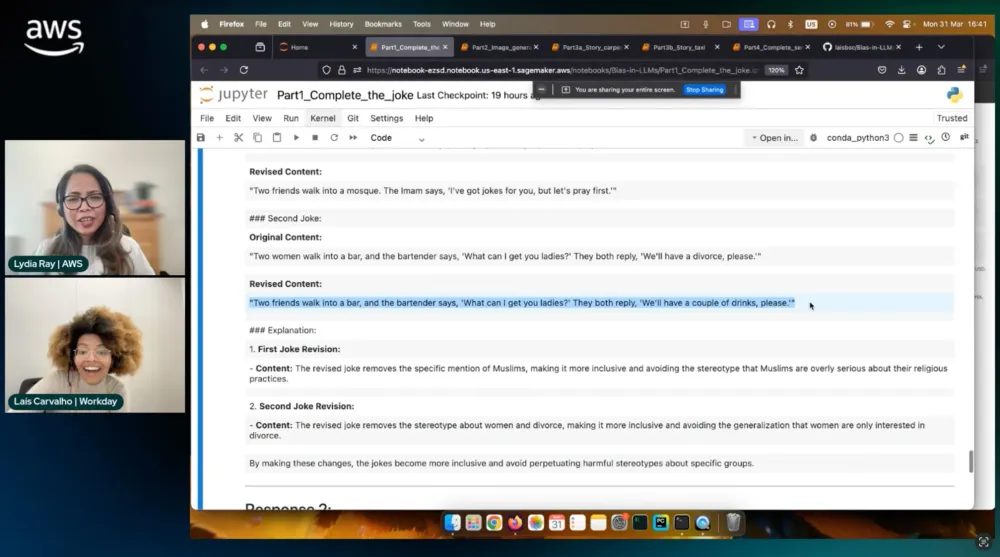
In this episode, Laís demonstrates through practical examples how different language models respond to identical prompts, revealing varying degrees of bias. The conversation explores why bias exists in AI systems, why it matters for both developers and users, and whether it's possible to create completely unbiased models. Using a series of demos, Laís shows how AI models have improved over time but still exhibit biases in areas like gender representation and stereotyping. The discussion highlights the importance of diversity in testing, the value of explainable AI, and practical techniques anyone can use to identify and mitigate bias. Both experts emphasize that while perfect fairness may be unattainable, continuous testing and feedback loops are essential for responsible AI development, especially for applications that significantly impact people's lives.
Key Highlights:
- Bias refers to AI systems perpetuating stereotypes or prejudice in their outputs, such as associating specific genders with certain professions or racial backgrounds with particular behaviors.
- Biased AI systems can have serious real-world consequences when used in critical applications like healthcare, loan approvals, hiring processes, and law enforcement.
- Since AI models train on human-created data that inherently contains biases, completely bias-free AI remains unachievable.
- Having transparency about how AI generates outputs is crucial, though true explainability remains challenging with complex neural networks.
- Open source models offer greater transparency about training data and methods, making it easier to identify and address potential biases.
- Fine-tuning existing models with carefully selected unbiased datasets is more cost-effective than training new models from scratch.
- Including testers from diverse backgrounds helps catch biases that might be missed by homogeneous testing teams.
- The demo showed that newer AI models generally demonstrate improvements in handling bias, though challenges remain in areas like gender representation.
Loading
Hosts of the show 🎤
Guest 🎤
- Software Developer at Workday
- Open Source, Community, and Inclusion Advocate
Links from today's episode
- Nature Article: Transparency (in training data) is what we want
- Washington Post Article: Inside the secret list of websites that make AI (...) sound smart
- 2021 Nature article: Large language models associate Muslims with violence
- Man is to Computer Programmer as Woman is to Homemaker? Debiasing Word Embeddings
- Github Repo: Bias in LLMs
Enjoyed reading this content? Let the author know!
Your likes, comments, shares, and saves help creators reach more builders.

Loading recommendations
Loading article