

From Logic to Learning: The Future of AI Lies in Neuro-Symbolic Agents
This article explores how software agents serve as the architectural foundation for neuro-symbolic AI — integrating reasoning, memory, and action across symbolic and neural layers. It provides practical guidance for designing and deploying these agents using AWS native services and modern orchestration patterns.

Defining Neuro-Symbolic AI
Paraphrased from the paper arXiv:2305.00813v1 [cs.AI] “Neurosymbolic AI - Why, What, and How”:
Neuro-symbolic AI is an approach that integrates the structured, compositional reasoning of symbolic systems (such as logic, rules, and knowledge graphs) with the pattern recognition and generalization strengths of neural networks. It aims to achieve more robust, interpretable, and flexible intelligence by enabling systems to both learn from unstructured data and reason over structured knowledge—bridging perception and cognition within unified architectures.
The Divide Between Reasoning and Creativity
Artificial Intelligence has long pursued two divergent paths: expert systems and generative models. Expert systems emerged from symbolic AI, capturing human expertise in a rigid, logical structure of IF-THEN rules and state machines. These systems excelled at tasks requiring transparency, reliability, and domain specificity. In contrast, generative AI, powered by neural networks and large language models (LLMs), thrives in ambiguity. It generates, adapts, and converses fluently, but often lacks grounding and explainability.
As organizations move beyond proofs of concept and into operationalizing AI, these limitations and strengths have become more visible. The rigidity of expert systems hinders adaptability, while the creative output of LLMs lacks the structured reasoning enterprises demand. The question is not "Which approach wins?" but rather, "How do we combine the best of both?"
Expert Systems vs. Generative AI: A Brief Comparison
- Expert Systems: Symbolic, deterministic, rule-based; interpretable but rigid, can be fragile under change.
- Generative AI: Neural, probabilistic, data-driven; adaptive but opaque.
Expert systems offer trust and traceability but require manual maintenance and cannot generalize. Generative AI can synthesize information and scale rapidly but often struggles with factual grounding and reproducibility. The future lies in their convergence.
The Shift Toward Agentic AI
The evolution from generative AI applications to Agentic AI represents a structural transformation. Instead of calling an LLM like a calculator (or a chatbot), developers are increasingly creating autonomous agents that reason, plan, and act. These agents can invoke tools, maintain memory, and collaborate with other agents across workflows.
In this paradigm, each agent can be considered a domain-specific expert system enhanced by generative capabilities. For example, a compliance agent may follow strict policy rules but use an LLM to interpret ambiguous language. A research agent may pull facts from a knowledge graph but use generative techniques to synthesize summaries.
When these agents collaborate, they mirror a team of specialized experts solving a problem together—a Multi-Agent System (MAS). Collaboration between agents introduces challenges like task delegation, semantic alignment, and shared memory, but also opens the door to scalable, modular intelligence.
Why Software Agents Are the Bridge
The true breakthrough in neuro-symbolic AI comes not just from combining models—but from embodying that combination in software agents. Agents are more than function wrappers or API orchestrators; they are autonomous, goal-driven entities that perceive, reason, and act.
Within each agent, symbolic components (rules, knowledge graphs, task plans) provide structure, traceability, and logic. Neural components (LLMs, embeddings, retrieval) bring flexibility, language understanding, and generalization. The agent boundary acts as a unifying interface.
This means Agentic AI is not just a pattern—it is the practical path to neuro-symbolic AI. When we compose multi-agent systems, we compose scalable, modular intelligence—each agent solving a piece of the symbolic-creative integration problem.
In this light, the software agent becomes not just a consumer of AI—but the architectural vessel through which next-generation AI will be built and governed.
Why Neuro-Symbolic AI is the Future
To build truly effective Agentic AI, we must transcend the limitations of purely symbolic or purely neural systems. Symbolic reasoning provides transparency, repeatability, and deterministic logic — essential for domains that require trust, compliance, and interpretability. But symbolic systems alone can be rigid, unable to adapt or generalize beyond their predefined rules.
Conversely, neural models like LLMs offer fluency, adaptability, and generalization from vast amounts of unstructured data. They can infer context, handle ambiguity, and generate language with human-like flexibility. Yet they lack grounding, struggle with long-term memory, and often produce unverifiable or hallucinated output.
Neuro-symbolic AI fuses these paradigms, creating systems that can both reason and learn — systems that can:
- Understand language using neural networks.
- Ground understanding in structured knowledge bases.
- Execute logic using explicit rules and policy frameworks.
- Explain decisions through symbolic traces while adapting to new inputs through learned representations.
In the agentic context, this enables software agents that can:
- Interpret user goals flexibly (neural).
- Plan and make decisions deterministically (symbolic).
- Reflect on outcomes and evolve (neuro-symbolic feedback loops).
This convergence empowers enterprises to design AI that is not only capable and creative, but auditable, trustworthy, and aligned with business logic. It's the foundation for building intelligent systems that can operate autonomously while remaining accountable.
Agents become the ideal abstraction to encapsulate this blend — each with a bounded scope, a clear reasoning interface, and the ability to evolve over time.
Designing Agentic AI Systems
To effectively design neuro-symbolic agent systems, solution architects must start by understanding the internal composition of a software agent and how it maps to scalable, cloud-native infrastructure. This section outlines the functional building blocks of neuro-symbolic agents, explores how memory supports their capabilities, and presents a reference architecture for implementing them on AWS.
1. Agent Composition: Perceive → Reason → Plan → Act
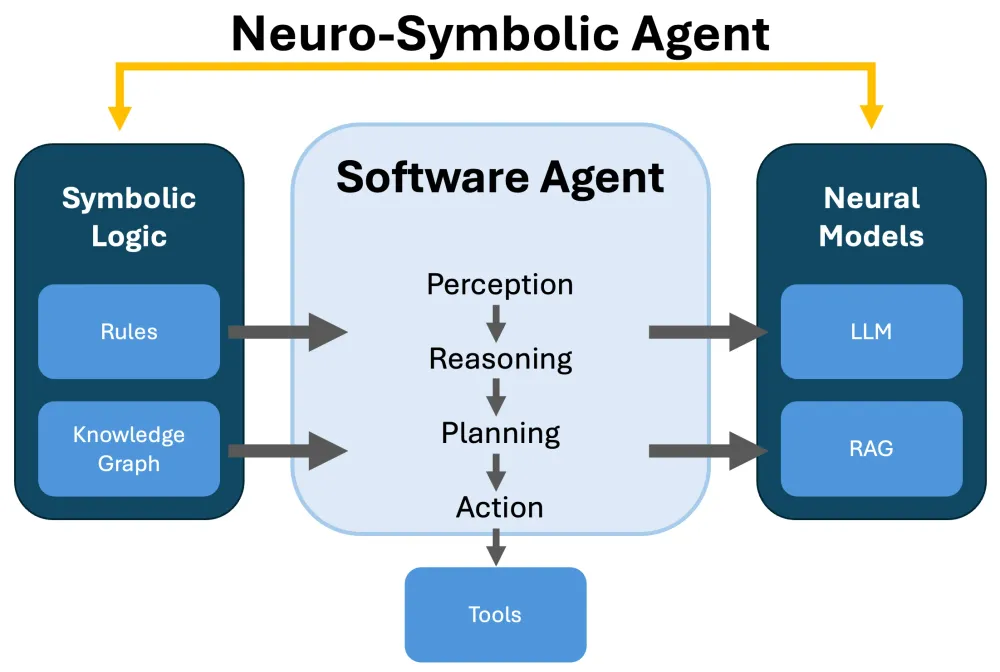
This diagram introduces the internal composition of a neuro-symbolic software agent—built around four functional pillars: Perception, Reasoning, Planning, and Action. These functions are supported by symbolic logic (rules, knowledge graphs) and neural models (LLMs, RAG pipelines). This architectural composition enables the agent to observe the world, interpret and reason about it, make decisions, and take actions using external tools or APIs.
By establishing this structure, we create a repeatable unit of intelligence—one that is modular, explainable, and extensible. It forms the core building block for a larger distributed system of agents operating at enterprise scale.
2. Memory in Agent Design

Effective agents need memory, but different types of memory serve different roles:
Short-Term Memory (STM) is ephemeral and task-focused:
- Holds context like user inputs, task state, or recent decisions
- Enables coherent multi-turn reasoning and planning
- Backed by in-memory stores or caches (e.g., Redis)
Long-Term Memory (LTM) is persistent and generalizable:
- Stores reusable knowledge like facts, rules, or indexed documents
- Enables grounding, personalization, and historical recall
- Backed by vector databases (e.g., FAISS), knowledge graphs (e.g., Amazon Neptune), or enterprise search systems (e.g., Amazon Kendra)
In a neuro-symbolic agent, STM feeds into Reasoning and Planning, while LTM provides the factual foundation for Perception and Action. Together, they make the agent intelligent, adaptive, and self-consistent.
See figure 3 below for visual mapping of STM/LTM to agent capabilities.
By establishing this structure, we create a repeatable unit of intelligence—one that is modular, explainable, and extensible. It forms the core building block for a larger distributed system of agents operating at enterprise scale. The symbolic side (e.g., rules, knowledge graphs) informs deterministic decision-making. The neural side (e.g., LLMs, RAG pipelines) powers perception, language interpretation, and adaptation. The agent encapsulates these layers and exposes a unified interface for planning, reasoning, and coordination across a distributed, multi-agent system.
With this memory architecture in place, we can now map the agent’s functional components to scalable cloud infrastructure.
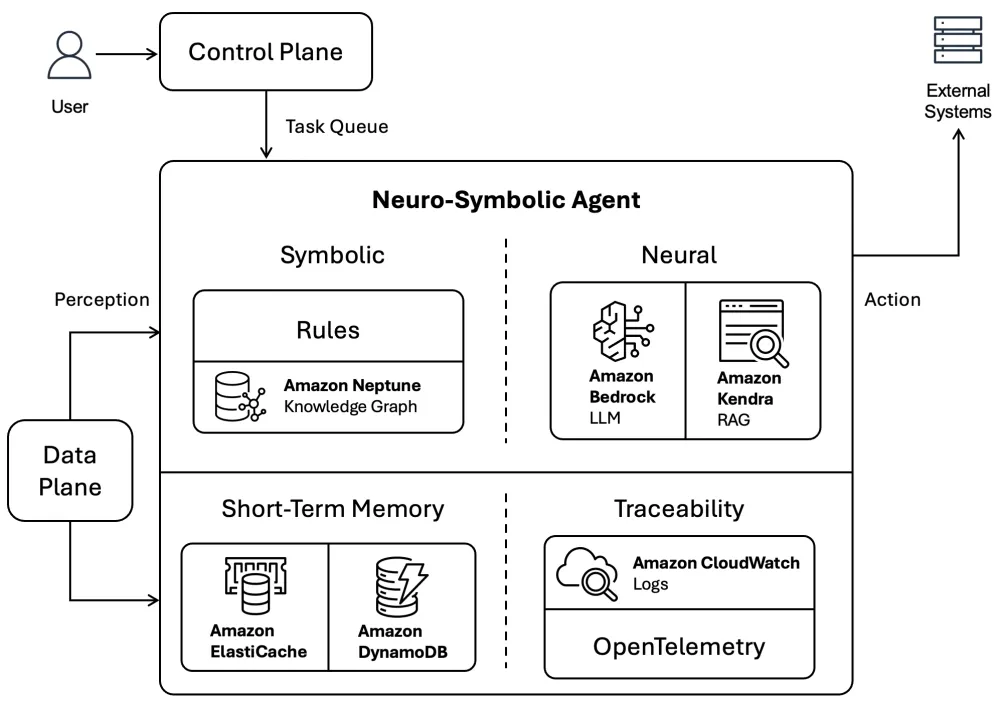
This architecture illustrates how a neuro-symbolic agent can operate in an enterprise setting. It combines symbolic reasoning (rules engines, structured data) with neural perception (LLMs, embeddings) to power capabilities such as contextual understanding, compliance enforcement, and task execution. The agent interacts with users, systems, and services using orchestrated components across a control plane and data plane.
Architects need to focus on how neuro-symbolic agents fit into larger enterprise systems, with attention to governance, scalability, and system boundaries.
Reference Architecture Highlights:
- Control Plane: Coordinates task delegation and agent lifecycle
- Data Plane: Facilitates memory sharing, knowledge graph updates, audit logs
- Agent Composition: Each agent encapsulates a bounded context with clear interfaces
Enterprise Considerations:
- Auditable LLM decisions via symbolic overlays, and holistic logging
- Agent-to-agent communication policies
- Reuse of agent templates across domains
- Integration with enterprise data governance policies
- Permissions structures and secure bounded contexts
Toolchain Integration:
- Amazon Bedrock (LLM as a service)
- AWS Step Functions (orchestration). Amazon ECS (runtime execution in memory - containerized MAS) or AWS Lambda (event driven execution)
- Amazon EventBridge (agent messaging bus)
- Amazon CloudWatch (monitoring), AWS CloudTrail / OpenTelemetry (observability)
Implementing Neuro-Symbolic Agents
Software developers looking to build neuro-symbolic agents can start by combining deterministic logic with LLM-powered reasoning in modular components.
Example Agent Pattern (pseudo code):
plaintext
class ComplianceAgent:def __init__(self):self.rules_engine = load_policy_rules()self.llm = BedrockLLM()def validate_input(self, input_text):interpreted = self.llm.summarize(input_text)return self.rules_engine.evaluate(interpreted)
Recommended Stack:
- Logic Layer: Open Policy Agent (OPA), JSON Logic , ( Prolog for complex symbolic logic)
- LLM Layer: Amazon Bedrock , Strands Agents , LangChain
- Orchestration: AWS Lambda , AWS Step Functions , Temporal
- Memory & Retrieval: Amazon ElastiCache , Amazon Kendra , FAISS
Agentic Patterns to Explore:
- Tool-augmented Agents
- Reflect-Refine Feedback Agents
- Multi-Agent Task Routing (e.g, Supervisor, Swarm, Graph, or Arbiter patterns)
- Blackboard Model Collaboration (Task planning)
Strands SDK Example 1: Compliance Agent with Structured Output
This example demonstrates a compliance agent that combines deterministic policy rules with LLM-powered reasoning to interpret ambiguous language.
plaintext
from strands import Agentfrom strands_tools import calculatorfrom strands.models import BedrockModelfrom pydantic import BaseModel, Fieldfrom typing import Optionalclass ComplianceCheck(BaseModel):policy_violated: bool = Field(description="Indicates if a policy was violated")violation_reason: Optional[str] = Field(description="Reason for the policy violation")agent = Agent(system_prompt=("You are a compliance officer. Analyze the provided text to determine if it violates any company policies. Use the calculatorfor any necessary calculations."),tools=[calculator],model=BedrockModel(model_id="us.anthropic.claude-3-7-sonnet-20250219-v1:0"))input_text = "The employee accessed confidential data without authorization."result = agent.structured_output(ComplianceCheck, input_text)print(f"Policy Violated: {result.policy_violated}")print(f"Reason: {result.violation_reason}")
This code defines a ComplianceCheck model using Pydantic for structured output, initializes an agent with a specific system prompt and tools, and processes an input text to determine policy compliance.
Strands SDK Example 2: Multi-Agent Workflow for Document Analysis
This example demonstrates a multi-agent workflow where each agent specializes in a specific task: extracting data, analyzing trends, and generating reports.
plaintext
from strands import Agentfrom strands_tools import workfloworchestrator = Agent(system_prompt="You are an orchestrator managing a document analysis workflow.",tools=[workflow])workflow_tasks = [{"task_id": "data_extraction","description": "Extract key financial data from the quarterly report.","system_prompt": "You extract and structure financial data from reports.","priority": 5},{"task_id": "trend_analysis","description": "Analyze trends in the data compared to previous quarters.","dependencies": ["data_extraction"],"system_prompt": "You identify trends in financial time series.","priority": 3},{"task_id": "report_generation","description": "Generate a comprehensive analysis report.","dependencies": ["trend_analysis"],"system_prompt": "You create clear financial analysis reports.","priority": 2}]orchestrator.tool.workflow(action="create", workflow_id="doc_analysis", tasks=workflow_tasks)orchestrator.tool.workflow(action="start", workflow_id="doc_analysis")status = orchestrator.tool.workflow(action="status", workflow_id="doc_analysis")print(status)
This code sets up a workflow with three tasks, each handled by a specialized agent. The orchestrator manages the execution flow, ensuring that each task is performed in the correct order.
Strands SDK Example 3: Agents as Tools Pattern
This example illustrates the "Agents as Tools" pattern, where specialized agents are wrapped as callable tools and invoked by an orchestrator agent.
plaintext
from strands import Agent, tool@tooldef research_agent(query: str) → str:agent = Agent(system_prompt="You are a research assistant.")return agent(f"Research the following topic: {query}")@tooldef analysis_agent(data: str) → str:agent = Agent(system_prompt="You are a data analyst.")return agent(f"Analyze the following data: {data}")@tooldef report_agent(insights: str) → str:agent = Agent(system_prompt="You are a report writer.")return agent(f"Generate a report based on these insights: {insights}")orchestrator = Agent(system_prompt="You are an orchestrator coordinating research, analysis, and reporting.",tools=[research_agent, analysis_agent, report_agent])topic = "Market trends in renewable energy"research = orchestrator.tool.research_agent(query=topic)analysis = orchestrator.tool.analysis_agent(data=research)report = orchestrator.tool.report_agent(insights=analysis)print(report)
In this setup, each specialized agent focuses on a distinct task, and the orchestrator agent manages the overall workflow by invoking these agents as tools.I
These examples show how the Strands SDK can be used to create modular, collaborative agents that implement neuro-symbolic reasoning in composable workflows.
For more detailed information and advanced use cases, refer to the Strands Agents SDK documentation:
Toward Collaborative, Trustworthy Intelligence
As we move beyond chatbots and content generators, the future of AI lies in Agentic AI systems composed of collaborative, domain-specialized agents. Each agent acts as an expert—but not in the brittle sense of legacy expert systems. Instead, they are neuro-symbolic agents: blending the reasoning of symbolic logic with the adaptive capabilities of generative models.
This convergence offers a new path forward. Enterprises can build intelligent systems that reason like experts, adapt like humans, and collaborate like teams—all while staying grounded, auditable, and purpose-driven.
The AI of the future won’t just talk. It will think, act, and reason—together—through the agent abstraction that unifies logic and learning.
Resources and Further Reading
Enjoyed reading this content? Let the author know!
Your likes, comments, shares, and saves help creators reach more builders.

Loading recommendations
Loading article