

Building Autonomous Agents That Think, Remember, and Evolve
How memory, reflection, and meta-tooling transform AI from a script runner into an intelligent security engineer


IMPORTANT: Use this solution only for ethical security testing and education. Test exclusively on systems you own or have explicit written permission to test.
Imagine AI agents that go beyond executing commands to think like experts, retain learning, and create tools autonomously. This vision comes to life in Cyber-AutoAgent , an open-source autonomous security testing solution that transforms recent AI research into practical applications leveraging Strands Agents SDK, Mem0 and Amazon Bedrock.
The Core Components of Autonomous Agency
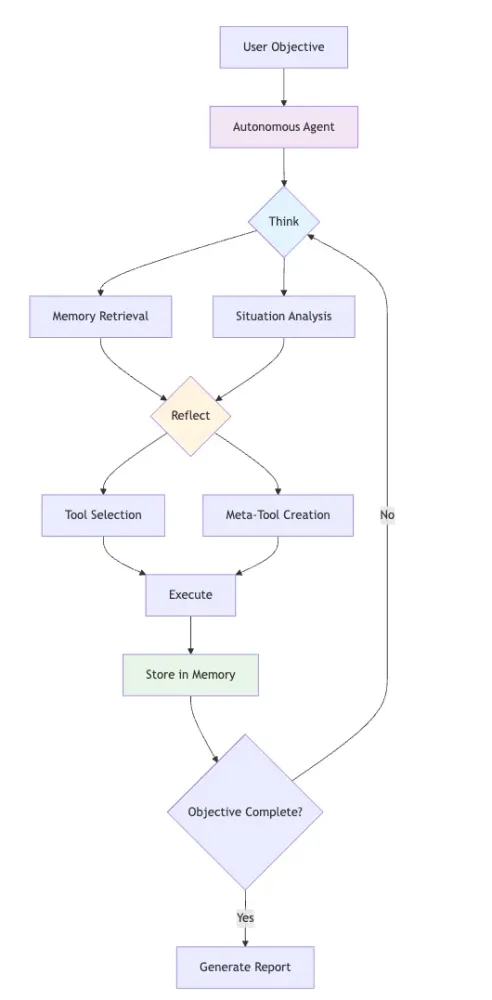
Through building Cyber-AutoAgent, I've applied the key components that research has identified as essential for autonomous agents. Recent surveys in the field reveal that autonomous agents typically consist of four main modules: a profile module for agent design, a memory module to store information, a planning module to strategize future actions, and an action module to execute planned decisions [1].
In Cyber-AutoAgent, these manifest as integrated capabilities:
2. Memory That Persists and Learns
Memory module plays a crucial role in agent architecture design. It stores information perceived from the environment and leverages these recorded memories to facilitate future actions [1]. Cyber-AutoAgent implements a hybrid memory system:
- Long-term Memory: Using mem0 with in-memory FAISS vector storage for semantic search across all findings
- Short-term Memory: Strands framework's SlidingWindowConversationManager for conversation context
Here's how memory transforms the agent's capabilities:
Without Memory | With Short & Long Term Memory |
|---|---|
Repeats same failed attempts | Learns from failures and adapts |
No context between findings | Builds mental model of target |
Can't answer "What did I find?" | Semantic search across all discoveries |
Starts from scratch each time | Accumulates expertise over time |
The implementation leverages vector storage for semantic retrieval:
@tooldef memory_store(content: str, category: str = "general", metadata: Optional[Dict] = None) -> str: """Store evidence in vector memory for semantic retrieval""" result = mem0_instance.add( content, user_id="cyber_agent", metadata={"category": category, "timestamp": datetime.now(), "operation_id": operation_id} ) return f"✓ Memory stored [{category}]: {content[:100]}..."This enables powerful queries like "What SQL injections did I find?" that return contextually relevant findings across the entire assessment.
3. Reflection Enables Learning from Every Action
The agent doesn't blindly execute commands—it thinks, evaluates, and adapts. Reflexion research demonstrated how agents can verbally reflect on task feedback signals to improve decision-making [3]. Cyber-AutoAgent integrates this reflection directly into its planning process rather than as a separate module.
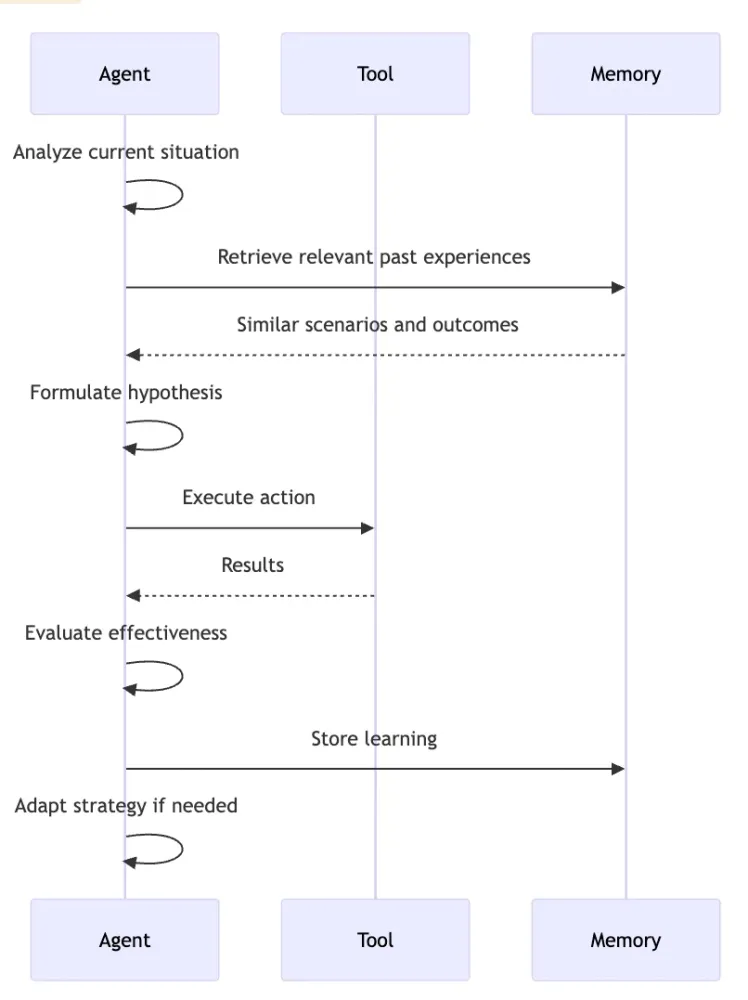
# Initial Attempt"I'll try a basic XSS payload to test the filters..."↳ Running: <script>alert('XSS')</script>Result: Error - 'script' tag filtered
# Reflection"The application is filtering script tags. Based on my memory of similar scenarios, I should try event handlers instead..."↳ Running: <img src=x onerror=alert('XSS')>Result: Error - 'onerror' filtered
# Adapted Strategy"Multiple event handlers are blocked. Let me check for less common onesand try different quote types..."↳ Running: <body onpageshow=alert("XSS")>Result: Success! Flag captured
This creates a continuous cycle of action → observation → reflection → adaptation that runs throughout the assessment.
4. Dynamic Tool Creation and Usage
Research has shown that any method enhancing LLMs through external means qualifies as a tool, and that tool learning represents a promising paradigm for augmenting the capabilities of LLMs to tackle highly complex problems [2]. Cyber-AutoAgent takes this further by not just using tools, but creating them on demand using the stand-agents prebuilt editor and loader tools:
# Agent recognizes need for custom approach"Standard sqlmap isn't efficiently extracting the nested data structure. I'll create a specialized tool for this scenario..."
# Creates custom tool in real-time@tooldef extract_nested_privileges(target: str, session_cookie: str) -> dict:    """Extract complex privilege structures from custom database schema"""    # Agent writes complete implementation    # Handles pagination, nested queries, and custom encoding    return structured_results
This isn't pre-programmed—it emerges from the agent's understanding that existing tools are insufficient for the current challenge.
Zero to Autonomous: 3-Minute Setup
Want to see this in action? Here's the fastest path to running your own intelligent security agent:
Prerequisites Check (30 seconds)
# Verify Python 3.9+python --version
# Check AWS CLIaws configure list
# Confirm Docker is runningdocker --version
Quick Install (1 minute)
# Clone and setupgit clone https://github.com/westonbrown/Cyber-AutoAgent.gitcd cyber-autoagentpip install -e .
# Verify installationpython src/cyberautoagent.py --help
Deploy Test Target (30 seconds)
# Launch DVWA in Dockerdocker run -d -p 8080:80 vulnerables/web-dvwa
# Verify it's runningcurl http://localhost:8080
Launch Your First Assessment (1 minute)
python src/cyberautoagent.py \ --target "http://localhost:8080" \ --objective "Find and demonstrate SQL injection vulnerabilities" \ --iterations 30That's it! In under 3 minutes, you'll see the agent thinking, exploring, remembering, and potentially even creating custom tools to achieve its objective.
Real-World Impact: A Tool for Augmentation, Not Replacement
Let me be clear upfront: Cyber-AutoAgent is not a replacement for skilled security professionals. It's a powerful assistant that can handle certain tasks remarkably well, but it has important limitations.
Traditional ethic security assessments takes days of active testing for good reasons. Human experts bring irreplaceable skills to the table—business context understanding, creative thinking about edge cases, and the ability to recognize subtle security issues that don't fit standard patterns. What Cyber-AutoAgent offers is the ability to automate the repetitive parts of this process.
What It Can't Do (Yet):
- Understand business logic flaws that require deep context
- Perform social engineering or physical security assessments
- Navigate complex authentication flows or multi-step processes
- Recognize subtle security anti-patterns
- Make risk assessments based on business impact
- Handle applications with heavy client-side logic or mobile apps
Here's a real example from testing DVWA:
[20:57:23] Started assessment of 172.17.0.4[20:57:31] Identified DVWA application[20:58:12] Discovered SQL injection vulnerability[20:58:45] Reflected: "Can exploit this for data extraction"[20:59:03] Created custom extraction tool[21:00:18] Extracted full database schema[21:03:18] Assessment complete in ~10 minutesYes, it found vulnerabilities quickly. But DVWA is intentionally vulnerable—it's designed for testing. On a production application with WAF, rate limiting, and complex business logic, the agent would need much more time and might miss subtleties a human would catch.
The Architecture That Powers Intelligence
The magic happens through careful orchestration of specialized components:
Component | Role | Technology |
|---|---|---|
Reasoning Engine | Thinks and plans through CoT | AWS Bedrock |
Memory System | Stores and retrieves knowledge | mem0 + FAISS |
Tool Orchestrator | Executes actions | Strands Agents SDK |
Meta-Tooling | Creates new capabilities | Dynamic code generation |
Reflection Module | Evaluates and adapts | Built into agent loop |
These aren't just bolted together—they form a coherent system where each component enhances the others.
Why This Matters Beyond Security
The techniques demonstrated in Cyber-AutoAgent apply far beyond penetration testing. Any domain where expertise involves pattern recognition, creative problem-solving, and learning from experience can benefit:
Software Development: Agents that understand your codebase, remember architectural decisions, and create custom refactoring tools.
Scientific Research: Agents that remember experimental results, reflect on hypotheses, and create custom analysis tools.
Business Analysis: Agents that track market patterns, adapt strategies based on outcomes, and build custom ML models.
The key insight is that memory + reflection + meta-tooling creates agents that genuinely learn and adapt, not just execute predefined scripts.
Open Source: Advancing the Field Together
I've released Cyber-AutoAgent as open source because these patterns—strategic planning, persistent memory, and dynamic tool creation—represent important steps in how we build autonomous systems. The codebase provides:
Complete Implementation: Every component is ready to be used and documented.
Practical Examples: Real security assessments demonstrating each capability.
Integration Guides: Connect with your existing tools and workflows.
Research Foundation: Build on these patterns for your own domains.
Visit https://github.com/westonbrown/Cyber-AutoAgent/tree/main to explore the code, contribute improvements, or fork it for your own experiments.
The Road Ahead
This is just the beginning. Current research directions include:
Hierarchical Memory Organization: Moving from flat vector storage to graph-based knowledge representation, enabling even more sophisticated reasoning about relationships between findings.
Multi-Agent Collaboration: Teams of specialized agents sharing memory and coordinating actions, like a red team working together.
Continuous Learning: Agents that improve not just within a single assessment, but across multiple engagements, building true expertise.
Join the Autonomous Agentic Fun!
We're witnessing the evolution from automation to true autonomy. Agents are becoming partners that think, learn, and create alongside us. The combination of persistent memory, self-reflection, and dynamic tool creation opens possibilities we're just beginning to explore.
Whether you're a security professional, AI researcher, or developer interested in pushing boundaries, lets experiment with these patterns. Fork the repo, try the examples, and share what you build. Together, we can advance the state of autonomous agents and explore what becomes possible when AI can truly think, remember, and evolve.
The future isn't about AI replacing experts—it's about AI that learns to think like one!
Built with ❤️ using AWS Bedrock, Strands Agents SDK, and mem0
Remember: With great autonomy comes great responsibility. Always use ethically and legally.
References
[1] Wang, L., Ma, C., Feng, X., Zhang, Z., Yang, H., Zhang, J., Chen, Z., Tang, J., Chen, X., Lin, Y., Zhao, W. X., Wei, Z., & Wen, J. R. (2024). A survey on large language model based autonomous agents. Frontiers of Computer Science, 18(6), 1–26. https://doi.org/10.1007/s11704-024-40231-1
[2] Tool Learning with Large Language Models: A Survey. (2024). arXiv preprint arXiv:2405.17935v3. Retrieved from https://arxiv.org/html/2405.17935v3
[3] Shinn, N., Labash, B., & Gopinath, A. (2023). Reflexion: Language Agents with Verbal Reinforcement Learning. Advances in Neural Information Processing Systems, 36. https://arxiv.org/abs/2303.11366
Enjoyed reading this content? Let the author know!
Your likes, comments, shares, and saves help creators reach more builders.

Loading recommendations
Loading article