

Q-Bits: Building Safe and Efficient Web APIs with Rust, Actix Web and Amazon Q Developer
Learn how to create high-performance web APIs in Rust using the Actix framework. Amazon Q Developer will demonstrate how to set up routes, handle request parsing and validation, and implement async handlers.

Welcome to another installment of Q-Bits , our regular series showcasing cool ways Amazon employees are leveraging Amazon Q Developer. Today, we're looking at how Amazon Q Developer benefits Rust developers when building safe and efficient Web APIs with Actix Web.
Introduction
This article will explore some of the steps I take to plan and implement a Web API with Rust and Actix Web. I'll be using Amazon Q Developer as my companion along the way.
Amazon Q Developer and JetBrains RustRover
JetBrains RustRover is my IDE of choice when working on Rust projects. Amazon Q Developer and JetBrains RustRover make an excellent combination for Rust developers, enhancing productivity and code quality. Amazon Q can be integrated directly into the RustRover IDE, allowing developers to access AI assistance without leaving their coding environment.

While RustRover offers deep Rust language support, Amazon Q can provide additional context, best practices, and explanations tailored to Rust development. By combining Amazon Q Developer's AI capabilities with RustRover's specialized Rust development environment, developers can create a powerful, efficient workflow for Rust programming.
Planning
It's often tempting to dive straight into writing code, with Amazon Q Developer as my coding companion, I can start to ask questions that are in my head or apply a bit of rubber duck debugging , except this time the duck talks back!
From the Amazon Q Developer Chat window within RustRover, I can start bouncing ideas around, for example:
"How can I implement rate limiting in my Actix-web API?"
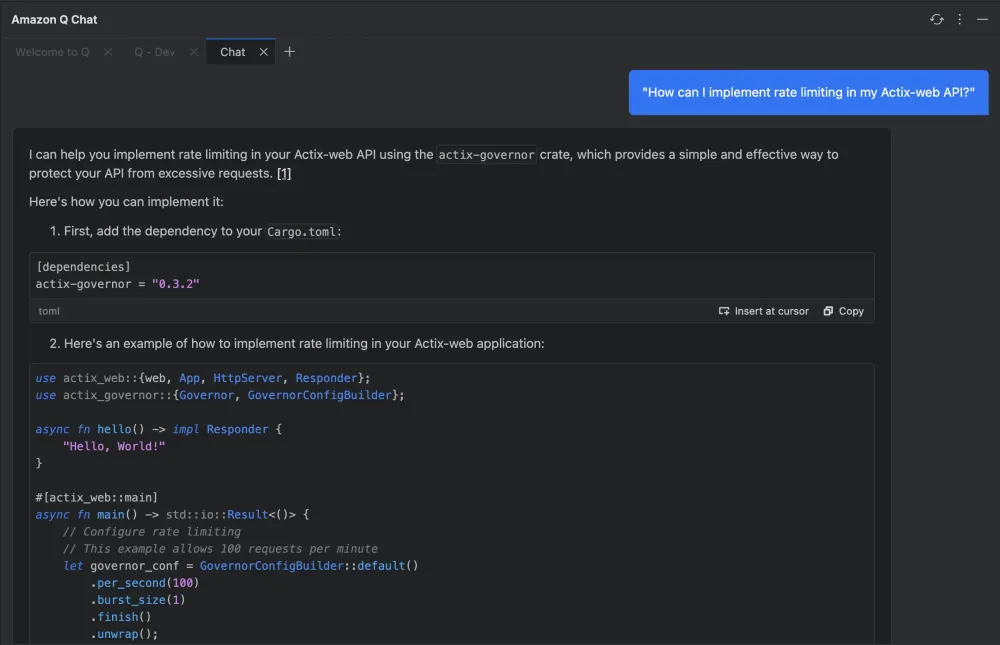
What I love about this is that Amazon Q Developer introduces me to a new package, actix-governor, provides a code example, explains what the sample implementation does in plain English, and even includes advice for production usage.
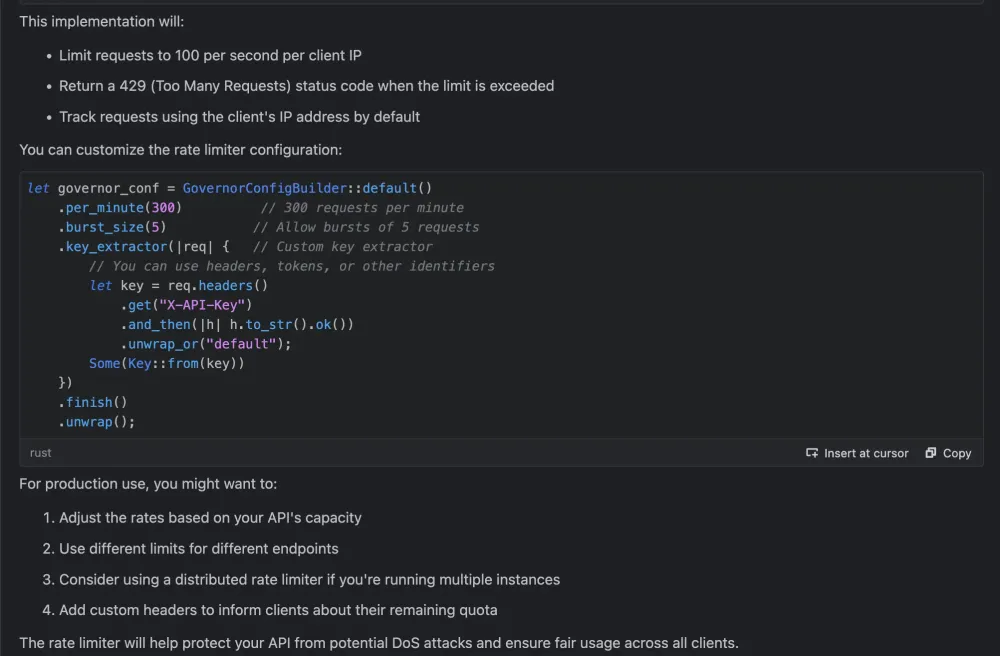
Other typical questions I might ask :
"Describe the best practices for error handling and response formatting in an Actix-web API."
"How can I structure my Actix project to ensure scalability and maintainability?"
"What are some strategies for API versioning in an Actix-web application?"
"How can I implement request validation and sanitization in my Actix-web API?"
Implementing Our API with Q Developer Agent for Software Engineering
Now I have some good ideas, and I'm ready to begin implementing my API; this is where the Q Developer Agent for Software Engineering comes in. Using the /dev command within the chat window, I can ask Amazon Q Developer to build my API.
Create a RESTful Web API using Rust and the Actix web framework. The API should:
- Set up a basic project structure with proper cargo dependencies for Actix and any necessary database libraries.
- Implement CRUD (Create, Read, Update, Delete) operations for a 'User' resource with fields: id, name, email, and created_at.
- Use a database (e.g., PostgreSQL) for data persistence. Include connection pool setup.
- Implement proper error handling and return appropriate HTTP status codes.
- Include input validation for the API endpoints.
- Implement basic authentication using JWT (JSON Web Tokens).
The agent immediately gets to work:
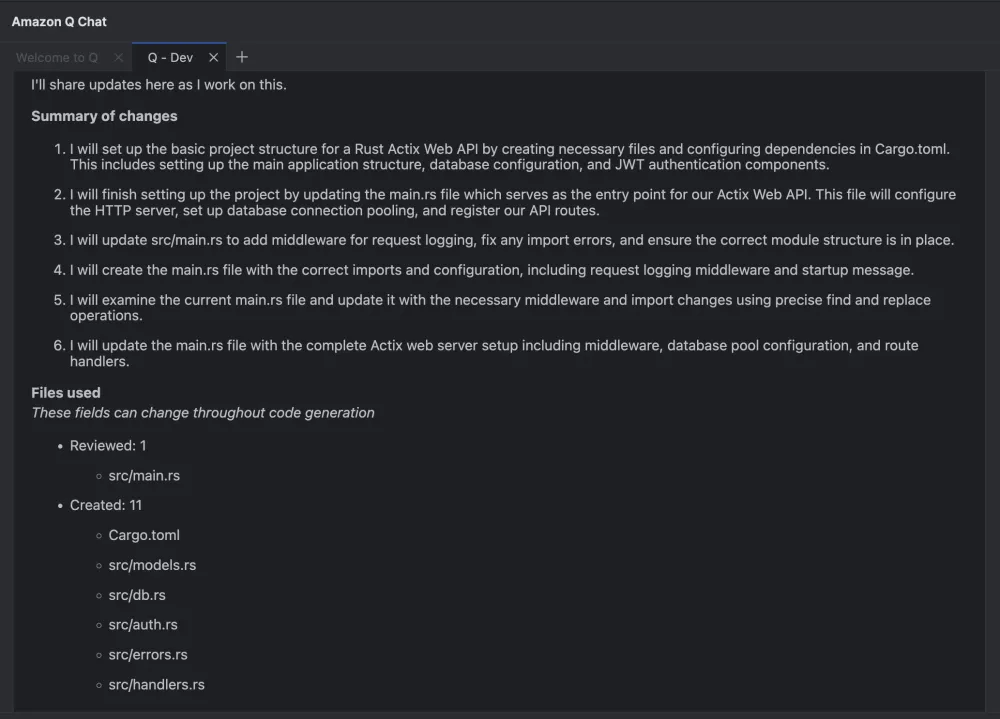
I can review the proposed updates and iterate with additional prompts and then accept the changes. What I love about this is that Q Developer has done much of the heavy lifting, including creating database migration scripts:

And CRUD implementation for my data persistence layer:
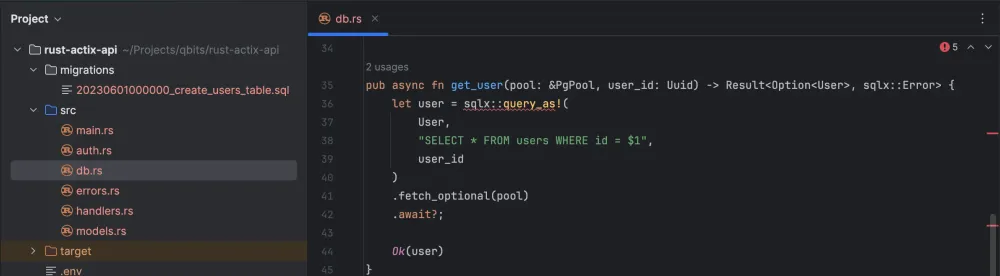
Browsing my new code, I can see the logging middleware has been added to the Actix-web server configuration code. I can use the Amazon Q -> Explain Code feature to help me understand the implementation:

Conclusion
In this post I've shown how Amazon Q Developer has been used to plan, implement and review a Web API built with Rust and Actix Web. The design was driven via prompts and Amazon Q Developer took care of the implementation for me.
My work is not finished, I will be continuing to use Amazon Q Developer to help me take this project through the rest of the SDLC, including:
- Setup examples of unit and integration tests
- Add Swagger/OpenAPI documentation for the API
- Define a Dockerfile to create a container image
- Define CloudFormation to provision and deploy my API to AWS
- Setting up a CI/CD pipeline
Enjoyed reading this content? Let the author know!
Your likes, comments, shares, and saves help creators reach more builders.

Loading recommendations
Loading article