
How did I Prepare for AWS Certified Solutions Architect Professional Course SAP-C02?
Navigating the AWS Solutions Architect Professional certification isn't just about technical knowledge—it's about strategic thinking and exam mastery. In this blog, I'll break down my personal approach to conquering this challenging exam, sharing insider tips, question-solving strategies, and curated resources that transformed my preparation. Whether you're aiming to validate your cloud architecture expertise or take your AWS skills to the next level, these insights will provide a roadmap to success.

The AWS Certified Solutions Architect — Professional certification targets individuals with two or more years of practical AWS system management experience in a solutions architect role.
It's very rightly said that an exam is hard; it tests whether you understand the business requirement, can translate it into an architecture diagram, and visualize the services involved. Your ultimate goal is to create a highly available, scalable, secure, reliable, and resilient architecture.
Suppose you are just starting with Cloud or have never done much hands-on work in the lab. In that case, you should find some cloud formation scripts, examine the intended architecture diagrams, and visualize the infrastructure created for you within a few minutes. Observe everything built for you in-depth, like how each service is integrated! I'm grateful for all the free credits that I will consume in the years to come.
If you do not have previous AWS experience, sign up for AWS Skill builder , do some hands-on labs, grab your AWS Associate trifecta ( Solution Architect, Developer associate and SysOps associate), and then proceed for this exam!
‘ This is My Architecture ’ is a video series that showcases innovative architectural solutions on the AWS Cloud by customers and partners. Each episode examines the most interesting and technically creative elements of each cloud architecture.
‘ How to Build This ’ is a video series designed to assist people with big ideas on how to bring their minimum viable product (MVP) to life using AWS services!
Watch Customer Success Stories & increase agility, lower costs, and accelerate innovation using AWS.
Your learning curve reduces if you tend to open the console, do your hands on the labs, and then make notes! Watching videos and reading cheat sheets will make it a memory exercise for you, increase your effort, and make learning less fun!
In the exam, you will have scenario-based questions, and you may have four options. Out of the two or more are correct, but zeroing in on the final. The most appropriate one needs you to understand that introducing a new service will increase cost and ease of implementation — ask yourself if this can be done better considering the scale of the organization.
It’s good to know AWS Snowcone is used to collect and process data, transfer with AWS DataSync, or ship the device with data to AWS for offline transfer. This Snow family comes in three variants; I only remember the range for exabytes of data to be brought from on-prem to AWS. Recognizing the exact number for each service isn’t needed. It would be great to have a trailer with a standard-size container on six wheels called Snowmobile.
You can read further updates about Snowcone here . If you have been following on Russia — Ukraine war, have a look how Amazon saved over 10PB of vital Ukrainian data Using Snowball Edge SSDs .
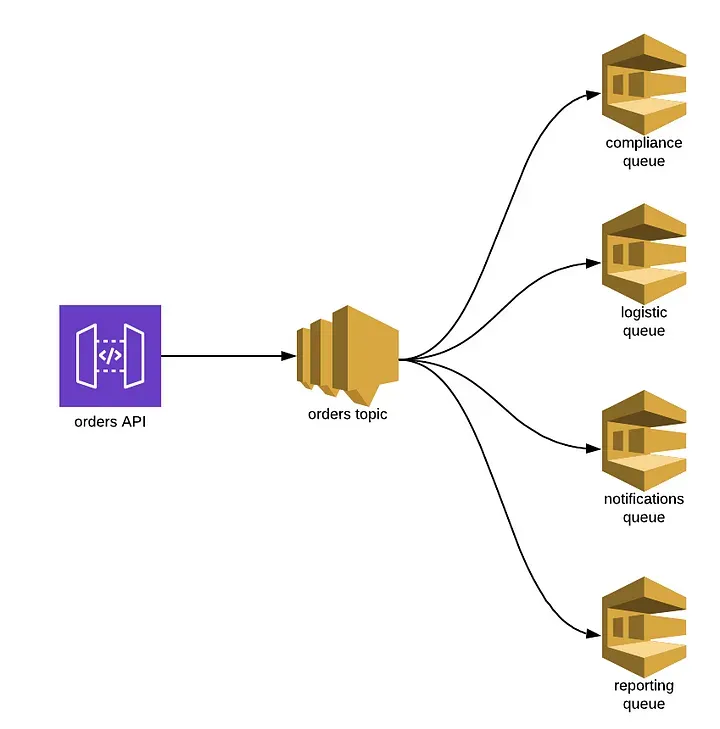
Scenario 1: What is Fan-out and where it is being used?
SNS sends notifications to 1: Many subscribers and SQS sends messages from one service to another. Let’s discuss a scenario when you add an item to the Amazon marketplace, you are billed, and you receive Invoice #001; details related to this invoice are sent to the processing team (they will pack your order and ship) as well as for analytical purposes to find whether the customer order is genuine, find their fraudulent activity, if any, and disable cash on delivery considering their purchase patterns in the past. For this, you will be doing fan-out messaging using SNS.
Scenario 2: How can you manage and implement governance in your cloud estate with multiple accounts? How do you apply policies and programmatically allocate and share resources?
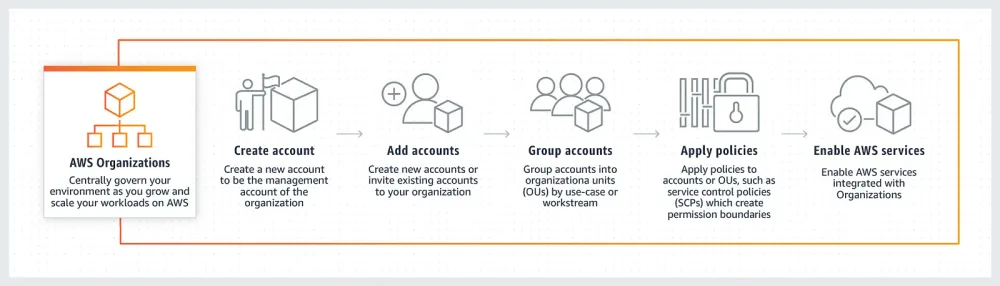
Every organization has multiple AWS accounts. They scale up what they want (SCP Policy — Always deny) to accounts or groups for governance and simplify billing (Consolidated billing) using a single payment method for all your accounts.
AWS Organizations helps you centrally manage and govern your environment as you grow and scale your AWS resources. Once you’ve created the organization and verified your email, you can create or invite other accounts into your organization, categorize the accounts into Organizational Units (OUs), create service control policies (SCPs), and take advantage of the organization’s features from supported AWS services.
Service control policies (SCPs) are policies you can use to manage permissions in your organization. SCPs help ensure your accounts stay within your organization’s access control guidelines. It offers central control over the maximum available permissions for all accounts in your organization.
Create an AWS Organization on the parent company’s AWS account and invite all the subsidiary AWS accounts. Ensure consolidated billing is enabled on the parent account’s AWS Billing and Cost Management console**.** Consolidated billing allows the management account owner to have only one invoice for all accounts.
Recommend links for you to dive further deep: 1. Do you really need mutiple AWS accounts ? 2. Organizing Your AWS Environment Using Multiple Accounts 3. AWS multi-account strategy for your AWS Control Tower landing zone
Scenario 3: Deployment of Elastic Beanstalk application with absolutely no downtime. The solution must maintain complete compute capacity during deployment to avoid service degradation
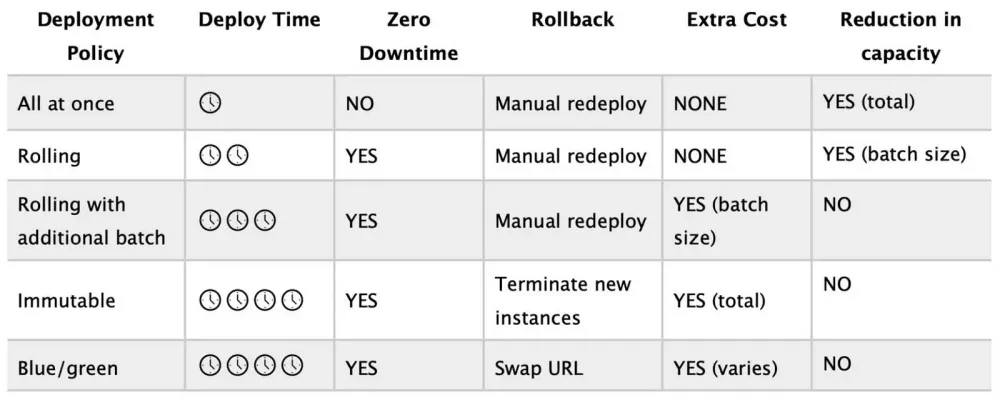
You will choose the “Rolling with additional Batch” deployment policy in Elastic Beanstalk.
3 a. When to use Blue-Green deployment? XYZ company’s team release team wants to deploy new features to the v2 production environment, route 10% of traffic to it, and then route the rest 90% slowly once the Prod environment is stable; gradually, the old domain (v1) is phased out.
3 b. Scenario when deployment of Elastic Beanstalk application wherethe new version was mixed with the current version — You will select the “Immutable deployments” deployment policy in Elastic Beanstalk.
AWS Elastic Beanstalk provides several options for processing deployments, including deployment policies and options that let you configure the batch size and health check behaviour during deployments.
Each deployment policy has advantages and disadvantages, and selecting the best approach for each situation is essential. The following tables summarise the different deployment policies:
AWS Elastic Beanstalk deployment options, you may have questions based on these options.
Scenario 4: You want to monitor the traffic that is reaching your EC2 instance
You want to determine the direction of to and fro traffic, or if you are not able to reach an example and you feel this is due to restrictive security group rules, then you must use VPC Flow logs.
It is a feature that enables you to capture information about the IP traffic going to and from network interfaces in your VPC. Flow log data can be published to Amazon CloudWatch Logs or Amazon S3. If you want a quick video of what’s inside VPC flow logs, click here .
Scenario 5: You want to share specified AWS resources that you own with other AWS organizations.
AWS Resource Access Manager (AWS RAM) enables you to share specified AWS resources that you own with other AWS accounts.
You can use trusted access to enable an AWS service that you specify, called the trusted service, to perform tasks in your organization and its accounts on your behalf. This involves granting permissions to the trusted service but does not otherwise affect the permissions for IAM users or roles. When you enable access, the trusted service can create an IAM role called a service-linked role in every account in your organization.
That role has a permissions policy allowing the trusted service to do the tasks described in that service’s documentation. This enables you to specify settings and configuration details that you would like the trusted service to maintain in your organization’s accounts on your behalf.
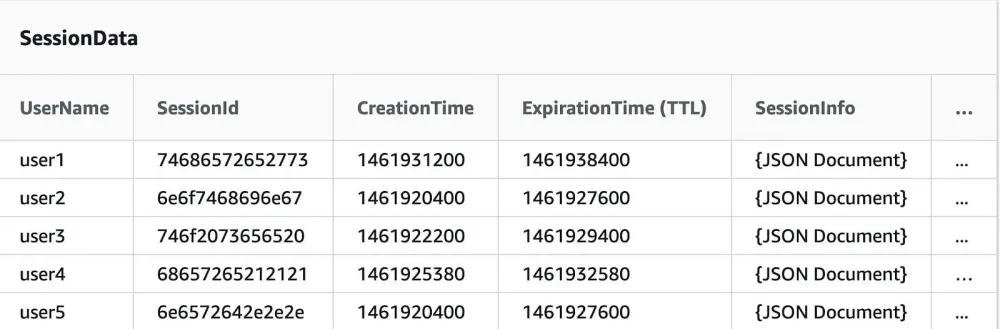
Scenario 6: You must implement a cost-effective solution to delete session data in a DynamoDB table.
Time to Live (TTL) for Amazon DynamoDB lets you define when items in a table expire so that they can be automatically deleted from the database. With TTL enabled on a table, you can set a timestamp for deletion on a per-item basis, allowing you to limit storage usage to only relevant records.
TTL is useful if you have continuously accumulated data that lose relevance after a specific period (for example, session data, event logs, usage patterns, and other temporary data). When TTL is enabled, a background job checks the TTL attribute of items to determine whether they are expired.
Processing takes place automatically and doesn’t affect read or write traffic to the table. Deletes performed via TTL are not counted toward capacity units or request units. TTL deletes are available at no additional cost.
Scenario 7: What is the difference between SAM and CloudFormation? How will you create multiple resources across AWS accounts?
The primary differences between AWS SAM templates and AWS CloudFormation templates are the following:
• Transform declaration*. The declaration Transform: AWS::Serverless-2016–10–31 is required for AWS SAM templates. This declaration identifies an AWS CloudFormation template as an AWS SAM template.
• Globals section. The Globals section is unique to AWS SAM. It defines properties that are common to all your serverless functions and APIs. All the AWS::Serverless::Function, AWS::Serverless::Api, and AWS::Serverless::SimpleTable resources inherit the defined properties in the Globals section.
• Resources section*. In AWS SAM templates, the Resources section can contain a combination of AWS CloudFormation resources and AWS SAM resources.
Only the Transform and Resources sections are required of these three sections, and the Globals section is optional.
I hope this helps you understand the amount of preparation and scenarios you need to master before appearing for this examination. Cram less, practice and visualize more. Options may appear very similar, and you won't be able to eliminate them through guessing and keywords alone! Happy prepping for AWS Solutions Architect professional exam.
Enjoyed reading this content? Let the author know!
Your likes, comments, shares, and saves help creators reach more builders.

Loading recommendations
Loading article